
The house is quiet, the lights are off, and the cough starts again at the same point in the night. It is a rattling, chesty sound, sometimes with a faint whistle at the end of a breath. Your child sleeps badly, so you do, and in the morning they are bright and running about as if nothing happened. You have probably been told it is a virus, and you have probably been given more than one course of treatment that did not seem to make a difference.
The question parents bring is simple. Why does my child cough at night, and why is it still going on? Often the honest answer is that it may not be an infection at all, and finding that out is the point of the appointment.
Chest pain, signs of a stroke, severe breathlessness, heavy bleeding, a severe allergic reaction or symptoms of sepsis need 999 or A&E immediately. For urgent advice that cannot wait, call NHS 111.
Why does my child cough at night when they seem well in the day?
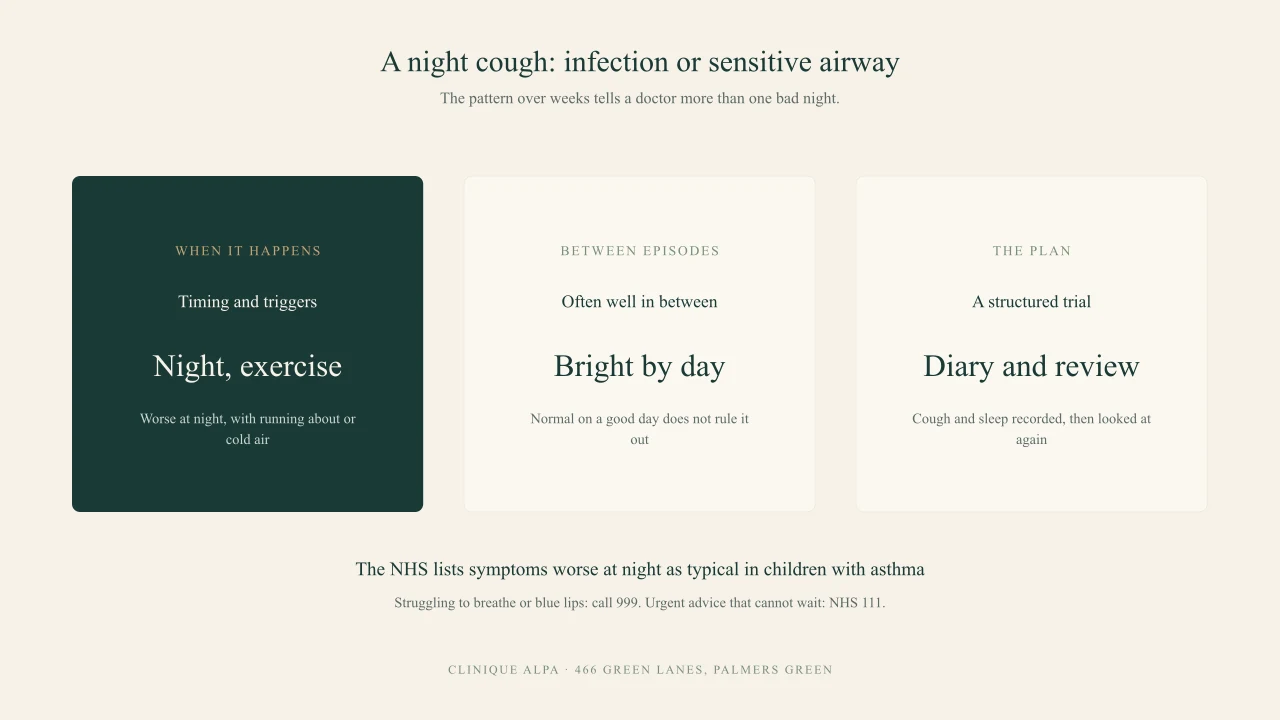
Night is when the airways are most sensitive. Lying flat, cooler air in the bedroom, and the natural daily rhythm of the lungs all make a twitchy airway more likely to tighten and cough. A child who runs about happily at noon can still cough through the small hours. The NHS lists symptoms that are worse at night and in the early morning as typical of asthma in children, along with wheezing, coughing, shortness of breath and a tight chest.
That does not mean every child with a night cough has asthma. Many small children wheeze with viral colds and grow out of it. What matters is the pattern, and the pattern is what I try to build up in the appointment.
What does a doctor ask about a night cough?
What I look at in clinic starts with the story told over weeks, not days. When did the cough begin, and did it start with a cold or come out of nowhere? Does it come with every cold, or does it never quite leave between them? Is it worse at night, on waking, after running about, with laughing, in cold air, or after being around pets, dust or smoke? Does your child wheeze, and have you heard it yourself? Do they get breathless when playing, or stop and sit out games that they once enjoyed?
I ask about the nose as well as the chest. A blocked or runny nose, snoring, mouth breathing, itchy eyes, and a cough that begins as a tickle can all point towards allergy or a nose that drains down the throat at night. I ask about eczema and allergies in the child and the close family, because children who have those tend to have sensitive airways too. I ask about sleep, appetite, and what the cough has done to the household.
I also ask what has already been tried and what happened. This matters more than parents expect. A cough that has not responded to a course of treatment for infection is telling me something. It does not prove there is no infection, but it moves viral wheeze, a sensitive airway or an allergic cause higher up the list.
Then the examination. I look at how your child breathes at rest and count the rate. I look for signs of effort, and I listen at the front and back of the chest for wheeze, crackles, or a silent area. I check the ears, the nose and throat, the skin for eczema, and the growth and general condition. Between episodes, a child with a sensitive airway can sound completely normal, which is one reason the history carries so much weight. A normal chest on a good day does not rule out a problem at night.
If the picture fits, one sensible step is a short, structured trial of treatment for airway sensitivity, with a diary of cough and sleep and a review after a couple of weeks. Whatever the result, it is information, and I look again rather than carry on regardless. I also talk about triggers that can be changed, such as smoke exposure.
From Dr Mitesh Parmar
Does the cough come after colds, exercise, laughing or cold air, and does anyone in the family have asthma, eczema or hay fever? Those are my first questions. I listen for wheeze and check how well the child breathes when well. Fast breathing, a struggling chest or blue lips means 999.
Why does my child cough at night but not during the day?
A cough that is mostly nocturnal and shows up with exercise or in certain places usually points towards the airway being irritable, either from asthma, an allergy or lingering after a viral illness. A cough that is wet and productive, with a temperature and an unwell child, points more to infection. When the two are mixed, as they often are in a toddler who goes to nursery and catches everything, I treat the picture rather than the label and plan a review.
Why does my child cough at night without a cold?
Without a cold, the usual suspects are an airway that tightens easily, allergy to something in the bedroom or house, a blocked nose draining at night, and smoke or dry air. Hay fever can cause a cough as well as a runny nose, and the NHS notes it can also cause sneezing, itchy eyes and a blocked nose. Reflux and other causes are less common but can be considered if the usual ones do not fit.
When should a child with a night cough be seen sooner?
Book a review if your child wakes at night with the cough, is needing their asthma treatment more often, is not improving, or the symptoms are stopping them doing usual activities. This is the NHS advice for children with asthma symptoms. Get urgent help if:
- your child is struggling to breathe, or cannot speak or feed because of breathlessness
- the skin pulls in under or between the ribs with every breath
- the lips, tongue or skin look blue or grey
- treatment is not helping, or the symptoms are getting worse
- your child is floppy, very drowsy or hard to wake
Call 999 if an attack is getting worse at any point or does not improve after the maximum dose of their reliever, and do not drive to A&E yourself. Even after a child recovers from an attack, the NHS advises seeing a GP within 2 days. For a cough that has not improved after several weeks, my article on a child cough for two weeks covers what to look for.
How do we approach a night cough at Clinique Alpa?
You see Dr Parmar for 30 minutes at Palmers Green, with a parent present. The fee is £100 and is shown before you book. I take the history, examine your child, explain the most likely cause and agree a plan with you, including a clear review point. Where a treatment trial is sensible we talk it through together, and if I think something else is going on I say so. With your consent, a summary goes to your NHS GP.
If you want to read about infection in the chest first, start with the signs doctors look for in a child chest infection, or see the asthma guide in our health library.
Common questions
Is a night cough in a child always asthma?
No. Many young children wheeze with colds and later stop. A pattern of night symptoms, exercise symptoms and slow recovery between colds is what raises the question.
Should I keep my child off nursery?
A child who is bright, feeding and not feverish is usually fine to attend. If they are tired from a poor night or unwell, rest at home is sensible.
More in this series: cough in children
- Child chest infection signs doctors look for
- Child cough for two weeks
- Recurrent chest infections in children and large tonsils
Drafted with AI assistance, clinically reviewed by Dr Mitesh Parmar, MBBS MRCGP, Principal GP and Clinical Director at Clinique Alpa, 466 Green Lanes, Palmers Green, London N13 5PA. This article is general information, not personal medical advice. In an emergency call 999. For NHS advice call 111 or visit nhs.uk.