
The cough has been chesty for a couple of days, there was a temperature last night, and tonight your child is breathing in a way that makes you stand at the bedroom door for longer than usual. The tissue box is empty and you have looked at the colour of the phlegm more closely than you ever expected to. By the time parents book, they have usually decided it is either nothing or something, and cannot tell which.
When this comes up in consultation, the real question is rarely the cough. It is what a doctor can hear and see that a parent cannot, and whether that changes what happens next. A child chest infection is a good example of a problem where the examination decides almost everything, so here is what I look for.
Chest pain, signs of a stroke, severe breathlessness, heavy bleeding, a severe allergic reaction or symptoms of sepsis need 999 or A&E immediately. For urgent advice that cannot wait, call NHS 111.
What are the child chest infection symptoms?
A chest infection in a child usually follows a cold. The cough turns chesty, there may be a temperature, and the child is more tired than the cold alone would explain. Some children wheeze. Some go off their food and want to be held. The NHS describes a chesty cough, wheezing, a high temperature and tiredness as the main features, with most people improving within 7 to 10 days, although the cough and mucus can last up to 3 weeks.
What parents tend to miss is that the cough is the least useful part of the story. A child can cough hard and be perfectly well in between. Another can cough very little and be working hard to breathe. The pattern between the coughs tells me more than the coughing does.
What does a doctor look at in a child chest infection?
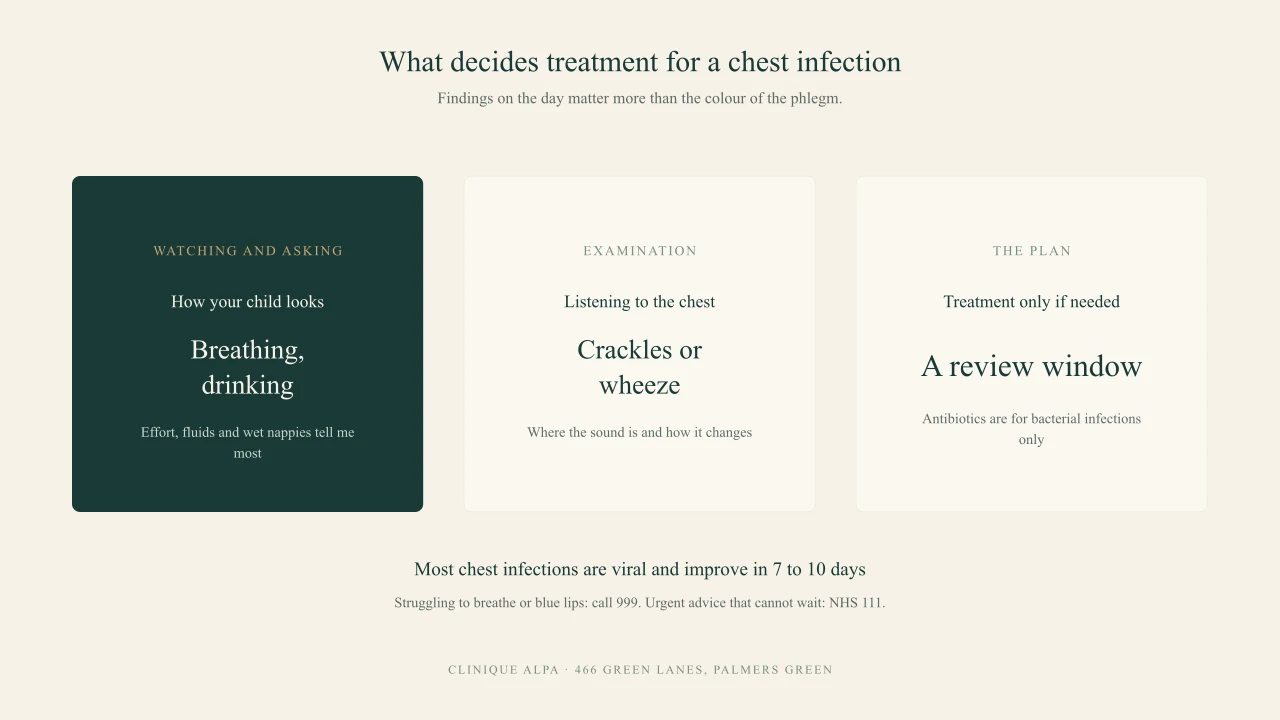
What I look at in clinic starts before I touch the child. I watch them come in. Are they playing with the toys on the floor or lying against a parent? Are the breaths quiet and even, or can I hear them across the room? A child who is smiling and curious has told me a good deal already.
Then the history, in the order that matters. How long the cough has lasted and whether it is getting better or worse. Whether the child is drinking and passing urine as usual, because fluid intake is a better guide to how ill a child is than the thermometer. Whether there has been a temperature and how it has behaved. Whether breathing seems faster or harder than normal, and whether it is worse when they are asleep. Whether anyone at home or at nursery has the same illness. Earlier episodes matter too, because a child who has coughed and wheezed before is a different picture from one who has never had a chest problem.
Next, the examination. I count the breathing rate while the child is calm, which is harder than it sounds and is easiest before they notice. I look at the chest wall for signs of effort: the skin pulling in between the ribs, the nostrils widening, the tummy working with each breath. I check the colour of the lips and tongue, the pulse, and whether the fingers are warm. The oxygen level is measured with a small clip on a finger, and the clinic has medical oxygen on site if a child needs it while a transfer is arranged.
Then I listen. Crackles in one area suggest something different from a wheeze that is heard evenly on both sides. A viral illness often gives a mixed sound across the chest, noisy and changeable, which can shift after a cough. A more local finding in one part of the lung makes a bacterial cause more likely. I also look in the throat and ears, because a child with a chesty cough and a bulging eardrum has two problems, and parents only worry about one.
Treatment follows from the findings, not from the colour of the phlegm. NHS advice is that antibiotics are used only for bacterial chest infections, and that viral ones usually clear without them. If I do think treatment is needed, I explain why and what to watch for in the next few days. If I do not, I say so, and I say what would change my mind.
From Dr Mitesh Parmar
I watch the child before I touch them: how they are breathing, whether the ribs pull in, how alert and playful they are. Then I listen to the chest and check oxygen. Fast breathing and tiredness matter more than the cough. If your child is struggling to breathe, grunting or very drowsy, call 999.
Does a child chest infection need an X ray?
Not routinely. A chest X ray is a question the examination raises, not an automatic step. If the findings are unclear, if a child is not improving as expected, or if there is a concern about a particular area of the lung, I discuss whether an image would change the plan. If it would not, we do not need it.
What about child chest infection syrup?
Parents often ask whether a cough syrup will help. The NHS advises that cough medicines are not suitable for children under 6, and that honey should not be given to babies under 12 months. Warm drinks are not advised for small children either. What helps more is fluids little and often, rest, and keeping the room free of smoke. The cough itself is doing a job, clearing the airways, and quietening it is not the aim.
When should a child be seen sooner?
Come in or call sooner if your child:
- is breathing faster than usual, or you can see the skin pulling in under the ribs or between them
- is drinking much less than normal, or has had no wet nappy for 12 hours
- is unusually sleepy, floppy or hard to settle
- has a temperature that is not coming down, or a cough that is getting steadily worse rather than easing
For fever in a young baby the NHS is specific: under 3 months with a temperature of 38C or higher, or 3 to 6 months with 39C or higher, needs urgent advice from NHS 111 or an urgent GP appointment. Call 999 if a child is struggling to breathe, has pauses in breathing, has blue or grey skin, lips or tongue, or is floppy and will not stay awake. If your instinct says something is wrong, trust it. The NHS bronchiolitis page says the same.
How do we approach a child chest infection at Clinique Alpa?
You see Dr Parmar for 30 minutes in Palmers Green, with a parent or guardian present throughout. The fee is £100 and is shown before you book. I examine your child, explain what I find, agree the plan with you, and give you a specific window for review rather than telling you to come back if things do not improve. With your consent, a summary goes to your NHS GP. If your child is more unwell than a clinic visit can safely manage, I will say so and arrange the right place for them to be seen. The clinic is not for emergencies.
If a cough has gone on longer than you expected, I have written about a child cough that lasts for two weeks. For a cough that wakes your child, see why a child coughs at night. The wider picture is on our children's health page.
Common questions
Is a child chest infection contagious?
The viruses that cause most chest infections spread through coughs and shared surfaces, so yes, the illness can pass between children. Hand washing and keeping a poorly child at home while they are feverish both help.
How long does a child chest infection last?
Most improve in 7 to 10 days, with a cough that can linger for up to 3 weeks. If it lasts longer, or your child is getting worse, book a review.
More in this series: cough in children
- Why does my child cough at night with a wheeze
- Child cough for two weeks
- Recurrent chest infections in children and large tonsils
Drafted with AI assistance, clinically reviewed by Dr Mitesh Parmar, MBBS MRCGP, Principal GP and Clinical Director at Clinique Alpa, 466 Green Lanes, Palmers Green, London N13 5PA. This article is general information, not personal medical advice. In an emergency call 999. For NHS advice call 111 or visit nhs.uk.