
The scan has been the question for weeks. The pain sits low in the back, it has refused to settle with rest, and somewhere along the way a friend, a physiotherapist or an internet search has said the word MRI. By the time people book with me they are rarely asking whether they are in pain. They are asking whether a scan would change anything.
It is a fair question, and the honest answer is that a back pain MRI scan is not the first step for most people, and is the urgent step for a few. This page is about telling the two apart: which features of back pain make a scan a matter of timing, and which make it a matter of waiting a little longer.
Chest pain, signs of a stroke, severe breathlessness, heavy bleeding, a severe allergic reaction or symptoms of sepsis need 999 or A&E immediately. For urgent advice that cannot wait, call NHS 111.
When does back pain need a scan quickly?
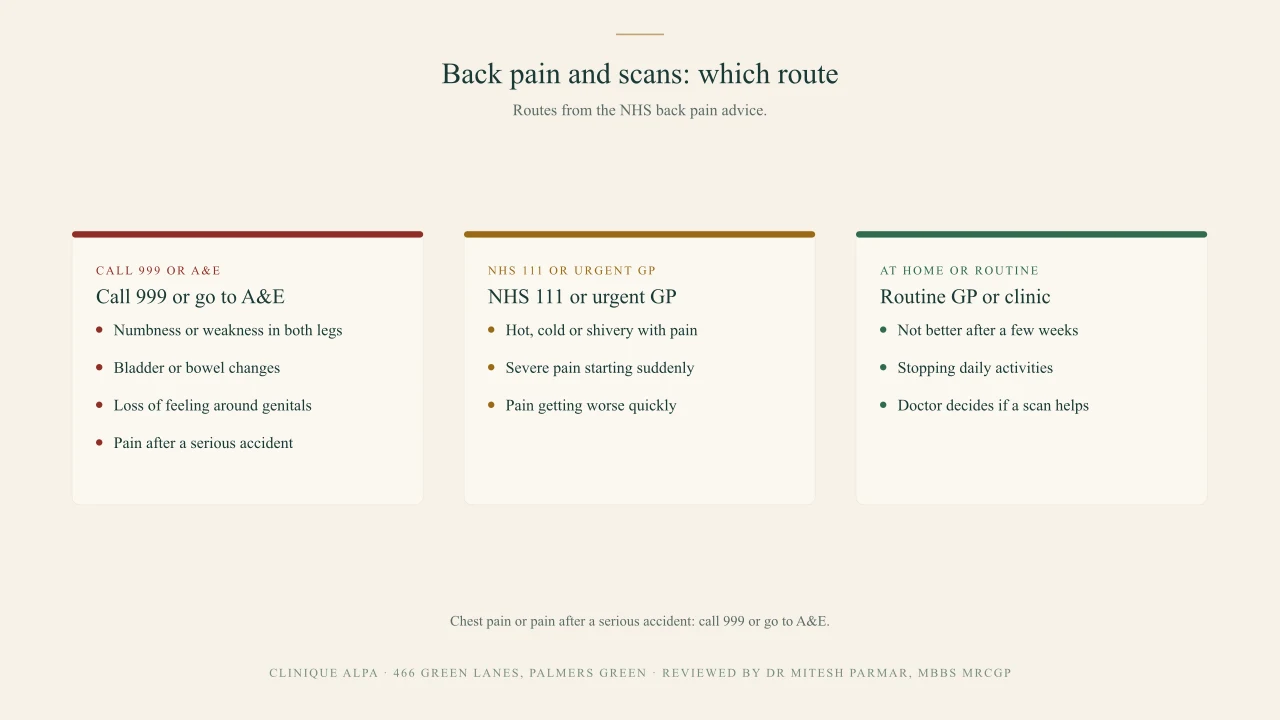
The NHS is specific about the signs that mean back pain should not wait for a routine appointment. Call 999 or go to A&E if you have back pain and:
- Pain, tingling, weakness or numbness in both legs.
- A loss of feeling around your genitals or anus.
- Changes in your bladder or bowels, such as difficulty peeing.
- Changes in how your penis or vagina feels during sex.
- Chest pain.
- Pain that started after a serious accident, such as a car accident.
The NHS advises against driving yourself. Ask someone to drive you or call 999 for an ambulance, and bring your medicines. In this group any scan is arranged through hospital, not through a booked appointment. A private clinic is the wrong place to start with any of these, and I say so on the phone before we talk about an appointment.
Ask for an urgent GP appointment or call NHS 111 if the pain makes you feel hot, cold, shivery or generally unwell, or if it is severe, starts suddenly or is getting worse quickly. Those features are about infection, bleeding or something acute in the spine, and they move the question from whether to scan to how soon.
What if the pain has simply gone on for weeks?
This is the situation most people are in, and it is where scan decisions are hardest. The NHS advises seeing a GP if back pain has not improved after treating it at home for a few weeks, is stopping you doing day to day activities, or is leaving you worried or struggling to cope. It also lists features that deserve a conversation rather than a wait:
- Weight loss you cannot explain.
- A lump or swelling in your back, or a change in the shape of your back.
- Pain that does not ease with rest or is worse at night.
- Pain that is worse when you sneeze, cough or open your bowels.
- Pain coming from the top of the back, between the shoulders.
When this comes up in consultation, people often tell me the pain has been "mechanical" for a long time: worse on bending, easier when lying flat. A scan rarely changes the plan for that pattern, because it will often show wear that many people without pain also have. What changes the plan is the way the pain behaves, and whether anything new has joined it.
What does a doctor look at before suggesting a back pain MRI scan?
What I look at in clinic is the story first, and the order in which things happened. When did the pain start, and has it moved? Does it travel down a leg, and to where? Is there numbness, pins and needles or a feeling that the leg is cold or heavy? Has anything changed in how you pass urine or open your bowels, even slightly? People are often embarrassed to mention that part and apologise for it. I would much rather hear it early.
The questions that follow are about the person around the back. Weight loss, night pain, fever, a history of cancer, recent infection, long term steroid use, and whether the pain followed a fall or a knock. Each of these shifts the balance towards earlier imaging. I also ask what the pain stops you doing, and what you are afraid it means, because the fear is often more specific than the symptom.
The examination is simple and deliberate. I watch how you stand and move, feel along the spine, and test strength, sensation and reflexes in the legs. Pain, numbness or weakness that follows one nerve root tells me something different from pain that spreads across the lower back. I check blood pressure and pulse, and sometimes the temperature, and I note any sensation changes around the saddle area where the clinical picture calls for it, with a chaperone available whenever an intimate examination is needed.
From there the decision has three possible shapes. If there are red flags, the answer is urgent hospital assessment, and I make the call with you. If there are nerve signs that are not improving, an MRI scan may be arranged and I explain what it is looking for. If the picture is mechanical, the plan is movement, pain control, physiotherapy and a firm date to look again, because a scan with no clear question tends to produce a report that worries people without helping them.
One more piece that people miss: a scan that has already been done is not the end of the question. A report describes structures. It does not say which of them is causing the pain. I read the report against what I find on examination, and where they do not match I say so.
From Dr Mitesh Parmar
I examine first, because the findings in the legs matter more than the picture. I check power, feeling, reflexes and walking. A scan changes my plan when there is nerve weakness, red flags or pain that is not behaving like a muscle strain. New numbness around the groin or loss of bladder control means A&E today.
What should you bring if you have been told to expect a scan?
- The name of any scan or X ray you have had, and where, so the images can be requested.
- A list of your medicines and how much of them you actually take.
- A note of when the pain started, where it travels, and what makes it better or worse.
- Any change in your legs, bladder or bowels, written down, even if it seems small.
- What you are most worried it is.
If sciatica is part of the picture, I have written about the specific warning signs in sciatica red flags, and about how it is treated in sciatica treatment with a private GP.
Common questions
Does back pain always need an MRI scan?
No. The NHS advice for most back pain is to treat it at home first and see a GP if it has not improved after a few weeks. A scan becomes a question when there are nerve signs or warning features such as those above.
What is a back pain MRI scan report?
It is a written description of what the scan shows. It has to be read alongside your symptoms and an examination, because many changes it describes are also seen in people with no pain.
Is a back injury MRI scan different?
After a serious accident the NHS advice is 999 or A&E, not a clinic appointment. For a lesser injury, the same questions apply as for any back pain: what has changed in the legs, and what the examination shows.
How do we help with back pain at Clinique Alpa?
You can book online or call and tell us what the pain is doing. A clinic consultation at 466 Green Lanes is 30 minutes with a doctor and is £100; the fee is shown before you pay and the other fees are on appointments and fees. If getting to the clinic is the problem, a home visit is an option. If we arrange an MRI scan, we explain what it is looking for first, and with your consent a summary goes to your NHS GP, because this care sits alongside the NHS rather than replacing it.
Drafted with AI assistance, clinically reviewed by Dr Mitesh Parmar, MBBS MRCGP, Principal GP and Clinical Director at Clinique Alpa, 466 Green Lanes, Palmers Green, London N13 5PA. This article is general information, not personal medical advice. In an emergency call 999. For NHS advice call 111 or visit nhs.uk.