
The cough has been going for a few days, and tonight it ended in a vomit down your front. Then again, a little later. Your baby seems cross rather than floppy, but every parent in that position asks the same thing: is this a chest problem, a tummy problem, or both, and how do I know they are still drinking enough?
A baby cough and vomiting together is common, and it is usually the cough that causes the vomiting rather than the other way round. The part that decides what to do is not the cough at all. It is what is going in and what is coming out.
Chest pain, signs of a stroke, severe breathlessness, heavy bleeding, a severe allergic reaction or symptoms of sepsis need 999 or A&E immediately. For urgent advice that cannot wait, call NHS 111. In a child, a limp or floppy body, blue, grey or blotchy skin, laboured breathing or a baby under 3 months with a temperature of 38C or higher belongs on that same list.
What does baby cough and vomiting usually mean?
A baby swallows a lot of mucus during a cold, and a hard bout of coughing can bring it back up, along with milk. That is the most common pattern: a wet cough, a gag, then a vomit that looks like milk and mucus, with the baby settling afterwards. It tends to happen more when they are laid flat, at the end of a long coughing spell, or soon after a feed.
It is a different picture if the vomiting carries on without the coughing, if a baby cannot keep feeds down, or if the baby also has diarrhoea or a high temperature. That is a stomach infection or something else, and the cough is a bystander. Telling the two apart is most of the job.
When is baby cough and vomiting an emergency?
Call 999 or go to A&E if your baby:
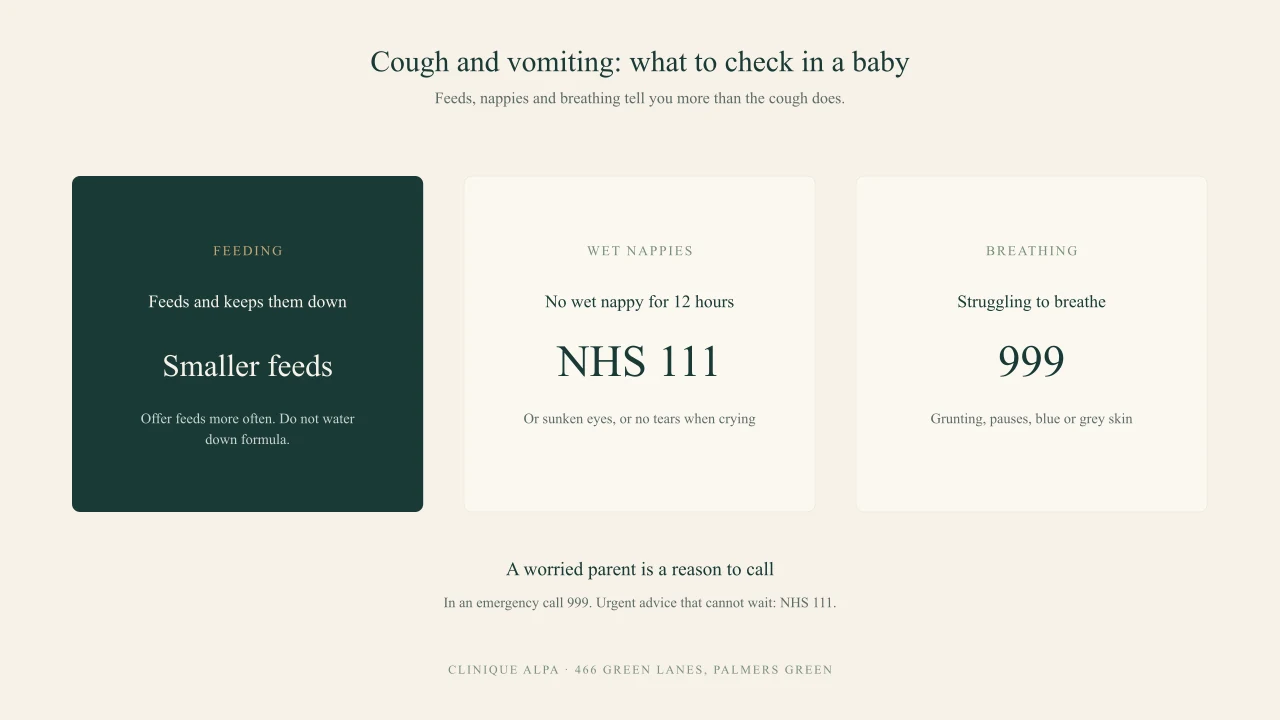
- Is struggling to breathe: grunting, fast breathing, or the tummy sucking in under the ribs.
- Has pauses in their breathing.
- Has skin, lips or tongue that look blue, grey, pale or blotchy.
- Is floppy and will not wake or stay awake.
- Is sick with green or yellow green vomit, or vomit that is red or looks like coffee grounds.
Call NHS 111, or ask for an urgent doctor the same day, if your baby:
- Is under 3 months and has a temperature of 38C or higher, or is 3 to 6 months and has a temperature of 39C or higher.
- Is feeding or eating much less than normal, or has stopped breast or bottle feeding while unwell.
- Has had no wet nappy for 12 hours or more, or has sunken eyes or no tears when crying.
- Keeps being sick and cannot keep fluids down.
- Is very tired, irritable or just not themselves.
If you are worried about a baby under 12 months who is being sick, NHS advice is to call 111. A worried parent is a reason to call, whatever the list says.
What do feeding and hydration checks show?
What I look at in clinic starts with the feed, because a baby who is feeding well is telling me a lot. I ask what a normal feed looks like, how many they take, whether they come off the breast or bottle to cough, and whether the vomit follows a feed or comes at any time. A baby who feeds, coughs, vomits a little and goes back for more is a different case from one who will not latch.
Then hydration. How many wet nappies in the last day, compared with usual. Whether the nappy is heavy or barely damp. Whether they cry with tears, whether the mouth is moist, and whether the soft spot on the top of the head is sunken. I look at the eyes and the skin, and how quickly the baby perks up when I speak to them.
Next, the breathing, watched before it is examined. Rate, effort, nostrils flaring, the chest drawing in, any wheeze or crackle. I check the oxygen reading with a pulse oximeter, the temperature, the colour and the tone. I listen to the chest, feel the tummy for tenderness or swelling, and look at the ears and throat. Is the baby gaining weight? Has the nappy changed?
I also ask what has been tried. The NHS notes that some cough medicines should not be given to children under 12, and hot lemon and honey drinks are not suitable for babies in their first year. Many parents have already used something because they wanted to do something. I would rather know than judge.
The plan from there is often simple, which is what makes it hard to trust at 2 in the morning. Keep feeding, in smaller amounts more often if your baby is sick. Do not water down formula. Prop up for a short while after feeds, hold upright during coughing spells, and track wet nappies. Antibiotics do not help a viral cough, and I will say so if I do not think they are needed. I give a clear time to review and a clear list of what means ring sooner.
From Dr Mitesh Parmar
What I check first is hydration: wet nappies, tears, the soft spot on top of the head not sunken, and whether feeding is still happening. A baby who is breathing fast, pulling in at the ribs, going blue, or too sleepy to feed needs 999 or A&E. For anything less clear, call NHS 111.
Baby coughing and vomiting at night: why is it worse?
Lying flat lets mucus run to the back of the throat, and the cough that follows can empty the stomach. Babies who are unwell also sleep lightly and wake to cough. What helps is held upright for a short while after feeds, regular feeds in smaller amounts and a clear nose so they are not swallowing so much. If a baby wakes at night and is also breathing fast or noisily, that is a different question, and I have covered it in noisy breathing in a baby at night.
For a baby with a fever as well as a cough, my page on a baby with a cough and fever is the better starting point, and bronchiolitis in babies explains the chest infection that can sit behind a cough that gets worse over days. If the cough comes with loose stools instead, see a baby with a cough and loose stools.
Common questions
What can I do for baby coughing and vomiting mucus?
Keep offering feeds in smaller amounts more often, hold your baby upright during coughing spells and keep a count of wet nappies. Ask a doctor to check them if they are feeding less, or if the vomiting continues without the coughing.
Is there a treatment for baby coughing and vomiting?
Most coughs are viral, so treatment is supportive: feeding, fluids, rest and watching. Antibiotics do not treat a viral cough, and some cough medicines are not suitable for young children.
When should I worry about vomiting in a baby?
Worry sooner with green or bloodstained vomit, no wet nappy for 12 hours or more, or a baby who will not feed. Call 111 if you are worried about a baby under 12 months who is being sick.
How do we help at Clinique Alpa?
Call 020 8882 8088 or book online and tell us how your baby is feeding. If it sounds like an emergency we tell you to call 999 first. A 30 minute clinic consultation at 466 Green Lanes is £100 and a parent or guardian stays throughout. If travelling with a poorly baby is too much, a home visit lasts 60 minutes and is from £250 on a weekday, with travel priced by postcode. This is GP care for children, not a paediatrician service, and with your consent a summary goes to your NHS GP.
More in this series: babies with a cough
Drafted with AI assistance, clinically reviewed by Dr Mitesh Parmar, MBBS MRCGP, Principal GP and Clinical Director at Clinique Alpa, 466 Green Lanes, Palmers Green, London N13 5PA. This article is general information, not personal medical advice. In an emergency call 999. For NHS advice call 111 or visit nhs.uk.