
Two scans, two different answers. An early ultrasound that showed nothing, a later and more detailed scan that did show something, and pain that has not waited for either. Someone in this position is often waiting weeks for a hospital appointment while the pain gets worse, and wondering whether a pelvic pain specialist is what they need, or whether they have simply not been heard.
The question I am usually being asked is when scan findings plus painful periods tip over from something a GP can manage into something that needs a gynaecologist. This is the third of three pieces. The first covers pain that never settles and the second covers what fibroids and cysts mean on a report.
Chest pain, signs of a stroke, severe breathlessness, heavy bleeding, a severe allergic reaction or symptoms of sepsis need 999 or A&E immediately. For urgent advice that cannot wait, call NHS 111.
When do you need a pelvic pain specialist?
The NHS describes a gynaecologist as the specialist to see when endometriosis is suspected, and says that if treatment is not working or symptoms are very severe, referral to a specialist endometriosis service may follow. In the same spirit, the NHS advice on period pain is to see a GP if pain stops you doing your usual activities, and to expect referral if pain does not improve or a condition such as fibroids is suspected.
In practice I think of four triggers for a specialist opinion:
- Pain that is getting worse over months despite sensible first line treatment.
- A scan that shows something the earlier scans did not, such as a cyst on an ovary or signs of deposits on the womb.
- Pain outside the period, with sex, or with passing urine or stool.
- A wish to become pregnant, since that changes which treatments are suitable.
Any one of these is enough for the conversation. All of them together is usually enough for a referral.
What does a doctor look at before referring?
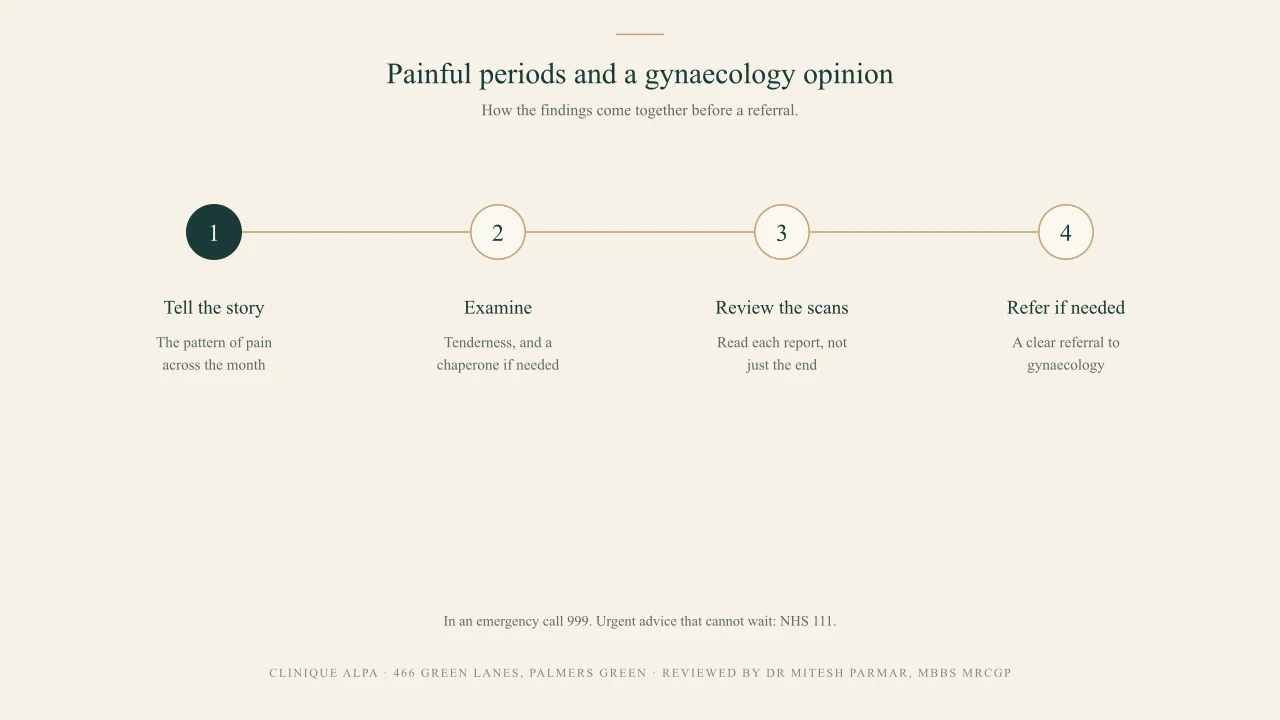
What I look at in clinic is whether the story, the examination and the scans point in the same direction, because a good referral is a clear one. I ask about the timeline of the pain, its pattern across the month, and how it has changed over the last few months. I ask what has been tried and for how long, and what happened. I ask about the effect on work, sleep, intimacy and mood, since those matter to the specialist and to the plan. I go through the scan reports myself, not just the conclusions, and note which one was done when, since a scan done at a different point in the cycle can give a different picture.
The examination is gentle and focused: tenderness in the lower tummy, any mass, and, where appropriate and with a chaperone available, a pelvic examination. I check the basics too, because someone in pain for weeks is often anaemic, dehydrated or short of sleep, and these make everything worse. Blood tests are chosen to fit, and I explain what each one is for and what the result would change. If a further scan or an MRI would answer a question that is still open, I say so, so that you are not left to guess what the specialist will want to see first.
The NHS notes that endometriosis symptoms overlap with adenomyosis, fibroids, pelvic inflammatory disease and irritable bowel syndrome, and that diagnosis can take a long time. A person who has already waited for years does not need me to repeat the whole workup. They need me to pull the findings together, say which question is still open, and write it down so the next doctor can start where we stopped.
From Dr Mitesh Parmar
I ask how the pain relates to periods, bowels, bladder and sex, and whether it wakes you. Different scans find different things, which is why two reports can disagree. I would rather help you reach the right specialist with a clear summary than wait for another test. Severe sudden pain means A&E.
What can be done while you wait for the specialist?
A great deal of suffering happens in the gap between a referral and the appointment. I am a GP, not a gynaecologist, and I do not do surgery. What I can do is review how pain is being treated and whether it is working, discuss other options with you, deal with side effects, look for anaemia, and give plain safety netting about when to go to hospital. The NHS lists painkillers, heat, a TENS machine and hormonal options among the usual approaches. Surgery is usually considered by the NHS only when other treatments have failed, when disease is extensive, or when fertility is affected.
Pain can also be so intense that it hurts elsewhere: the muscles of the back and tummy tighten against it. That alone is not a reason to panic, but severe pain that is getting worse is a reason to be assessed urgently, and not to sit it out at home.
When should you come in sooner?
The NHS says to call 999 or go to A&E if pelvic pain is severe, getting worse, or painful when you move or touch the area, or if you feel faint or dizzy, have pain at the tip of the shoulder, difficulty breathing or heavy vaginal bleeding. Do not drive yourself. Call NHS 111 or get an urgent GP appointment if the pain comes with a high temperature, vomiting, unusual discharge or bleeding, difficulty peeing or pooing, or if you could be pregnant.
Seek a routine appointment sooner if pain is changing, spreading, or keeping you off work. The pages on endometriosis pain management and pelvic pain assessment cover that gap in more detail.
Common questions
Is there a pelvic pain specialist near me?
The NHS route is a referral to gynaecology, and a doctor can help make that referral clear. At Clinique Alpa, you see a GP in Palmers Green who can review your results and refer you on where clinically appropriate after assessment.
Do I need a referral to see a gynaecologist?
Often yes for NHS care. A consultation gives you a clear summary and a reasoned referral to take forward.
Can a GP help while I wait for a specialist?
Yes. Reviewing pain relief, checking blood counts and giving clear advice on when to seek urgent care are all things a GP can do while you wait.
How do we help at Clinique Alpa?
Call 020 8882 8088 or book online. A 30 minute clinic consultation at 466 Green Lanes is £100. I go through your scans and results, examine, set out what is still unanswered and, where clinically appropriate after assessment, refer you to gynaecology. With your consent, a summary goes to your NHS GP.
More in this series: period pain and pelvic pain
Drafted with AI assistance, clinically reviewed by Dr Mitesh Parmar, MBBS MRCGP, Principal GP and Clinical Director at Clinique Alpa, 466 Green Lanes, Palmers Green, London N13 5PA. This article is general information, not personal medical advice. In an emergency call 999. For NHS advice call 111 or visit nhs.uk.