
A small hand keeps going up to one ear. Parents notice the pulling first. The face crumples, the face crumples, and the baby who feeds well has turned fussy, clingy and hot. There has been a cold in the house for days, so it could be nothing more, but the temperature has gone up and nobody is sure.
A baby fever with an ear infection behind it is common, and so is a baby fever with nothing but a cold. The two look alike from the outside, and a baby cannot say where it hurts. So the question is two questions: is it the ear, and does this baby need to be seen today? On the second the answer is often yes.
Chest pain, signs of a stroke, severe breathlessness, heavy bleeding, a severe allergic reaction or symptoms of sepsis need 999 or A&E immediately. For urgent advice that cannot wait, call NHS 111.
Is it a baby fever ear infection or a cold?
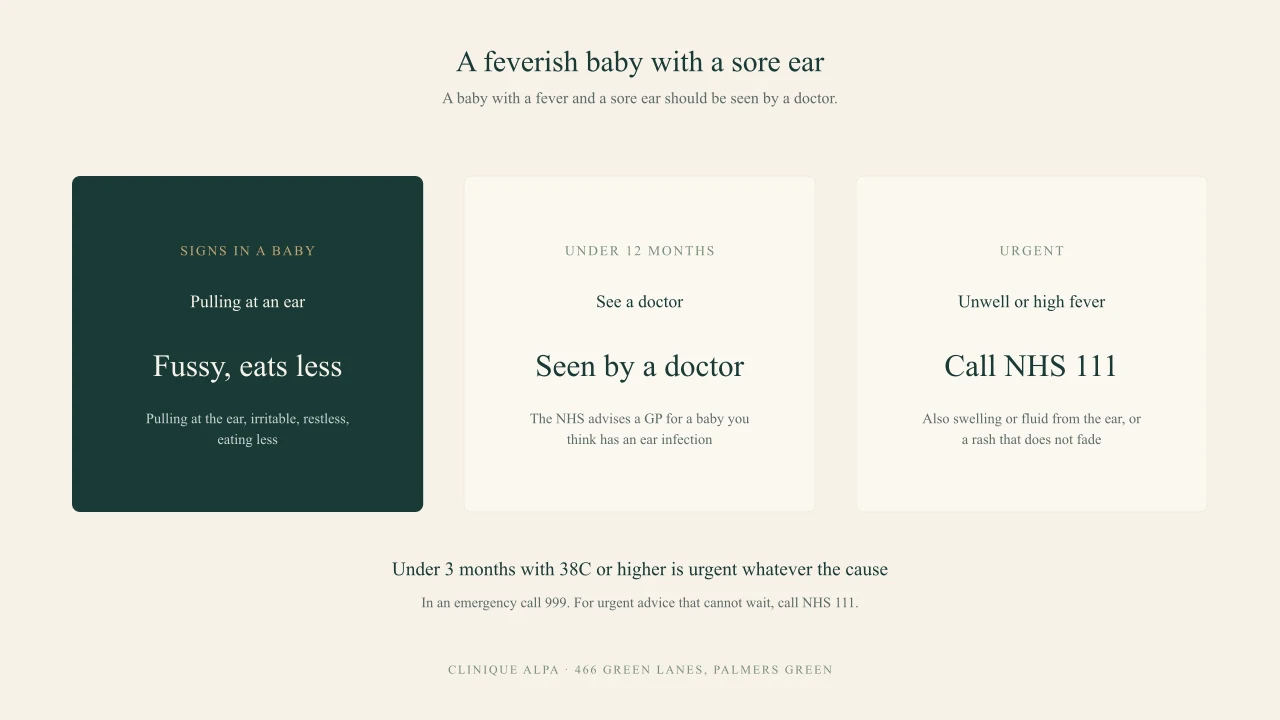
Often it is both. Colds and ear infections go together because the same blocked nose that comes with a cold can lead to fluid behind the eardrum. The NHS page on ear infections lists what a baby does when an ear hurts: rubs or pulls at the ear, is irritable or restless, eats less, may not react to some sounds and may lose balance once mobile. A fever can go with any of these.
What you cannot tell from the sofa is the difference between a cold with a sore ear and an infection that needs treatment. Teething is blamed often, and it can cause dribbling and crying, but it is not something I accept as the explanation until I have looked in the ears. The NHS says most ear infections clear up in about 3 days and can last up to a week, and advises seeing a GP if you think a child under 12 months has one.
What do I look at in a baby with a fever and an ear infection?
When this comes up in consultation, the baby is usually in a parent's arms with a red face and a damp vest. I start with a few minutes of watching. How does the baby look at me? Do they follow a face, settle on a shoulder and stay, or stay stiff and fretful? Colour, breathing effort and alertness are first, because they decide how urgently I need to move.
Then the story. How long has there been a fever, and has it been steady or coming and going? Is there a cold, a cough, noisy breathing? How are feeds going, and how many wet nappies in the last day? Has there been vomiting, loose stools, a rash? Has any medicine been given, and when? Is the baby sleeping or hard to rouse? Parents of babies often mention that the baby is more clingy than usual. I take that seriously.
Then the examination, from the ears outwards. I look into both ears with an auroscope, because an ear infection can be in one or both. A red, bulging eardrum, fluid behind it or a discharge points to infection. A pink eardrum in a crying baby can be misleading, so I look at the whole child, not only the drum. I check the throat and nose, feel the glands in the neck and behind the ear, listen to the chest, feel the tummy, look at the skin and check temperature, pulse, breathing rate and oxygen level.
That whole picture matters, because a baby with a fever can have more than one thing going on. An ear infection can sit alongside a chest infection, for example, and fast breathing in a feverish baby is not something I explain away as the fever. Breathing that is fast, laboured or noisy moves the baby towards hospital.
The outcome is one of three. The ear is infected and I explain what that means and what we do about it, because the right treatment depends on the cause and on which part of the ear is affected. Or the ears are clear and the fever has another source, which I then look for. Or the baby is more unwell than the ear explains, and goes to hospital for assessment. I phone ahead and write a letter, where clinically appropriate after assessment. I always give a specific time to look again, and I tell parents exactly what would bring them back sooner.
From Dr Mitesh Parmar
I look in the ears, but I also check breathing, hydration and how alert your baby is, because those tell me more than the ear alone. A floppy baby, poor feeding, a fever with a rash that does not fade, or any fever in a very young baby needs urgent help: 999 or A&E.
When must a baby with a fever and sore ear be seen?
Call 999 or go to A&E if your baby has a rash that does not fade under a glass, a stiff or floppy body, a bulging soft spot on the top of the head, a weak, high pitched or continuous cry, is hard to wake or very sleepy, will not feed, or has blue, grey or pale skin or lips. The same applies to fast, grunting or laboured breathing, and to cold hands and feet.
Whatever the cause, a baby under 3 months with a temperature of 38C or higher needs urgent help, as does a baby of 3 to 6 months with 39C or higher. Those thresholds come from the NHS. Do not wait to examine the ears first.
Ask for an urgent appointment or call NHS 111 if the baby has an ear infection and seems generally unwell, has swelling around the ear, fluid coming from it, is being sick, or is under 12 months with earache in both ears. The NHS says to call 111 for advice about any child under 5. Do not put anything in a baby's ear, including cotton buds.
What about baby high fever and ear infection with a rash?
A rash alongside a fever and an ear problem means the rash needs its own look. Press a glass against it. If it does not fade, it is 999. If it fades and the baby is otherwise alert and feeding, it is often a viral rash, but a doctor should still see it. I have written about the rash question separately in a child's fever with a rash.
How is this different from a chest cold in a baby?
With a cough and noisy, fast breathing, the first thought is the chest, not the ear. See a baby with a cough and fever and bronchiolitis in babies. For a fever that has run on for days, see a child fever lasting 5 days. For a baby or toddler who has had a seizure with a fever, see a first fever seizure.
How do we approach this at Clinique Alpa?
A clinic consultation at 466 Green Lanes is 30 minutes for £100. The fee is shown before you pay, and every fee is on appointments and fees. With your consent a summary goes to your baby's NHS GP. If a baby cannot easily be brought in, a doctor can visit at home, and you can read about home visits.
Common questions
Can a baby have a severe ear infection without a fever?
Yes. Fussiness, pulling at the ear and feeding less can all happen without a fever. A baby under 12 months with suspected earache should still be seen.
Is a baby fever ear infection an emergency?
Not usually, but a baby with a rash that does not fade, a high fever in the youngest age groups, or signs of serious illness is. If you are unsure, call 111.
More in this series: fever in babies and children
- Child fever lasting 5 days
- A child's fever with a rash when to worry
- Febrile seizure toddler: what parents need to know
Drafted with AI assistance, clinically reviewed by Dr Mitesh Parmar, MBBS MRCGP, Principal GP and Clinical Director at Clinique Alpa, 466 Green Lanes, Palmers Green, London N13 5PA. This article is general information, not personal medical advice. In an emergency call 999. For NHS advice call 111 or visit nhs.uk.