
By the time most parents call about a child fever lasting 5 days, the routine has worn a groove in the house. Fluids are offered every few minutes, the thermometer lives on the kitchen counter and the nights have been broken into short pieces. The fever has eased once or twice and then come back, which is almost harder than a fever that never moved.
The question underneath is not whether the number is high. It is whether this is a virus taking its time, or a fever with something behind it that now needs finding. Day 5 is a sensible place to stop waiting, and the NHS draws the line in the same place.
Chest pain, signs of a stroke, severe breathlessness, heavy bleeding, a severe allergic reaction or symptoms of sepsis need 999 or A&E immediately. For urgent advice that cannot wait, call NHS 111.
Why does a child fever lasting 5 days need a proper look?
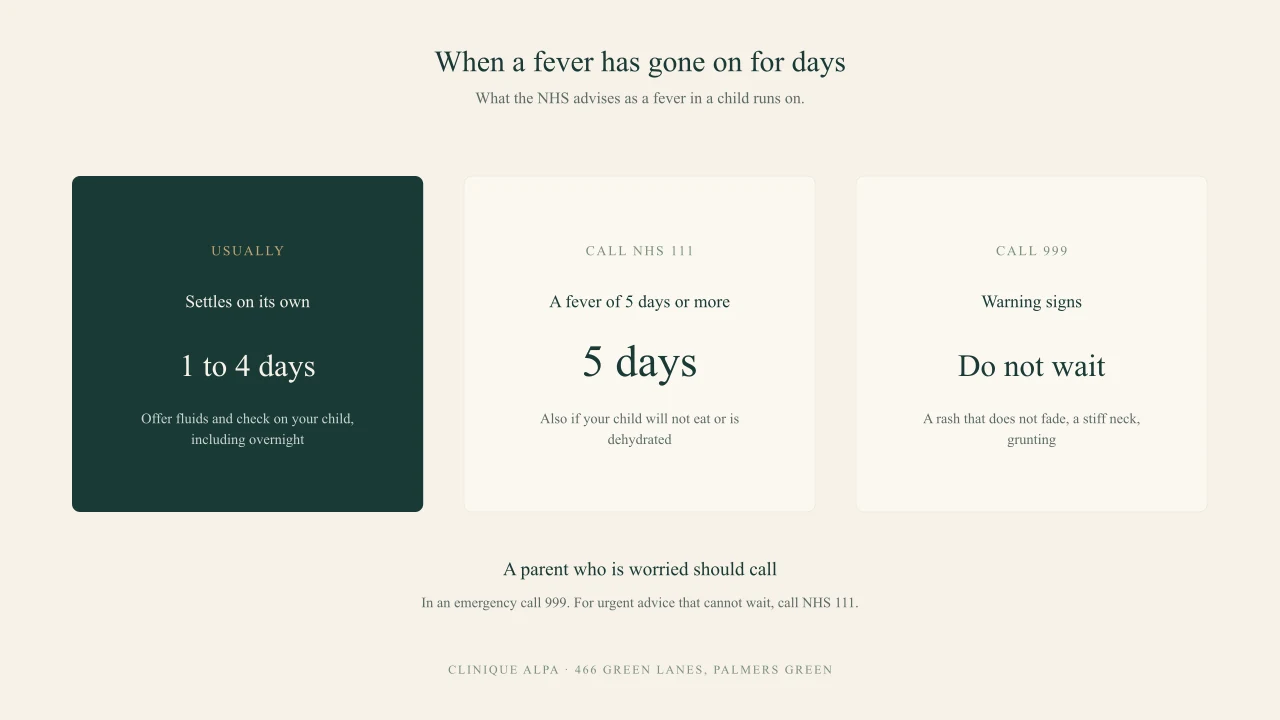
Most fevers in children settle within 1 to 4 days, as the NHS guidance on fever in children explains. A fever that is still there on day 5 is outside the usual run, and the NHS advice is to call 111 at that point. I would add one thing from clinic: the number of days matters less than whether anyone has actually examined your child during them.
A fever is a sign, not a diagnosis. Behind a fever that runs on there is usually an infection that has settled somewhere: an ear, a throat, a chest or the urine. Sometimes one infection has been followed by a second. Sometimes a virus simply has a long tail. Much less often, something else is keeping the temperature up. Each of these needs a different next step, and none of them can be told apart from the thermometer alone.
How do I assess a child fever for 5 days in clinic?
When this comes up in consultation, parents often arrive with a good timeline on their phone. I start there. Did the fever ever settle fully between peaks? Did it go away and return? What else came with it: a cough, ear pulling, a sore throat, tummy pain, a change in the urine, a rash, a limp? What is going in and what is coming out, in fluids, wet nappies or toilet trips? What medicine has been given, and when? And who else around the child has been unwell?
Then I watch before I touch. A child who looks at me, reaches for a toy, objects loudly to being examined and then settles tells me something that no thermometer can. A child who is limp, glassy or unusually quiet tells me something too. I look at colour, breathing effort and how they respond to their parent.
The examination follows a fixed order, because skipped steps are how things get missed. Temperature, pulse and breathing rate. Oxygen level with a pulse oximeter. Both ears and the throat. The neck for glands and stiffness. The chest, listened to properly. The tummy. The skin, including a glass pressed on any rash. Then hydration: tears, the mouth, how recently the last wet nappy was. A urine sample is often the missing piece in a young child with a fever and no obvious focus. Blood tests are sometimes needed too, and I explain what each test is for and what the result would change before anything is done.
There are three usual endings. The first is reassurance with a plan: a clear explanation, what to watch for and a specific time to look again, agreed before you leave. The second is finding the source and treating it, with the plan written down. The third is a child who should be seen in hospital that day. In that case I telephone ahead and write a letter where clinically appropriate after assessment. Where a fever has gone on this long in a small child, I would rather send a child to hospital and be wrong than keep one at home and be wrong.
From Dr Mitesh Parmar
A fever that has gone on this long needs a proper look at the ears, throat, chest, tummy and skin, and often a urine sample, because the cause is not always obvious. I also watch how your child behaves when the temperature drops. Call 999 for a rash that does not fade under a glass, a stiff neck or floppiness.
What are the signs that mean act now?
Call 999 or go to A&E if your child has a stiff neck, is bothered by light, or has a rash that does not fade when you press a glass against it. The same applies if they are hard to wake or drowsy, have blue, grey or very pale lips or tongue, have unusually cold hands and feet, are struggling to breathe with grunting, sucking in under the ribs or very fast breathing, are extremely agitated or confused, or are not responding to you in the usual way.
Call NHS 111, or ask for an urgent assessment, if your child has a fever together with a rash, will not eat, is dehydrated (very few wet nappies, sunken eyes, no tears) or is simply not themselves and you are worried. These signs are listed in the NHS guidance and in the NHS meningitis symptom list.
Keep going with the basics while you decide: plenty of fluids, a loose layer of clothing, no sponging down, and fever medicine only if your child is uncomfortable, as the packet directs. The NHS advises against alternating two fever medicines unless a health professional tells you to.
Is a baby fever lasting 5 days different?
Yes, and the difference is the starting point. A baby under 3 months with a temperature of 38C or higher is urgent whatever the day count, and a baby of 3 to 6 months with 39C or higher is urgent too. A baby who has been feverish for days is not a home care question at all. Ring 111 or go to A&E. A toddler fever lasting 5 days is more common and more often turns out to be an ordinary infection. But even there I do not wait to be asked.
What changes with a child fever for 5 days and cough?
A cough on its own is common and usually harmless. A cough with a fever that has run for days moves the chest up my list. I check breathing rate and effort, oxygen level and what the lungs sound like, and whether the child is tiring from the work of breathing. Fast breathing, grunting or sucking in at the ribs belongs on the 999 list above.
If the fever has come with an ear infection or a rash, those have their own pages. I have written about a child fever with a rash, and about a baby with a fever and an ear infection. For a fever that started today and has not yet had time to behave, see whether a child with a fever can be seen today.
How do we approach this at Clinique Alpa?
A clinic consultation at 466 Green Lanes is 30 minutes for £100. A parent is with the child throughout. The fee is shown before you pay, and every fee is on appointments and fees. With your consent a summary goes to your child's NHS GP, because this is private care alongside the NHS and not a replacement for it.
Common questions
How long can a child fever last before I should worry?
Most settle within 1 to 4 days. If the fever reaches 5 days or more, call NHS 111 or arrange an examination, and do not wait for a number.
Is a child fever for 5 days always an infection?
Usually it is, but the type matters. That is why the examination comes before any decision about treatment.
Should I keep a feverish child off nursery or school?
Keep them at home while they are unwell and check on them regularly, including overnight, as the NHS advises. Your child's doctor can tell you when it is safe to return.
More in this series: fever in babies and children
- A child's fever with a rash when to worry
- Febrile seizure toddler: what parents need to know
- Baby fever ear infection or a cold
Drafted with AI assistance, clinically reviewed by Dr Mitesh Parmar, MBBS MRCGP, Principal GP and Clinical Director at Clinique Alpa, 466 Green Lanes, Palmers Green, London N13 5PA. This article is general information, not personal medical advice. In an emergency call 999. For NHS advice call 111 or visit nhs.uk.