
There comes a point in most long coughs when the plan to wait it out stops feeling like a plan. The cough has been going for two weeks. The nose has been running, then thick and green, and the nursery has asked whether your child should really be there. Then something new appears, perhaps a mark on the skin, and the question changes from how long a cough lasts to whether this is still the same illness.
That shift is worth taking seriously. A child cough for two weeks is common and usually harmless, but it is also the length at which I stop assuming and start checking. This article is about what I check and why.
Chest pain, signs of a stroke, severe breathlessness, heavy bleeding, a severe allergic reaction or symptoms of sepsis need 999 or A&E immediately. For urgent advice that cannot wait, call NHS 111.
Is a child cough for two weeks normal?
Often, yes. The NHS says a cough will usually clear up on its own within 3 to 4 weeks. Young children catch one cold after another, especially in nursery and school, and the cough from one can bridge into the next, so the whole season can seem like a single illness. Parents of toddlers often say it feels as if the cough has never gone away.
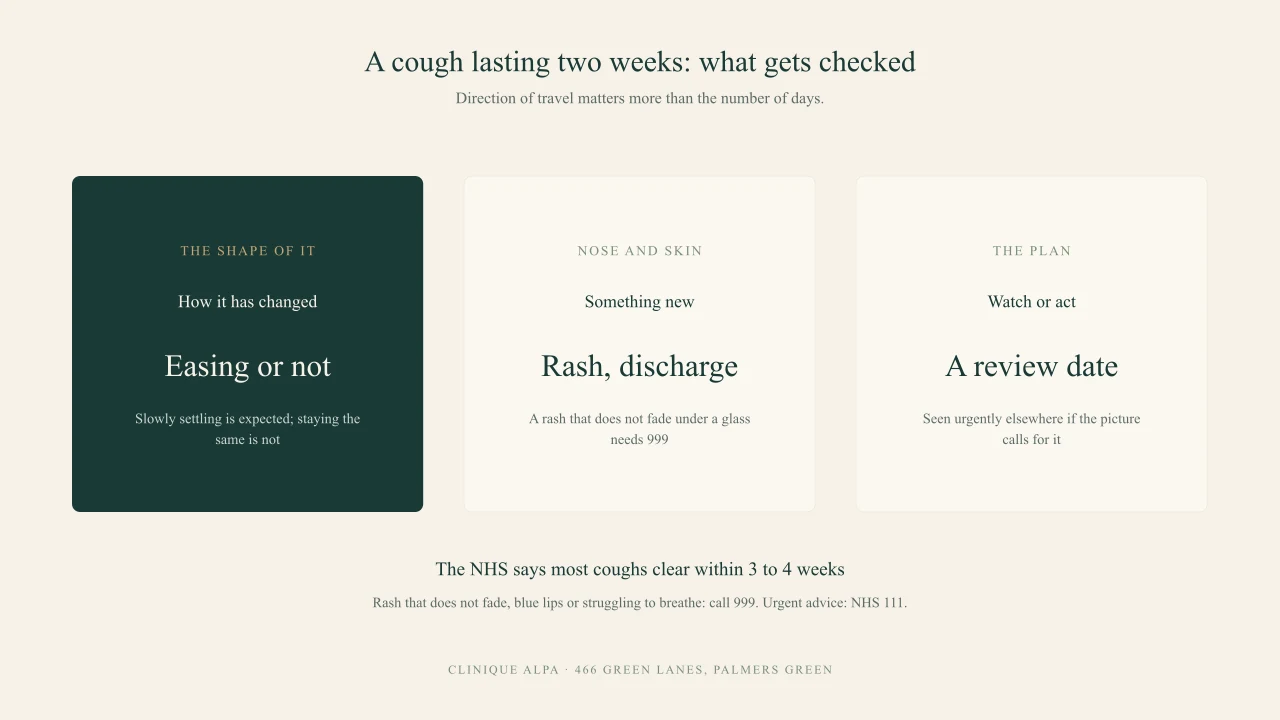
Two weeks is therefore not an alarm in itself. What matters is the direction. A cough that is slowly easing, with a child who is eating, drinking, playing and sleeping, is behaving as expected. A cough that is not changing, is getting worse, or arrives with something new needs a closer look.
What does a doctor check in a toddler with a cough for two weeks?
What I look at in clinic begins with the shape of the illness. Did it start with a cold and gradually settle, or did it begin as a dry tickle and become chesty? Has the child ever been completely free of it for a few days? Is it worse at night, with exertion, or after meals? Is there a temperature now, or was there one earlier that has gone? Has the cough changed in character, for instance into long bouts that end in a gasp or vomiting?
That last point matters. The NHS describes whooping cough as starting like a cold, with coughing bouts developing after about a week, often worse at night, sometimes ending in a whoop, and sometimes causing vomiting. A young baby may not whoop at all. I ask about vaccination status, because it changes how likely that is, and about anyone in the household with a persistent cough.
I ask about the nose. Thick green or yellow discharge is common as a cold runs its course and does not, by itself, tell me the cause. The NHS sinusitis page lists green or yellow mucus as a symptom and advises seeing a GP for a child of 11 or younger with sinusitis symptoms. A cough that is driven by mucus running down the back of the throat, worst when lying down, is a different problem from one driven by the chest, and the treatment is different.
Then I look at the child as a whole. How they sit, how they breathe, whether they are interested in the room. I count the breathing rate, check for effort, and listen to the chest. I look in the ears, the nose and the throat. I check the glands in the neck. I look at the skin carefully, all over where I can, because a long cough with a new rash can mean a viral illness with a rash, an allergy or a reaction, or occasionally something more serious. A single new spot that is not worrying in isolation is worth noting and following in a child who is otherwise unwell.
The glass test is how I tell the dangerous rashes from the harmless ones, and it is something parents can do at home. The NHS advises pressing the side of a clear glass firmly against the rash. A rash that does not fade under the glass is an emergency sign: call 999 or go to A&E.
I also ask what else is going on, because the cough can be the quietest symptom. Weight, appetite, tiredness, noisy breathing during sleep and any history of allergy all shape the next step. Some children with a long cough and a history of food or other allergy need their plan to account for that. Others need a short period of watching with a precise review date. A few need to be seen urgently somewhere else, and in that case I arrange it rather than leaving it to you.
From Dr Mitesh Parmar
Listening to the chest, looking in the throat and watching how hard your child works to breathe come first. Whether the cough is dry or wet, and worse at night, helps me separate a lingering cold from asthma. Fast breathing, pulling in at the ribs or a blue tinge needs 999.
Is a toddler cough for 2 weeks with no fever still worth checking?
Yes, if it is not improving. No fever is reassuring, as is a child who is clearly well in themselves. It does not exclude an irritable airway, post viral cough, allergy or a nose that is draining at the back of the throat. It also does not exclude whooping cough, which often has no high temperature. A short appointment now is better than another fortnight of guessing.
What about a baby cough for two weeks?
A younger baby is a different matter. The NHS says babies under 6 months with whooping cough usually need hospital treatment, and that you should see a GP or call NHS 111 if your baby is under 6 months and has symptoms. Do not wait for the two week mark in a young baby with a cough, particularly if feeding is affected.
When should a child with a cough be seen sooner?
Come in or call sooner if:
- the cough is very bad or getting quickly worse
- your child has lost weight, or is eating and drinking much less
- the cough has lasted more than 3 weeks
- your child is very unwell, or you are worried and cannot say why
Call 999 if your child has a rash that does not fade under a glass, blue or grey lips, tongue or skin, difficulty breathing, or is floppy, very drowsy or having a seizure. For urgent advice that cannot wait, call NHS 111. Rashes can be harder to see on brown or black skin, so look at paler areas such as the palms, soles and inside the eyelids.
How do we approach a long cough at Clinique Alpa?
You see Dr Parmar for 30 minutes at Palmers Green, with a parent present. The fee is £100 and is shown before you book. I take the full history, examine your child and explain what I think is going on, then agree a plan with a clear review date. Where an urgent assessment elsewhere is the safer choice, I tell you directly and arrange it, and a referral letter is written where clinically appropriate after assessment, included in the consultation fee. With your consent, a summary goes to your NHS GP.
If the cough has a chesty sound and a temperature, start with the signs doctors look for in a child chest infection. For a cough that wakes your child, see why a child coughs at night, and for the full picture of our work with children, our children's health page.
Common questions
Should I give my child cough medicine?
The NHS says some cough medicines should not be given to children under 12, and that honey is not suitable for babies under 1. Ask a pharmacist or GP first.
Can my child go to nursery with a cough?
If they are well in themselves and eating and drinking, usually yes. If they are exhausted, feverish or the cough is worsening, keep them home and have them seen.
More in this series: cough in children
- Child chest infection signs doctors look for
- Why does my child cough at night with a wheeze
- Recurrent chest infections in children and large tonsils
Drafted with AI assistance, clinically reviewed by Dr Mitesh Parmar, MBBS MRCGP, Principal GP and Clinical Director at Clinique Alpa, 466 Green Lanes, Palmers Green, London N13 5PA. This article is general information, not personal medical advice. In an emergency call 999. For NHS advice call 111 or visit nhs.uk.