
The medicine that settles the spinning has run out again. It was started some time ago, it works when you take it, and you only reach for it on bad days. So the request is simple: could the same supply be sent again?
It is a reasonable request, and sometimes the right answer is yes. But when dizziness keeps coming back, I would also like to know why. Recurrent dizziness deserves a review, not just a refill, and the review is more straightforward than people expect.
Chest pain, signs of a stroke, severe breathlessness, heavy bleeding, a severe allergic reaction or symptoms of sepsis need 999 or A&E immediately. For urgent advice that cannot wait, call NHS 111.
What does recurrent dizziness mean?
It means episodes that come and go over weeks, months or years, with normal spells in between. The word dizziness covers several different experiences: a spinning sense that the room is moving, which doctors call vertigo; a light headed, nearly faint feeling; and a general unsteadiness. Telling me which one it is does most of the work of narrowing the cause, so I ask people to describe it rather than name it.
The NHS page on vertigo says an attack can last from a few seconds to hours, and that if it will not go away or keeps coming back, you should see a GP. That is the standard I work to.
What are the causes of recurrent dizziness?
Inner ear problems that affect balance are the most common. The NHS names BPPV, which is triggered by particular head movements; labyrinthitis, which follows a cold or flu; and Ménière's disease, a rarer inner ear condition that can involve ringing in the ear or hearing loss. Migraine can cause vertigo, and so can some medicines. Sometimes the cause is never found.
Outside the inner ear, repeated light headedness is often about blood pressure falling on standing, low blood sugar in someone treated for diabetes, iron deficiency anaemia, dehydration, or anxiety. A good history separates these quickly, because each leaves a different fingerprint on when it happens.
Why does recurrent dizziness come with nausea and fatigue?
Nausea and vomiting are part of vertigo. The balance system is wired to the part of the brain that controls sickness, so a spinning episode often ends with sickness whatever the cause. Fatigue is common too, partly from the episodes themselves and partly from a poor night's sleep or worry about the next one.
What I do not want to do is assume that nausea and tiredness are simply part of the dizziness. Persistent tiredness with dizziness can also be anaemia, a thyroid problem or low mood, and these are all worth a blood test.
What do I look at in a review?
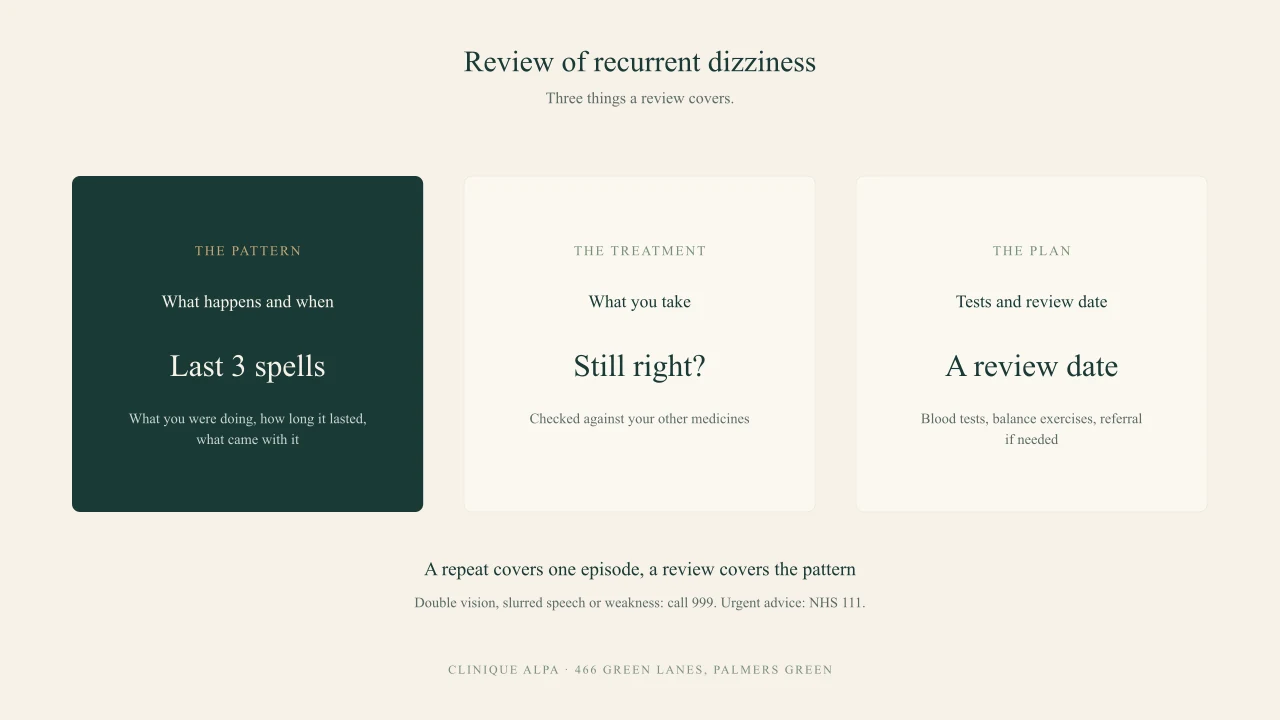
I begin with the diary, spoken aloud: when the last three episodes happened, what you were doing, how long each lasted, whether it was worse turning in bed, and whether it came with ringing in the ear, hearing change, headache or sickness. The pattern matters more than any single episode. A spin lasting minutes when you roll over points one way; episodes of hours with a blocked feeling in the ear point another; a swimmy feeling on standing points a third.
Then I look at what has been done so far. This is the part a repeat supply skips. What medicine are you using, how often, and does it help? Do you take it only on bad days, which is common and sometimes fine? Has it been checked against your other medicines, since some can themselves cause dizziness? A medicine that was right for one episode is not automatically right for the next three years.
The examination includes pulse, blood pressure lying and standing, temperature, the ears with an otoscope, eye movements, hearing in a basic way, and a check of balance and walking. The NHS describes a test where you move quickly from sitting to lying down, which can bring on positional vertigo and shows whether that is the cause. Blood tests are chosen from what I find: blood count, blood sugar, thyroid or kidney function. If something suggests the inner ear needs a specialist, such as hearing loss that is getting worse, I refer for further tests; the NHS says Ménière's disease is confirmed by a specialist with tests that may include blood tests and an MRI scan.
If the review is reassuring, you leave with a plan that is more than a repeat: what to take and when, what to avoid, balance exercises where they are suitable, and a date to review whether it is working. Where things are not improving, we change the plan instead of repeating it.
From Dr Mitesh Parmar
I do not simply say yes to a repeat request without asking what is causing the dizziness now. I check blood pressure lying and standing, the ears and eye movements, and everything else you take. Spinning with new weakness, trouble speaking or a severe headache needs 999.
When should I come in sooner?
- Dizziness with double vision or vision loss, trouble speaking, or weakness, numbness or tingling in an arm or leg: call 999.
- Dizziness with a severe headache, being sick, or a very high temperature or chills: ask for an urgent GP appointment or call NHS 111.
- Hearing loss, or ringing in the ear that is new.
- Episodes that are getting more frequent, longer or harder to cope with.
One practical point. The NHS says you must tell the DVLA if you have dizziness that starts suddenly or happens often, and not to drive if you feel dizzy or an episode is starting. Never drive yourself to A&E with dizziness.
If your dizziness came with a fever or sore throat, read dizziness with a fever or sore throat. The wider dizziness and vertigo guide covers the basics, and dizziness in older people covers the extra checks needed later in life.
How do we approach this at Clinique Alpa?
A clinic consultation is 30 minutes with a doctor at 466 Green Lanes for £100. I would rather see you face to face for this, since I need to examine your eyes, ears and balance. Blood tests are priced on the blood test prices page. With your consent, a summary goes to your NHS GP, so your records stay in one story.
Common questions
What is the cause of recurrent dizziness?
Most commonly an inner ear problem, but blood pressure, blood sugar, anaemia, migraine and some medicines can also be behind it. Sometimes no cause is found.
Is recurrent dizziness serious?
It is usually not dangerous, but it should be checked because treatable causes are easy to miss. Signs such as double vision, slurred speech or weakness need 999.
Can I keep taking the same treatment?
That depends on a review. A medicine that suited one episode may not suit repeated ones, and other medicines can contribute.
More in this series: dizziness
- Dizziness with a fever or sore throat
- Dizziness after eating with diabetes or high blood pressure
- Dizziness in the elderly with tiredness
- Leg numbness and balance problems
Drafted with AI assistance, clinically reviewed by Dr Mitesh Parmar, MBBS MRCGP, Principal GP and Clinical Director at Clinique Alpa, 466 Green Lanes, Palmers Green, London N13 5PA. This article is general information, not personal medical advice. In an emergency call 999. For NHS advice call 111 or visit nhs.uk.