
Families describe it in small, practical terms. Mum no longer gets up quickly from her chair. Dad holds the wall on the way to the bathroom. There is a sleepy spell in the afternoon, a heaviness in the legs, and a vague complaint that the world does not quite sit still in the evenings.
Dizziness in the elderly is common, and it is easy to dismiss as age. I try not to. In older people dizziness is rarely one thing, and the useful question is what is stacking up.
Chest pain, signs of a stroke, severe breathlessness, heavy bleeding, a severe allergic reaction or symptoms of sepsis need 999 or A&E immediately. For urgent advice that cannot wait, call NHS 111.
Why is dizziness in the elderly rarely a single problem?
Because the body of an older person is usually managing several things at once. The NHS lists the contributors to falls in older adults: muscles weakening with age, conditions such as arthritis, stroke or Parkinson's disease, low blood pressure, side effects of medicines, problems with eyesight or hearing, and dementia. Any one of these can make you unsteady. Several together can make you dizzy and tired without any of them being severe.
When this comes up in consultation, it is often an older adult with a long list of long term conditions and an equally long list of medicines. The dizziness has been going on for a while. A previous review ended with another medicine, and nothing changed. That sequence is the reason I start by asking what is being taken, not what to add.
What are the causes of dizziness in the elderly?
The NHS dizziness page lists inner ear problems, ear infection, migraine, dehydration, low blood sugar in people with diabetes, iron deficiency anaemia, and a drop in blood pressure on standing. For older people I add a few more to the list: the interaction of several medicines, poor sleep, low mood, loss of fitness after an illness, and eyesight that has quietly changed.
Dizziness in the morning in the elderly is often about blood pressure on getting up, after a night without fluids. Dizziness worse in the evening, with tiredness, can reflect low energy at the end of a day, the effect of medicines wearing off or peaking, or a blood sugar that has drifted. The time of day is a clue, which is why I ask for it.
How is dizziness in the elderly assessed and treated?
What I look at in clinic is broader than the head. I start by listening for what the person means by dizzy: spinning, faint, unsteady, or heavy legs on standing. Then I ask about falls, even near falls, and about the things that make it worse: standing quickly, turning in bed, big meals, hot days, or particular times after tablets. I ask about double vision, headaches, hearing and the ears, because the NHS lists these as reasons to be seen.
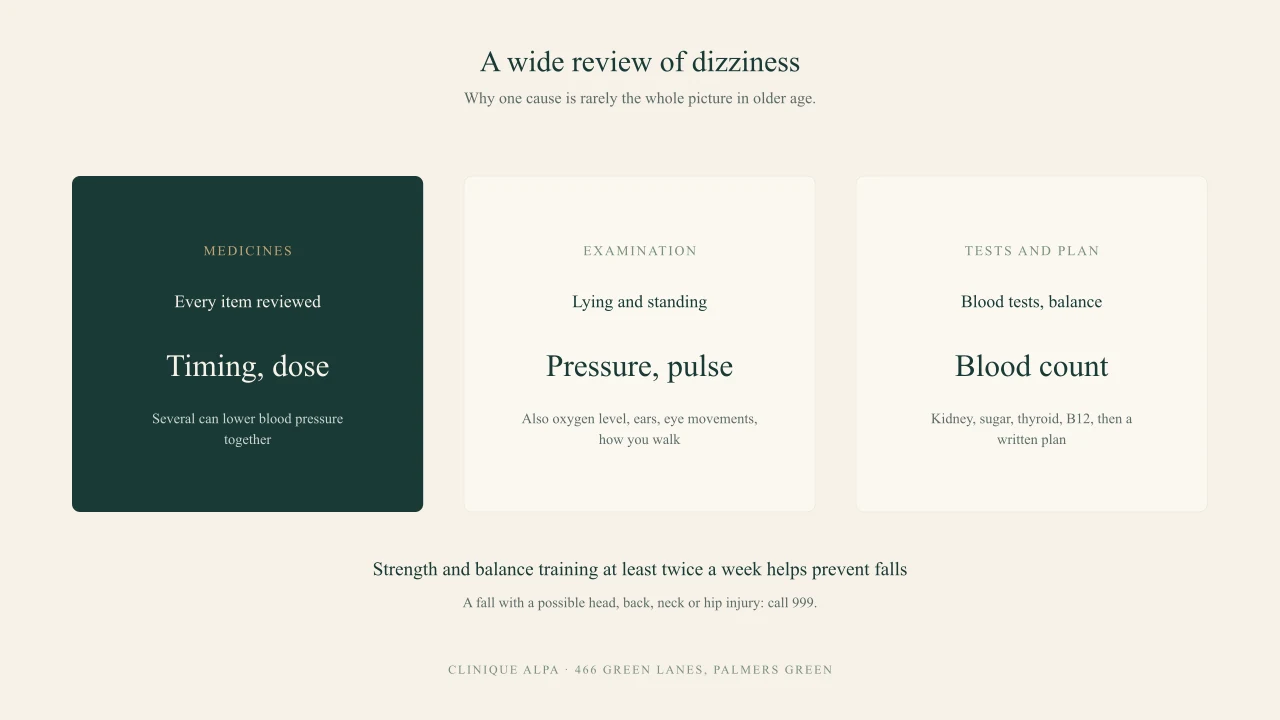
The medicine review is the longest part. I go through every item, including the ones bought over the counter. Which were started recently? Which are for blood pressure, the heart, fluid, diabetes or pain? Do several of them lower blood pressure? The NHS notes that some medicines cause low blood pressure and that a GP can review them. Often the answer is not to stop anything but to question the timing and dose, and to agree any change with the doctor who started it.
Then the examination. Blood pressure and pulse lying down and then after standing for a few minutes. Oxygen level, temperature, the heart and chest, the ears, eye movements, and how you walk, including getting up from a chair without using your arms. I look at the feet and ankles as well. The NHS says a GP checks balance by asking you to get up and move around, and that medicines should be considered in case they affect balance.
Blood tests are chosen from what I find. A blood count for anaemia, kidney function and salts, blood sugar or HbA1c, thyroid, vitamin B12, and sometimes vitamin D, since the NHS ties bone health to falls. I ask about eyesight and hearing tests, which are often overdue. If I see ear wax I explain that we do not remove it here, and I arrange removal with an external provider.
The plan is written for the family as well as the patient: what to change, what to track, and what would make me want to see the person sooner. If a fall service or physiotherapy would help, I say so. Strength and balance training at least twice a week is the NHS advice, and the NHS lists it among the steps that help prevent falls.
From Dr Mitesh Parmar
I check blood pressure lying and then standing, because a drop on standing is one of the commonest and most fixable causes. I also review every treatment being taken, since several together can cause dizziness. Sudden weakness, a drooping face, slurred speech or a new severe headache means 999.
When should I come in sooner?
- A fall with a possible injury to the head, back, neck or hip, or being unable to get up: call 999.
- Dizziness with double vision or vision loss, trouble speaking, or weakness, numbness or tingling: call 999.
- A fall where the person is in pain, injured or unwell: call NHS 111 or use the online service.
- Fainting or collapsing, or a change in the pulse.
- Dizziness that is new, worse, or following a change in medicine.
The NHS page on falls includes practical safety steps such as non slip footwear, a personal alarm and clear walkways. If the dizziness came during an infection, see dizziness with a fever or sore throat. If it has come and gone for years, recurrent dizziness and why it is reviewed covers that. If numbness and unsteadiness in the legs follow weight loss, read leg numbness and balance problems.
How do we approach this at Clinique Alpa?
A clinic consultation is 30 minutes with a doctor at 466 Green Lanes for £100. If getting here is the difficulty, a home visit lasts 60 minutes and is from £250 on a weekday, from £325 at weekends and bank holidays and from £450 for an evening start, with travel priced by postcode; see home visits. A relative is welcome to join, and with consent a summary goes to the NHS GP.
Common questions
What is the treatment for dizziness in the elderly?
It depends on the cause. Often it means reviewing medicines, checking blood pressure lying and standing, treating anaemia or infection, and balance exercises.
Is occasional dizziness in the elderly normal?
It is common, but it is not something to put up with. The NHS advises seeing a GP if it keeps coming back or you are worried.
Why is dizziness in the morning in the elderly so common?
Blood pressure can fall on getting up, particularly after a night without fluids or when taking several medicines. Getting up slowly helps.
More in this series: dizziness
- Dizziness with a fever or sore throat
- Recurrent dizziness and why it is reviewed
- Dizziness after eating with diabetes or high blood pressure
- Leg numbness and balance problems
Drafted with AI assistance, clinically reviewed by Dr Mitesh Parmar, MBBS MRCGP, Principal GP and Clinical Director at Clinique Alpa, 466 Green Lanes, Palmers Green, London N13 5PA. This article is general information, not personal medical advice. In an emergency call 999. For NHS advice call 111 or visit nhs.uk.