
It begins as an odd feeling underfoot, as if the floor were slightly padded. Then comes a burning sensation that appears when walking and eases when sitting, and a habit of reaching for the wall or the back of a chair on the way across the room. The person has noticed their clothes hanging looser, though they have not been dieting.
Leg numbness and balance problems on their own can have a straightforward explanation. Together with weight loss, they should be looked at as one story rather than three complaints.
Chest pain, signs of a stroke, severe breathlessness, heavy bleeding, a severe allergic reaction or symptoms of sepsis need 999 or A&E immediately. For urgent advice that cannot wait, call NHS 111.
What causes leg numbness and balance problems together?
When numbness, tingling or burning in the legs comes with poor balance, I think first of the nerves. The NHS describes peripheral neuropathy as numbness and tingling in the feet or hands, burning or shooting pain, poor balance and coordination, and weakness, especially in the feet. Diabetes is the most common cause in the UK, because high blood sugar gradually damages nerves. Other causes include nerve injury, infections such as shingles, side effects of some medicines, and heavy alcohol use.
Low vitamin B12 is another to check. The NHS lists pins and needles, muscle weakness, extreme tiredness and vision problems among the symptoms of B12 deficiency, and it is diagnosed with a blood test. It matters because it is treatable and the damage is better prevented than repaired. The NHS page on peripheral neuropathy sets out the rest.
The nerves are not the only place to look. Pressure on nerves from the back, circulation in the legs, problems in the spinal cord or brain, and simple muscle weakness can all produce a similar picture. This is why I do not stop at the first plausible cause.
Can weak legs cause balance problems?
Yes. Weak muscles, especially in the feet and lower legs, make it harder to correct a wobble. The NHS lists poor balance and muscle weakness together among the symptoms of neuropathy. Weakness after a long illness or a spell of weight loss has the same effect, because muscle is lost along with fat. So balance problems may be the nerves, the muscles or both, and the examination is designed to tell them apart.
Why does weight loss change how I think about numbness?
Because it widens the search. The NHS advises seeing a GP if you keep losing weight without changing your diet or exercise, and as soon as possible if weight loss comes with other symptoms. Possible causes include digestive conditions, an overactive thyroid, diabetes, heart failure, low appetite or malnutrition, medicines, stress and, less often, cancer. The page does not give a figure for how much loss matters. What matters is that it was not intended, and that it continues.
Weight loss can also be a cause of the neurological symptoms. A body short of nutrients, whether from a poor diet or poor absorption in the gut, can run low on the vitamins that nerves depend on. That is why the two symptoms are sometimes the same story told from two ends.
What do I look at in clinic?
I start with the timeline: which came first, how the numbness behaves (constant or with walking), where it sits, and whether it affects both sides. I ask what has been done already, since many people arrive with scans or blood tests from elsewhere. The first question I want answered is whether the weight loss has already been investigated, and whether there is anything outstanding.
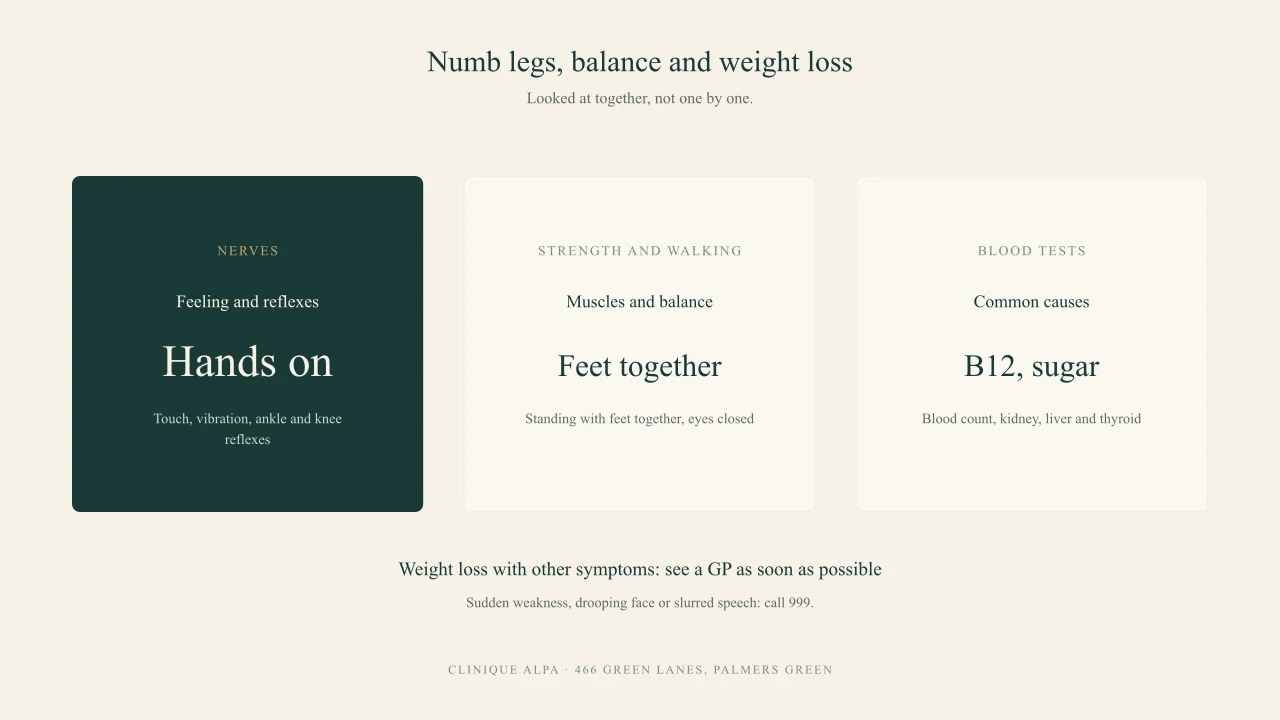
The examination is mostly with the hands and the eyes. I test strength in the feet, ankles, knees and hips, reflexes at the ankle and knee, and feeling for light touch, pin prick, vibration and joint position in the feet. Then walking: normal, on the toes, on the heels, in a line, and standing with feet together and eyes closed. The last one tells me whether the balance relies on sight and a sense of joint position that has been lost. I look at the feet for sores, since the NHS says a foot cut or ulcer that is not healing needs attention, and I feel the pulses at the ankles. I check blood pressure and pulse, and examine the abdomen.
Blood tests answer many of the questions in one visit: a blood count, B12, blood sugar or HbA1c, kidney and liver function, thyroid, and markers of inflammation or iron. Where a result is low, treatment can start. We give vitamin B12 replacement at the clinic where it is low or clinically indicated, alongside looking for the cause. For anything I cannot explain, I refer on or arrange further tests, and I make clear what is waiting and who is responsible for it. See blood test prices and investigations.
When results from different places do not agree, or tests were done by different teams who have not talked to each other, I draw them together on a single page. Many people say that this alone is a relief.
From Dr Mitesh Parmar
I test strength, reflexes, sensation and how you walk with eyes open and closed. Balance that worsens in the dark points to the nerves in the feet. I also check B12, sugar and the spine. Sudden numbness, weakness or loss of bladder control needs 999 or A&E.
When should I come in sooner?
- Sudden weakness, a drooping face or slurred speech: call 999.
- Weight loss you did not intend and which continues, with other symptoms: see a GP as soon as possible.
- A foot cut or ulcer that is not healing, or loss of feeling in the feet.
- Loss of balance or weakness that is getting worse, or any falls.
- Fainting or collapsing: seek urgent help.
If you are looking at a general overview, the numbness and tingling guide is the place to start. If dizziness is also a feature, read about dizziness in older people, and for unsteadiness after an infection see dizziness with a fever or sore throat. For repeating episodes, see recurrent dizziness, and for sugar and blood pressure see dizziness after meals.
How do we approach this at Clinique Alpa?
A clinic consultation is 30 minutes with a doctor at 466 Green Lanes for £100. Bring any scans or results you have, your medicines and a note of when the weight started to change. With your consent, a summary goes to your NHS GP, so that the work that is under way elsewhere is not duplicated. Every fee is on the appointments and fees page.
Common questions
What causes loss of balance and numbness in the legs?
Most often nerve damage from diabetes or another cause, low vitamin B12, or weakness of the muscles. A doctor examines and tests to tell them apart.
Can weak legs cause balance problems?
Yes. Weak muscles make it harder to correct a wobble, and weakness often goes with nerve problems.
Should I worry about leg numbness with weight loss?
It should be looked at together, not separately. The NHS advises seeing a GP as soon as possible if weight loss comes with other symptoms.
More in this series: dizziness
- Dizziness with a fever or sore throat
- Recurrent dizziness and why it is reviewed
- Dizziness after eating with diabetes or high blood pressure
- Dizziness in the elderly with tiredness
Drafted with AI assistance, clinically reviewed by Dr Mitesh Parmar, MBBS MRCGP, Principal GP and Clinical Director at Clinique Alpa, 466 Green Lanes, Palmers Green, London N13 5PA. This article is general information, not personal medical advice. In an emergency call 999. For NHS advice call 111 or visit nhs.uk.