
The alarm is not what wakes you. It is the need to get up, and it has happened three or four nights a week for long enough that you have stopped counting. By the afternoon you are tired, and the other change, the one you have mentioned to nobody, seems like part of the same tiredness.
People who search for erectile dysfunction nocturia are usually asking whether those two things have a shared cause. The honest answer is that they are separate symptoms, and neither one explains the other. What they share is that each can be a sign of something a doctor can check, and together they make a good reason to have it done properly.
Chest pain, signs of a stroke, severe breathlessness, heavy bleeding, a severe allergic reaction or symptoms of sepsis need 999 or A&E immediately. For urgent advice that cannot wait, call NHS 111.
Can urinary problems cause erectile dysfunction?
I would not claim a direct link. The NHS page on erection problems does not list urinary symptoms as a cause. It does say a GP will carry out a rectal examination of the prostate if you have symptoms such as needing to pee more often than usual. The two sets of symptoms are examined together because both are common, both can come with age, and both are easy to put off mentioning.
The same NHS page lists the causes of frequent erection problems: high blood pressure, high cholesterol, diabetes, some medicines, depression, anxiety and hormone problems. Poor sleep is not on that list, but it wears down mood and energy, and I take it seriously in its own right.
Does frequent urination at night point to the prostate?
It can. The NHS page on an enlarged prostate lists needing to pee more often or urgently, including at night, a weak flow, difficulty starting and dribbling afterwards. Symptoms usually come on slowly. The same page says these symptoms can sometimes have a more serious cause, such as prostate cancer, which is the reason to get them checked and not assume they are harmless.
It is not always the prostate. How much you drink and when, caffeine and alcohol in the evening, and medicines taken late in the day all affect how often you get up. A diary sorts these out better than memory does.
Does erectile dysfunction affect urination?
Not directly in the sense most people mean. An erection problem does not change how the bladder works. If you notice both, treat them as two questions with possible shared causes, and ask a doctor to look at both in one visit.
What does a doctor look at with erectile dysfunction and nocturia?
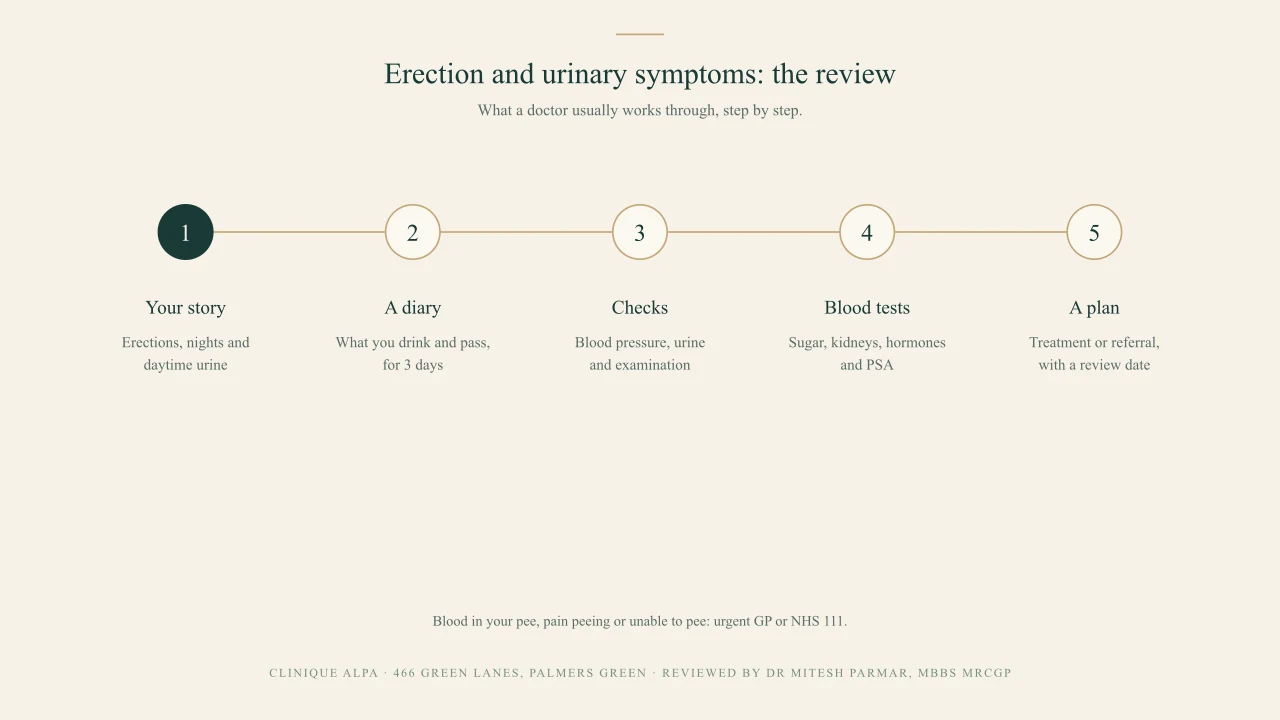
What I look at in clinic starts with the nights. How many times, at what hours, and how much is passed each time? The amount passed each time matters as much as the number of trips. I ask about the flow: whether it is slow to start, weak, interrupted, or leaves you feeling not quite empty. I ask about the day as well as the night, about thirst, about weight change, and about how you feel when you get up.
Then the erections: how they have changed, how reliable they are, and whether the difficulty is in getting or keeping them. I ask about medicines and supplements, alcohol, smoking, mood, sleep and stress, because the NHS lists several of these as causes and each is easy to overlook.
The NHS says you may be asked to keep a record, for at least 3 days, of what you drink and when and how much you pass. That small piece of homework is useful, and I would rather you start it before the appointment. A urine sample can be tested for infection or sugar. The examination covers blood pressure, the tummy and the genitals, with a prostate examination where your symptoms call for one. A chaperone is available whenever an intimate examination is needed, and I explain what I am going to do before I do it.
Blood tests are the other half of the review. In this situation I usually want glucose and HbA1c, a cholesterol profile, kidney function and a full blood count, and often thyroid function and hormone levels, because hormone problems are on the NHS list. The NHS notes a PSA blood test may be ordered for urinary symptoms. PSA can be raised for reasons other than cancer, so I talk through what a result can and cannot tell you before the test, not afterwards. Prices are on the blood test prices page, and the hormone side is covered in andropause and erectile dysfunction.
The plan then depends on what the results show. It might be treatment for something found, a change to a medicine, a referral to a urologist for tests such as a urine flow test or a bladder scan, or simply a review once the diary and bloods are in. I give a date to look again, so the symptoms do not drift.
From Dr Mitesh Parmar
I treat these two symptoms as a possible signal, not an embarrassment. I ask about thirst, weight and sleep, and check blood sugar and blood pressure, because diabetes and heart disease can show up this way. Prostate symptoms are another thing I look for. You do not need to know which problem it is before booking.
When do urinary symptoms need urgent help?
The NHS advice is to ask for an urgent GP appointment or contact NHS 111 if you notice blood in your pee, pain when you pee, or you cannot pee at all. Do not wait for a routine slot with any of these. Otherwise, make an appointment when you have trouble peeing or need to pee more often than usual. GPs are used to discussing these symptoms. High blood pressure can also sit behind erection problems, which I cover in erectile dysfunction and blood pressure.
Common questions
Why do I get up at night and have erection problems?
They can have separate causes or a shared one, such as diabetes or a medicine. A doctor can check both in the same visit with a history, an examination and blood tests.
Can frequent urination at night be a sign of something serious?
The NHS says urinary symptoms can sometimes be caused by more serious conditions, including prostate cancer, so they should be checked. Blood in the urine, pain on peeing or being unable to pee needs urgent help.
Which tests are used?
The NHS describes a urine test, a prostate examination, a diary of drinks and urine, and a PSA blood test. Other blood tests depend on your history.
How do we help at Clinique Alpa?
You can book online or call 020 8882 8088. A clinic consultation at 466 Green Lanes is 30 minutes with a doctor and costs £100. Tests are priced separately and we confirm the cost before you agree. With your consent a summary goes to your NHS GP. Fees are listed on appointments and fees.
More in this series: erectile problems
Drafted with AI assistance, clinically reviewed by Dr Mitesh Parmar, MBBS MRCGP, Principal GP and Clinical Director at Clinique Alpa, 466 Green Lanes, Palmers Green, London N13 5PA. This article is general information, not personal medical advice. In an emergency call 999. For NHS advice call 111 or visit nhs.uk.