
The collision is over and the bruises have faded, but the drive to work is not the same drive. The hands tighten on the wheel at the junction where nothing happened. The brake foot twitches when a car gets close behind. A passenger seat that used to be restful now feels like a place to brace.
Anxiety after car accident is one of the most understandable reactions there is, and also one of the least talked about. People often mention the neck first and the fear last, if at all. This page explains what is common, what a doctor looks for, and how it fits into an assessment alongside the physical injuries.
If you are at immediate risk of harming yourself or someone else, call 999 or go to A&E. For urgent mental health help, call NHS 111 and choose the mental health option, or call Samaritans free on 116 123, any hour.
Is anxiety after car accident normal?
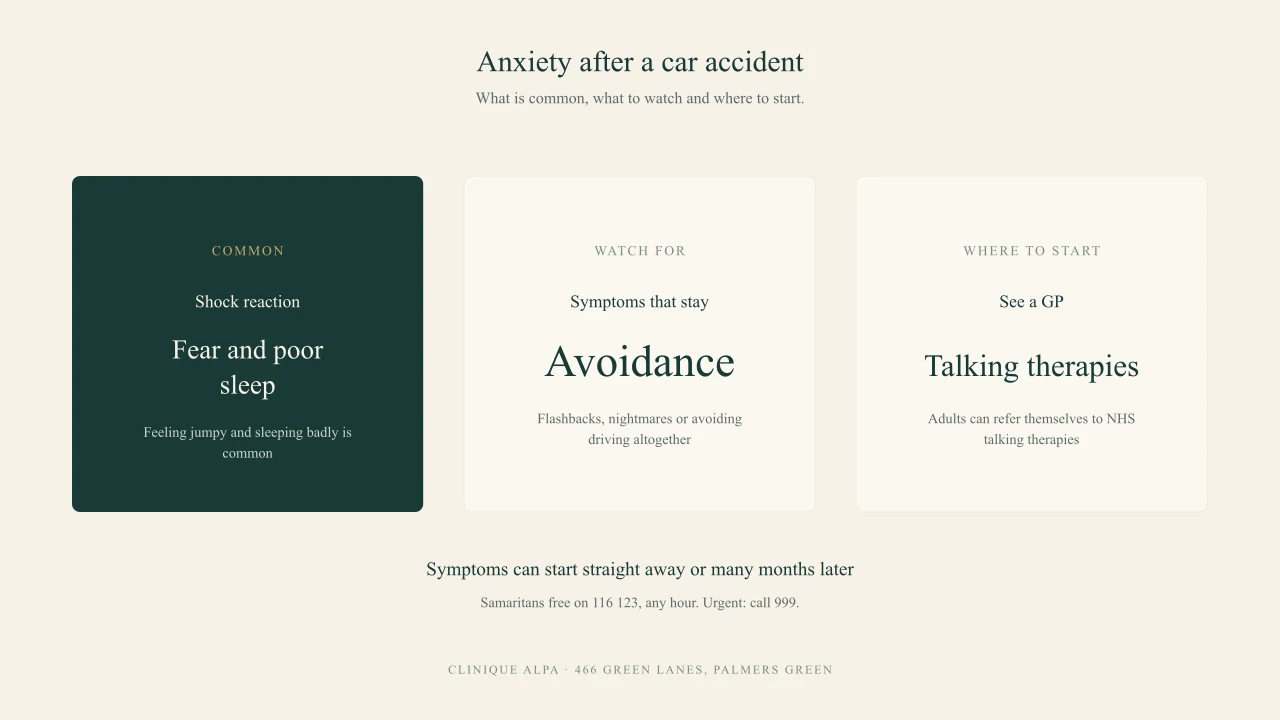
For most people, yes, at least for a while. Feeling jumpy, replaying the event, sleeping badly and wanting to avoid the road are a normal response to a frightening shock. In many people these reactions ease over the first weeks as the body settles and ordinary driving brings confidence back.
What I watch for is the opposite direction: reactions that stay the same or grow. The NHS describes post traumatic stress disorder as distressing thoughts about the event, which can come as flashbacks, intrusive images or nightmares, together with avoiding reminders, low mood or irritability, trouble sleeping, being constantly alert for danger and sometimes unexplained headaches or pain. It also says symptoms can begin straight after the event or many months, or even years, later. So the absence of fear in the first fortnight does not close the question.
What does driving anxiety look like?
It rarely announces itself as anxiety. It looks like taking a longer route to avoid a junction, giving up the motorway, asking someone else to drive, gripping the door as a passenger, checking the mirrors again and again, or a sudden surge of heart pounding and breathlessness when brakes squeal. Some people keep driving because they must and pay for it afterwards in exhaustion and a bad night. Others stop altogether, and the world gets smaller.
It tangles with the physical injury. Pain disturbs sleep, poor sleep sharpens anxiety, and anxiety makes muscles guard so that the neck and back hurt more. That loop is why I would never treat the neck and the fear as two separate visits. My own special interest is psychological medicine, and in practice the two are rarely apart.
What does a doctor look at?
What I look at in clinic starts with letting you set the pace. You do not have to relive the event in detail for me to understand it, and I will not push. I ask what the collision was like for you, in your own words, and then I ask about what has changed since: sleep, mood, concentration, nightmares, startling at noises, avoiding the road, panic, and how work and home life are going.
Timing matters. I ask when each symptom began relative to the collision, whether it is getting better, steady or worse, and what you were like before. A history of anxiety, low mood or earlier frightening events matters, not because it rules anything out, but because it changes the question from whether something has happened to what has been added. I ask about alcohol and any other substances used to cope, and about pain and sleep, because both feed the picture. I always ask about thoughts of harming yourself, and I ask plainly.
Then I weigh what I have heard. A normal shock reaction that is fading is one thing. Fear that has narrowed to driving, with otherwise good functioning, is another and is often very treatable. Low mood, a more general anxiety, or the cluster of intrusive memories, avoidance and heightened alertness described above point in other directions and call for more careful assessment. Brief questionnaires can help me track change over time. They support the conversation and do not replace it.
Where a formal psychiatric opinion is needed, the work is led by consultant psychiatrists. I explain what that involves in PTSD assessment and report after a traumatic event, and the clinic’s wider mental health work is on the psychiatry services page.
From Dr Mitesh Parmar
The accident itself, sleep, flashbacks and avoiding things matter to me, not only the driving. Fear after a collision is common and understandable. Help works best when it starts early, before avoidance becomes a habit. Thoughts of harming yourself need an immediate call to 999 or NHS 111.
What helps?
The NHS advice for anxiety is practical, and I agree with most of it. Talk to someone you trust. Keep regular sleep, activity and meals. Use calming breathing. Limit caffeine from coffee, tea, cola and energy drinks. Avoid alcohol, cigarettes and drugs as a way of coping. And do not avoid the things that frighten you: build up to them gradually.
For driving, gradual means a plan. Start as a passenger with someone you trust on a quiet road, then drive a short familiar route at a calm time, then lengthen it. A plan made in advance beats a test of nerve on a bad day. If fear persists, the NHS recommends talking therapies, and adults can refer themselves to NHS talking therapies without seeing a GP first. For post traumatic stress, the NHS lists trauma focused cognitive behavioural therapy and EMDR, a therapy using eye movements, among the treatments, agreed with a GP and mental health specialist. If you have been diagnosed and treatment is not helping, tell your GP or specialist.
When should you ask for help sooner?
- You have thoughts of harming yourself or ending your life: call 999, or NHS 111 and choose the mental health option, or Samaritans free on 116 123.
- Panic attacks are frequent or you cannot travel at all, even as a passenger.
- Flashbacks, nightmares or avoidance are taking over the day, or lasting for weeks.
- You are drinking more to cope, or mood is falling.
- Sleep has been poor for a long time and pain is rising with it.
For any of the last four, see a GP, or book an appointment with the clinic.
How do we approach this at Clinique Alpa?
A clinic consultation is 30 minutes at 466 Green Lanes, long enough to ask about the physical injury and the fear together. With your consent, a summary goes to your NHS GP, because this is private care alongside the NHS. Recovery from the physical side is covered in how long whiplash symptoms usually last.
Common questions
Does anxiety after car accident go away?
For most people it eases with time and a gradual return to driving. The NHS says most people with post traumatic stress improve, although some have longer lasting symptoms.
Can anxiety start months after a collision?
Yes. The NHS says post traumatic stress symptoms can begin straight away or many months later, so it is worth speaking to a doctor whenever they appear.
Sources: NHS: post traumatic stress disorder and NHS: generalised anxiety disorder.
This is an independent clinical opinion. It cannot be written to a required conclusion and does not guarantee the outcome of any claim, application, exemption or hearing.
All medico-legal assessments and expert reports are independent professional opinions. No particular diagnosis, conclusion, causation opinion, prognosis, consistency assessment, recommendation or outcome can be promised or guaranteed.
More in this series: after a road collision
- Delayed pain after car accident in the neck and back
- How long does whiplash last and what shapes recovery
- Headache and dizziness after a car accident
- Chest wall and rib pain after a car accident
Drafted with AI assistance, clinically reviewed by Dr Mitesh Parmar, MBBS MRCGP, Principal GP and Clinical Director at Clinique Alpa, 466 Green Lanes, Palmers Green, London N13 5PA. This article is general information, not personal medical advice. In an emergency call 999. For NHS advice call 111 or visit nhs.uk.