
The instruction arrives with a list of questions attached, and each one has to be answered in a document that a judge or a tribunal panel may read closely. For the person being assessed there is a second worry, quieter and more practical: what will I be asked, and will it stir things up before it settles them.
A psychological assessment for court is a structured medical interview, written up for a decision maker rather than for treatment. This page explains what it covers, how it differs from a clinic appointment and how independence is kept. It describes the process in general terms only.
If you are at immediate risk of harming yourself or someone else, call 999 or go to A&E. For urgent mental health help, call NHS 111 and choose the mental health option, or call Samaritans free on 116 123, any hour.
What is a psychological assessment for court?
The person who instructs the work, often a solicitor and sometimes the individual, sets out the questions the court needs help with. Typical ones are whether there is a mental health condition, how it affects daily functioning, whether it is linked to events in the case, what treatment would help and how long that might take, and whether it affects someone's ability to take part in proceedings. Not every instruction asks all of these, and a good doctor does not answer questions outside what they are qualified to say.
The word psychological is used loosely. Sometimes it means an assessment by a doctor with mental health training. Sometimes it means standardised testing by a clinical psychologist. I come back to that difference below, because choosing the wrong kind of expert is the commonest avoidable delay.
What does the doctor ask about in a psychological evaluation for court?
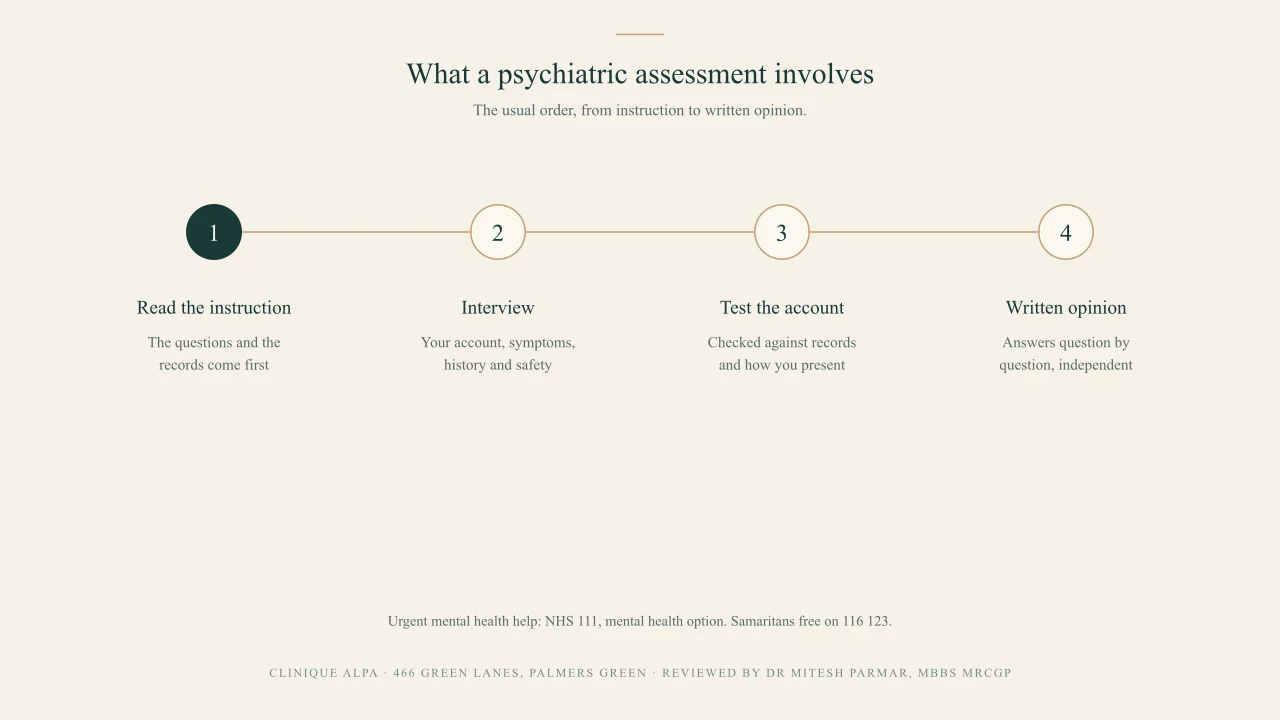
What I look at in clinic, and what any careful assessor looks at, begins before you arrive. The instruction and the records are read first, so that your time is spent on your account and not on reciting dates that are already on paper.
Then comes your account, at your pace. You are not asked to relive the worst moments in detail for the doctor to understand them. I ask what has been happening, how it has affected you, and what you were like before.
The NHS describes a mental health assessment as covering your mood, behaviour, health and family history as well as your symptoms, and that is the backbone of this one too. In practice the questions fall into a few groups:
- Current symptoms: mood, worry, sleep, appetite, energy, concentration, intrusive memories, avoidance, feeling constantly on guard.
- Effect on life: work, study, home, relationships, getting out of the house, managing money and paperwork.
- History: earlier mental health, any treatment and how it went, physical conditions, medicines, alcohol and other substances, and family background where it bears on the questions asked.
- Safety: I ask plainly about thoughts of self harm or harming others. If there is a concern, the person in front of me comes first and I act on it, whatever the report is for.
- Mental state: how you present during the interview, your speech, thinking, mood and understanding of your own situation.
Standardised questionnaires are sometimes used to measure severity. They support the interview and do not replace it.
The part people find most surprising is the independent stance. The doctor's duty is to the court, not to the side who pays. That means checking your account against the records and the way you present, and saying honestly where the evidence is thin, where something does not fit, and what further information would help. Done properly this protects you, because an opinion that has been tested is worth more than one that simply agrees.
From Dr Mitesh Parmar
Before meeting you, I read the instructions and records, so the time with you is not spent going over old ground. I explain the limits of confidentiality at the start. I cannot promise any particular conclusion, because my duty is to the court. If the interview leaves you distressed, say so, and we pause.
What does the report contain?
Reports follow a recognisable order. The instruction and the questions asked come first. Then the sources of information used, including the records seen and any that were not available. Then the history you gave, the findings from the interview, and finally the opinion, set out question by question.
The opinion deals with diagnosis if one is made, how the condition affects functioning, and, where the instruction asks for it, links to events and likely course. It also states plainly what could not be determined. Treatment recommendations are included when they help the decision maker, and the report ends with the doctor's declaration of their duty to the court.
A report is not a letter of support. It says what the doctor found, whichever way that falls. Reports are usually ready 48 to 72 hours after the assessment and once all records and instructions are in, and complex ones may need longer, which is stated at quotation.
Is a psychiatric assessment for court the same as psychological testing for court?
No, though the two can sit side by side. A psychiatric assessment is carried out by a doctor, who can diagnose, consider physical causes and comment on treatment including medicines. Psychological testing is usually carried out by a clinical psychologist and uses standardised measures, for example of memory or thinking, to answer specific questions.
Which one is needed depends on what the court is asking. If the question is about diagnosis and treatment, a doctor's assessment usually fits. If it is about thinking skills or a learning difficulty, specialist testing may be needed as well. Tell the instructing party before booking if you are unsure. The clinic's psychiatric report work is led by consultant psychiatrists, and we say honestly when a question needs a different kind of expert.
What if the assessment is distressing?
Some people find it hard, and that is allowed for. Breaks are normal and you can stop. An assessment for a report is not therapy, so it does not replace treatment, and it is worth thinking about support around it.
If you are struggling now, speak to a GP. The NHS says adults can refer themselves to NHS talking therapies for anxiety and depression without seeing a GP. If things feel unsafe, use the numbers at the top of this page.
How do we approach this at Clinique Alpa?
Contact the clinic and tell us the questions you have been given. We tell you honestly whether the route is a GP appointment or a consultant psychiatrist assessment, and the fee is confirmed before anything is booked. Psychiatric evidence for tribunals and other proceedings is prepared by our consultant psychiatrists; the wider picture is on the psychiatry services page and the medico legal report page.
If you are not sure where to start, a 30 minute clinic consultation is £100. A letter or summary is provided where clinically appropriate after assessment. For topic specific pages, see mental health evidence in asylum cases and psychiatric reports for a PIP tribunal.
Common questions
How long does a psychological assessment for court take?
It depends on the questions and the records, and complex instructions can need more than one sitting. The clinic confirms the scope and timescale before booking.
Is there a psychological evaluation for court near me?
Assessments arranged through the clinic take place in person in Palmers Green. Contact us with your instruction and we will tell you whether we are the right fit.
Can the doctor promise a particular finding?
No. The opinion is independent and is written from what the doctor finds, which is why the statements below matter.
Sources: NHS: post traumatic stress disorder and NHS: clinical depression overview.
This is an independent clinical opinion. It cannot be written to a required conclusion and does not guarantee the outcome of any claim, application, exemption or hearing.
All medico-legal assessments and expert reports are independent professional opinions. No particular diagnosis, conclusion, causation opinion, prognosis, consistency assessment, recommendation or outcome can be promised or guaranteed.
Drafted with AI assistance, clinically reviewed by Dr Mitesh Parmar, MBBS MRCGP, Principal GP and Clinical Director at Clinique Alpa, 466 Green Lanes, Palmers Green, London N13 5PA. This article is general information, not personal medical advice. In an emergency call 999. For NHS advice call 111 or visit nhs.uk.