
Someone has been going to therapy for a while, and now a third party wants to know how it is going. It might be a GP, an employer, an insurer, a solicitor or a tribunal. The request is polite and short, and it is surprisingly hard to answer, because progress in therapy is rarely a straight line.
A therapy progress report is the document that answers it. This page explains what such a report usually records, who reads it, and what you are entitled to decide about it. It is about the process in general, and it does not describe any one person's therapy.
If you are at immediate risk of harming yourself or someone else, call 999 or go to A&E. For urgent mental health help, call NHS 111 and choose the mental health option, or call Samaritans free on 116 123, any hour.
What is a therapy progress report?
It is a short written summary from the clinician delivering the therapy, or from a doctor reviewing it, of what has been done and what has changed. It is different from therapy notes. Notes are working records for the clinician. A progress report is written for a reader outside the room, so it leaves out most of what was said and keeps what that reader needs to know.
The usual readers are the person's own doctor, a funder or insurer deciding whether more sessions are justified, an employer thinking about adjustments, or a legal decision maker. Each wants something slightly different, which is why the first job is always to ask what the report is for.
What does a therapist progress report cover?
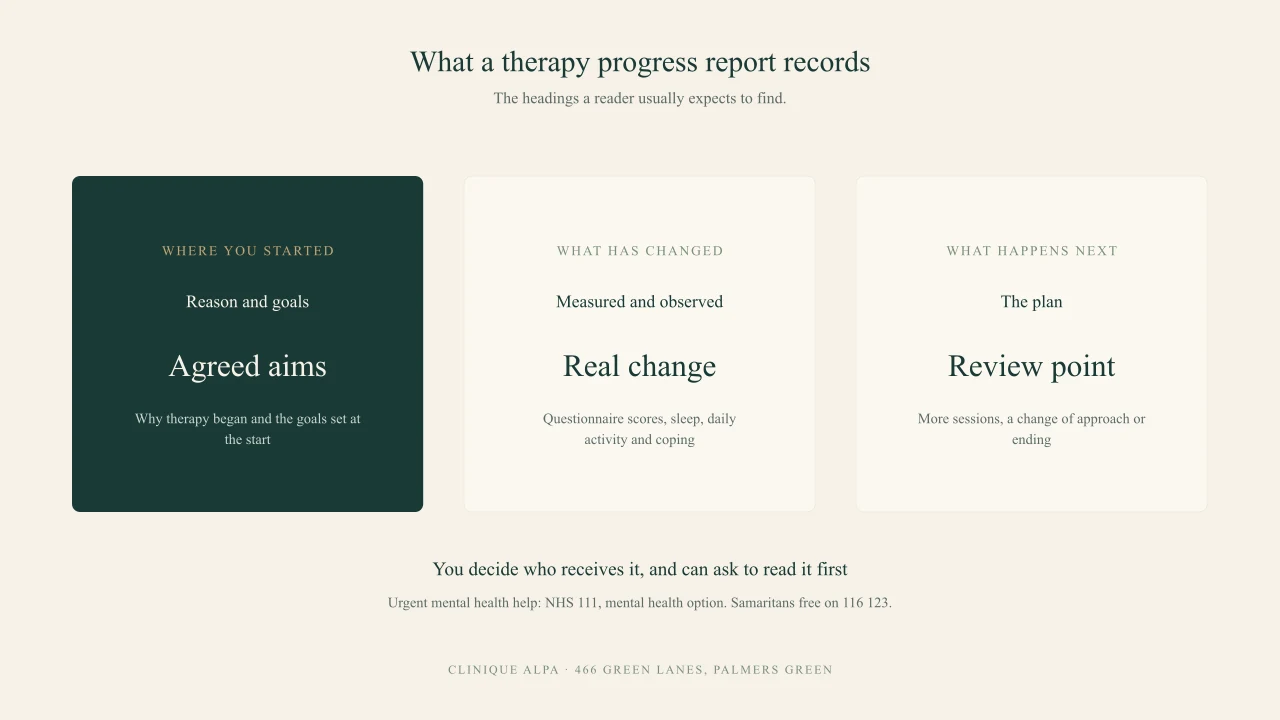
Templates vary, and some funders and employers supply their own form. The headings that turn up again and again are these:
- The reason therapy started, in a sentence or two, without personal detail beyond what the reader needs.
- The type of therapy and how many sessions have been attended, with any gaps and the reasons for them.
- The goals agreed at the start, and where each one stands now.
- Measured change, for example scores on routine mood or anxiety questionnaires repeated over time.
- Observed change: sleep, daily activity, work, relationships, and how the person copes when things go wrong.
- Risk, stated plainly and proportionately.
- What is getting in the way, such as practical barriers or a problem that therapy alone will not fix.
- The plan, meaning more sessions, a change of approach, a review point or ending.
Anyone asking for a therapy progress report template or example is usually looking for exactly this list. A good report is short. One page of specific statements beats four pages of general ones.
What I look at in clinic when I read one
When someone brings a report to me, or asks me to write about how treatment is going, I look for the same few things. First, whether the story the report tells matches the person in front of me. Second, whether the change described is large enough to matter in daily life and not just on a form. Third, whether the plan follows from what the report says.
The NHS lists several types of talking therapy, including guided self help, cognitive behavioural therapy and counselling, and sessions can be one to one, in a group, in person or by video. Course length depends on the approach. For depression, for example, the NHS gives 8 to 16 sessions for several talking therapies, including cognitive behavioural therapy, weekly or fortnightly. So a report written after a few sessions should say that it is early, and one written after a full course should say what has been achieved and what remains.
I also look for honesty about slow progress. Some people improve quickly. Others improve in one area and not another, or get worse for a while as difficult material is worked through. A report that says so is more useful to everyone than one that implies steady improvement, and it protects the person from being judged on a single bad week.
The last thing I check is the question of roles. A treating clinician describes treatment and progress. That is a different task from an independent expert opinion for proceedings, where the expert has a duty to the decision maker and has not been treating the person. Mixing the two roles causes trouble later. If a legal decision maker needs an independent view, say so early.
From Dr Mitesh Parmar
The report is only as good as the information behind it, so I rely on the therapist's notes and your own account. I describe what has been done, what has changed and what remains. I do not promise recovery or a conclusion. You should see what I say about you before it goes anywhere.
Who decides what goes into the report?
You do, to a large extent. A progress report contains personal information, and it should only be sent with your agreement, to the person you have agreed. It is reasonable to ask to read it first, to ask for something to be left out if it is not needed, and to ask what the reader will do with it.
If you are unhappy with something written about you, say so to the author. A factual error can be corrected. A difference of opinion can sometimes be noted.
How often should progress be reviewed?
There is no single rule. A short course has its own end point. A longer one is better reviewed at set points, agreed at the start, so that a report is easy to write when it is requested. If you are in treatment now and a report may be needed later, ask your therapist what they will measure and when.
When should you ask for help sooner?
A progress report is a look back. It is not a safety net. If you feel worse, if sleep or daily life is falling apart, or if you have thoughts of harming yourself, do not wait for a review point. Speak to a GP, use NHS 111 and choose the mental health option, call Samaritans free on 116 123, and call 999 if you are in immediate danger.
How do we approach this at Clinique Alpa?
If you are in treatment elsewhere and have been asked for a progress report, bring the request and the report to a GP appointment and we will go through it with you. A clinic consultation is 30 minutes for £100. With your consent, a summary can go to your NHS GP, and a letter or report is provided where clinically appropriate after assessment.
Where a legal question needs an independent psychiatric opinion, that work is led by consultant psychiatrists, and the fee is confirmed before anything is booked. I describe what that assessment involves in a psychological assessment for court, and the clinic's wider mental health work is on the psychiatry services page. If low mood is part of the picture, see seeing a private GP about low mood.
Common questions
What is a therapy progress report example used for?
It shows a reader the usual headings so that they can ask the right questions. It should never be copied word for word, because a report has to describe one person's real progress.
Can a therapist progress report be written after only a few sessions?
Yes, but it should say that treatment is at an early stage. Early reports describe what has been agreed and started, not results.
Does the report have to include everything discussed in therapy?
No. It should hold only what the reader needs, and you should agree who receives it.
Sources: NHS: talking therapies and NHS: treatment for depression.
This is an independent clinical opinion. It cannot be written to a required conclusion and does not guarantee the outcome of any claim, application, exemption or hearing.
Drafted with AI assistance, clinically reviewed by Dr Mitesh Parmar, MBBS MRCGP, Principal GP and Clinical Director at Clinique Alpa, 466 Green Lanes, Palmers Green, London N13 5PA. This article is general information, not personal medical advice. In an emergency call 999. For NHS advice call 111 or visit nhs.uk.