
By the second week the careful phase has worn off. The collision is a story you tell at work, but the neck still catches when you check a blind spot, and someone has asked whether you are not better yet. You were told it was only whiplash, and you were not told what that means for the calendar.
The honest answer to how long does whiplash last is a range, not a date. Most people recover in weeks to a few months, a minority take longer, and the doctor's job is to work out which group you are likely to be in and what would change that.
Chest pain, signs of a stroke, severe breathlessness, heavy bleeding, a severe allergic reaction or symptoms of sepsis need 999 or A&E immediately. For urgent advice that cannot wait, call NHS 111.
How long does whiplash last?
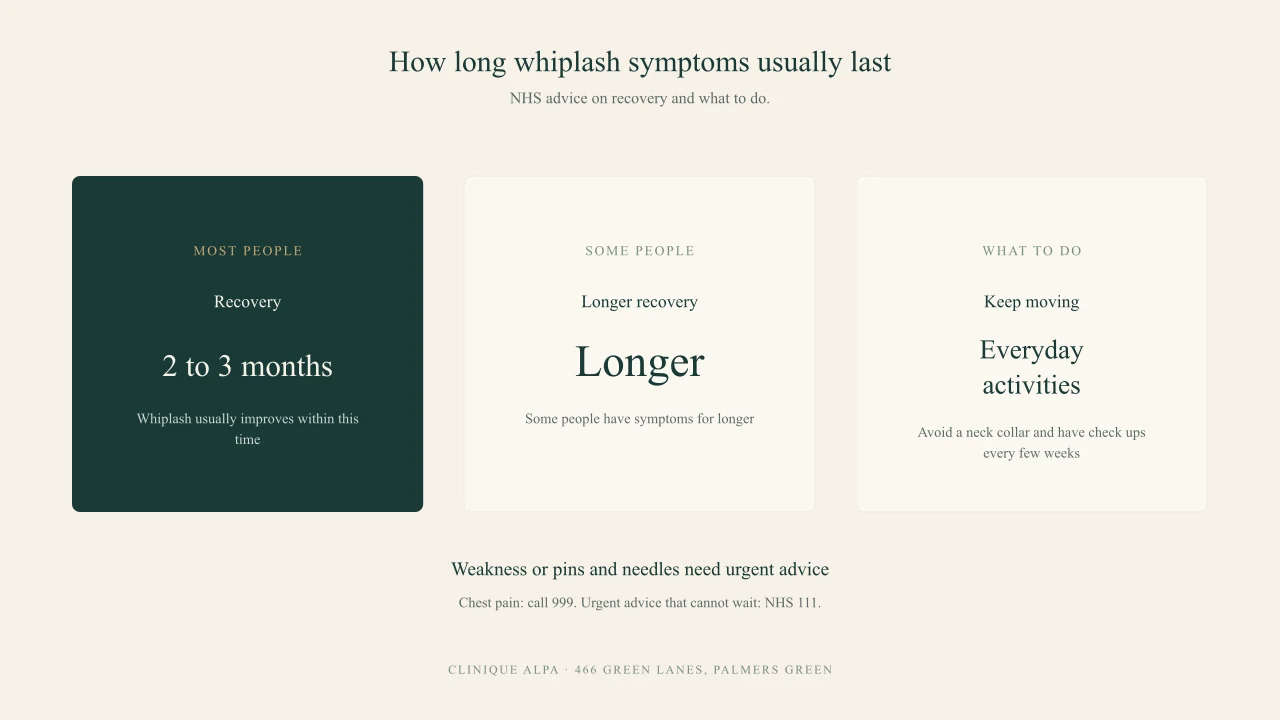
The NHS says whiplash usually improves within 2 to 3 months, though some people have symptoms for longer. That matches what I see. Stiffness and headaches tend to ease first. Pain with particular movements, such as turning in bed or reversing the car, often lingers longer. Recovery is rarely a straight line. A good week can be followed by a bad day after a long drive or a hard session at the desk, and that is not a relapse. It is the tissue telling you how much it can take.
The same range applies to injuries that look like whiplash after a fall or a sporting knock. The cause matters less than the extent of the strain and what you do next. If you want to understand why the pain arrived late in the first place, I have written that up in neck and back pain that starts days after a car accident.
How long does whiplash last in the neck compared with the shoulders and back?
Different areas recover at different speeds. The neck usually gives the clearest early improvement. Pain across the shoulders and upper back, which is often muscle holding tension on behalf of the neck, tends to follow it. The lower back sometimes lags, particularly in people whose work involves sitting, lifting or driving for long periods. Nerve symptoms, such as tingling into the arm, behave differently again and need their own assessment, which I cover in tingling in the arm after a car accident.
What shapes how long whiplash lasts?
I think about this as a small set of questions rather than a formula:
- How severe was the pain at the start, and is it settling?
- Is there arm or leg involvement, such as tingling or weakness?
- Was there a previous neck or back problem that has now flared?
- How demanding is your work, and have you been able to adjust it?
- How well are you sleeping, and how are you feeling about driving?
- Have you been able to keep moving, or has fear of pain made you stop?
The last two are easy to overlook. Poor sleep and worry make pain louder, and avoidance makes the neck stiffer, so a gentle plan for both belongs in the same conversation as the neck itself.
What does a doctor look at to estimate recovery?
What I look at in clinic is the trajectory, not a single reading. I ask how things were at the start, how they are now and what has made them better or worse. I like to see a pain diary if you have kept one, even a rough one. Then I examine: how far the neck turns and bends in each direction, which movements reproduce the pain, where the muscles are tight and tender, and whether strength, sensation and reflexes in the arms are normal. A normal neurological examination is reassuring, and a change in it is the main reason to look further.
The pattern matters more than the number. A pain score that falls from severe to moderate over a few weeks tells me more than any single day. If improvement has stalled, I ask why: is the neck being asked to do too much, too little or the wrong thing? That is when a targeted physiotherapy plan earns its place. The NHS advice is to keep doing everyday activities, to avoid a neck collar and to have check ups every few weeks, and in many areas you can refer yourself to NHS community musculoskeletal services without seeing a GP first.
I also keep a fixed point in mind: I would rather say that I do not know yet and set a review in 2 weeks than give a confident date that has not earned its confidence. A recovery estimate is a reasoned judgement that can be revised when new information arrives, such as a scan result or the response to treatment.
From Dr Mitesh Parmar
Neck movement and the nerves in the arms are what I test, and I note progress at each review rather than guess a date. Gentle movement generally does better than a collar. Stiffness that is easing is reassuring. Numbness, weakness in a limb or a severe headache after a collision needs NHS 111 or A&E.
When should you be seen sooner?
- Symptoms that have not improved after a week, or pain relief that is not working: see a GP.
- Severe pain despite pain relief, tingling or pins and needles, weakness in the hands, arms or legs, trouble walking or sitting upright, or a sudden electric shock feeling in the neck and back: get an urgent GP appointment or call NHS 111, and do not drive until you have spoken to someone.
- Chest pain, or back pain after a serious accident: call 999 or go to A&E.
What does a prognosis mean in a medico legal report?
When someone needs a report for a legal process, the doctor examines, reviews the records and then states a reasoned view on how the injury is likely to resolve, with the reasons. That may be full recovery within a stated period, partial recovery or a longer outlook, and it is based on the date of examination. It describes the injury and its course, not what the process will decide. I set out the duties that come with that role in the medico legal reports page.
How do we approach this at Clinique Alpa?
A clinic consultation is 30 minutes at 466 Green Lanes, with a doctor who has time to examine properly and to set a review date. With your consent, a summary goes to your NHS GP, because this is private care alongside the NHS.
Common questions
How long does whiplash last after a car accident?
Usually 2 to 3 months, according to the NHS, with some people taking longer. If you are not improving after a week, see a doctor.
How long does whiplash last after a fall?
The same range applies, because recovery depends on the extent of the strain. Get urgent advice for severe pain, tingling, weakness or trouble walking.
Sources: NHS: whiplash and NHS: back pain.
This is an independent clinical opinion. It cannot be written to a required conclusion and does not guarantee the outcome of any claim, application, exemption or hearing.
All medico-legal assessments and expert reports are independent professional opinions. No particular diagnosis, conclusion, causation opinion, prognosis, consistency assessment, recommendation or outcome can be promised or guaranteed.
More in this series: after a road collision
- Delayed pain after car accident in the neck and back
- Headache and dizziness after a car accident
- Chest wall and rib pain after a car accident
- Anxiety about driving after a car accident
Drafted with AI assistance, clinically reviewed by Dr Mitesh Parmar, MBBS MRCGP, Principal GP and Clinical Director at Clinique Alpa, 466 Green Lanes, Palmers Green, London N13 5PA. This article is general information, not personal medical advice. In an emergency call 999. For NHS advice call 111 or visit nhs.uk.