
Most people arrive with the same three questions. What will I be asked? Will it hurt? And what happens to what I say? A personal injury medical examination is more ordinary than people fear, and knowing the steps takes most of the dread out of it.
The question is a plain one: what does the examination and report for an injury consist of, from the moment it is arranged to the moment you read the finished document? This is the personal injury medical examination, step by step.
Chest pain, signs of a stroke, severe breathlessness, heavy bleeding, a severe allergic reaction or symptoms of sepsis need 999 or A&E immediately. For urgent advice that cannot wait, call NHS 111.
What happens before a personal injury medical examination?
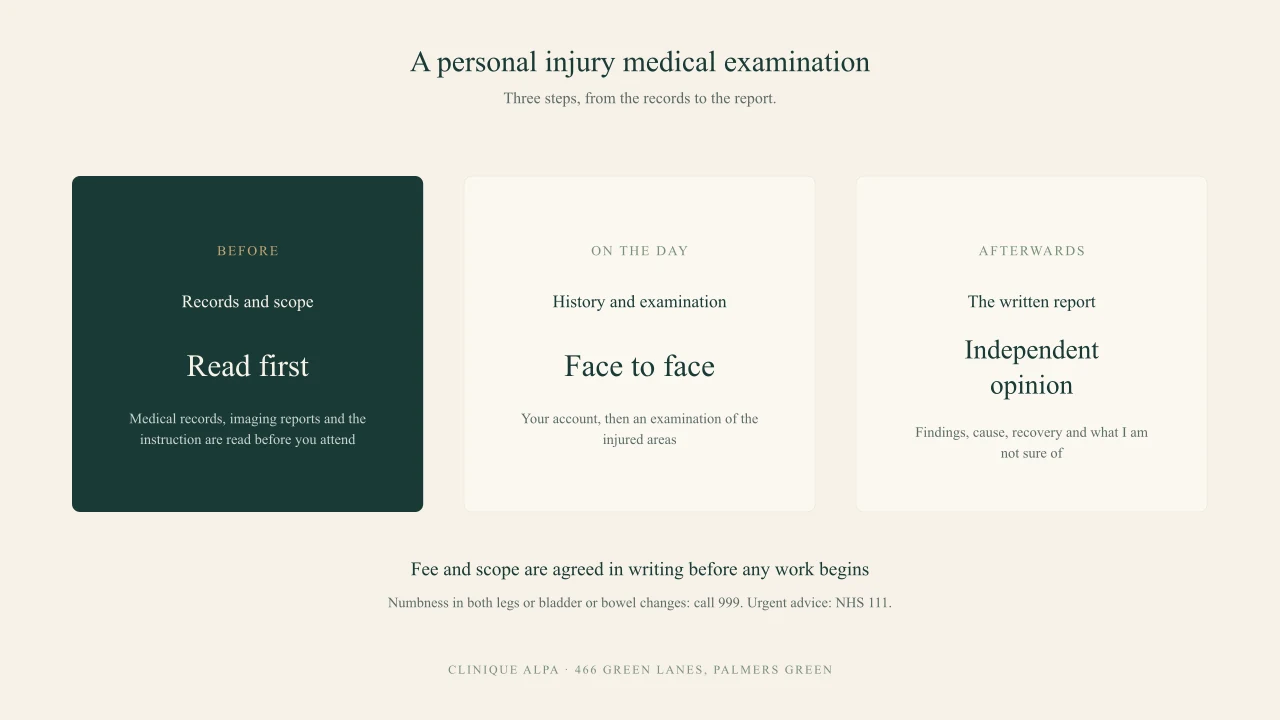
Three things, none of which involve you at first.
The scope is set. Someone, often a solicitor, but sometimes an individual, tells me what the report needs to address. Cause, current condition, recovery, and how the injury affects daily life and work are the usual questions. I confirm what I can and cannot cover, the fee and the timescale, in writing, before work begins.
The records are gathered. GP notes, hospital attendance records, physiotherapy entries, imaging reports and anything that records the injury soon after it happened. I read them before I see you, not afterwards. The pattern matters more than the single entry, and the earlier entries matter as much as the later ones.
You are told what to bring. A list of medicines, any scans or reports in your possession, the names of the people who treated you, and a note of the dates you remember. A short written timeline helps. It does not have to be neat.
What do I look at in the examination itself?
Start with the account. I ask you to tell the story in your own words, and I try not to interrupt. What happened, when, and in what order the symptoms appeared. Delayed symptoms are common. The NHS notes that whiplash symptoms can take several hours to appear, and I record when each began, not when you first mentioned it to someone.
Then the detail. Where the pain is, what it feels like, what makes it better or worse, how you sleep, how you manage at work and at home, and which things you have stopped doing. I ask about earlier injuries and conditions to the same area, because the report must separate what was there from what is new. I ask about treatment: what you were offered, what you tried, and what helped.
Then the examination, aimed at the areas that were injured. For a neck I look at posture and movement and test the nerves to the arms. For a back I look at movement, test strength and sensation in the legs and check reflexes. For a limb I compare with the other side. I measure what can be measured. I record what I see, not what I expect to see, and I keep it separate from what you tell me.
I also ask about the effects on mood, sleep and confidence, because injuries have those too. I note them. If something needs a different specialist, such as a psychiatrist, I say so and do not guess.
Throughout, a chaperone is available whenever an intimate or physical examination is needed, and you can stop at any point.
From Dr Mitesh Parmar
I explain at the start that my duty is to the court, not to either side. I take the history in your own words, then examine only what is relevant. Tell me about the bad days as well as the good. I cannot promise an outcome, because that is for others to decide.
What happens after the examination?
I write the report. It sets out who I am and what I was asked, the records I read, your account, my findings, and then the opinion: what I think caused the problem, how it has affected you, and what I expect from here. Where I cannot be sure, I say so. Where the evidence stops, I say that too.
The NHS says that whiplash usually gets better within 2 to 3 months, though some people have symptoms for longer. That is the kind of external reference point a prognosis should be set beside, and I explain how far your situation matches it and where it differs.
Sometimes the honest recommendation is a further step: an MRI scan, physiotherapy, or an opinion from an orthopaedic specialist. I say what each would settle and why it matters. A report that recommends a next step is not a weaker report.
Reports are usually ready 48 to 72 hours after the assessment and after all records and instructions are in. Complex reports may need longer, and I say that when I quote.
Is there a sample personal injury medical report?
The shape is consistent, though the content is yours. A personal injury medical report usually includes:
- Who instructed it and what questions it answers.
- The documents read.
- Your account of the event and of the symptoms since.
- The examination findings.
- An opinion on cause, current condition and likely recovery.
- Any recommendations for treatment or further opinions.
- A statement that the opinion is independent.
You will see the same sections whichever injury is involved. What differs is the depth in each, and I would rather give you the structure than a sample that could be mistaken for your own report.
When should you not wait for the examination?
Treat the injury first. The NHS advises calling 999 for back pain with pain, tingling, weakness or numbness in both legs, loss of feeling around the genitals or anus, bladder or bowel changes, chest pain, or pain that started after a serious accident. Urgent help from a GP or NHS 111 is advised for severe pain despite painkillers, pins and needles, weakness in the hands, arms or legs, or difficulty walking.
A report records an injury. It does not replace seeing a doctor about it.
Common questions
What does a personal injury medical assessment involve?
A review of your records, a history, an examination of the injured areas and a written independent opinion. The steps above describe each in turn.
Is a personal injury claim medical report written to support my side?
No. It is an independent opinion and cannot be written to a required conclusion. It records what the evidence shows, including what does not help your position.
How long does a personal injury medical examination take?
The appointment is long enough to take a proper history and examine the injured areas; I give you an estimate when we agree the scope. The report follows after the records are in.
How do we approach this at Clinique Alpa?
You see Dr Parmar at Palmers Green, or at home where attending the clinic is difficult. Direct instructions are welcome from solicitors and individuals, and I confirm the scope, fee and timescale before I start. Personal injury medico legal work is £250 per hour, with a written estimate agreed first.
For the duty an expert owes to the court, see what a medico legal report is. For fees, see medical report fees. If you need a doctor for the injury itself first, a clinic appointment is the quicker route.
This is an independent clinical opinion. It cannot be written to a required conclusion and does not guarantee the outcome of any claim, application, exemption or hearing.
All medico-legal assessments and expert reports are independent professional opinions. No particular diagnosis, conclusion, causation opinion, prognosis, consistency assessment, recommendation or outcome can be promised or guaranteed.
Drafted with AI assistance, clinically reviewed by Dr Mitesh Parmar, MBBS MRCGP, Principal GP and Clinical Director at Clinique Alpa, 466 Green Lanes, Palmers Green, London N13 5PA. This article is general information, not personal medical advice. In an emergency call 999. For NHS advice call 111 or visit nhs.uk.