
Most people step out of a collision feeling shaken but unhurt. They swap details, ring the insurer, get home and tell themselves they were lucky. Then the neck stiffens overnight, or the lower back begins to ache while they are making dinner, and the luck feels less certain.
That pattern, delayed pain after car accident, is one of the commonest things I am asked about, even after a low speed bump. It has a straightforward explanation, with a few exceptions that matter, and this page sets out both. The question underneath is usually simple: is this normal, and is it serious?
Chest pain, signs of a stroke, severe breathlessness, heavy bleeding, a severe allergic reaction or symptoms of sepsis need 999 or A&E immediately. For urgent advice that cannot wait, call NHS 111.
Why does delayed pain after car accident happen?
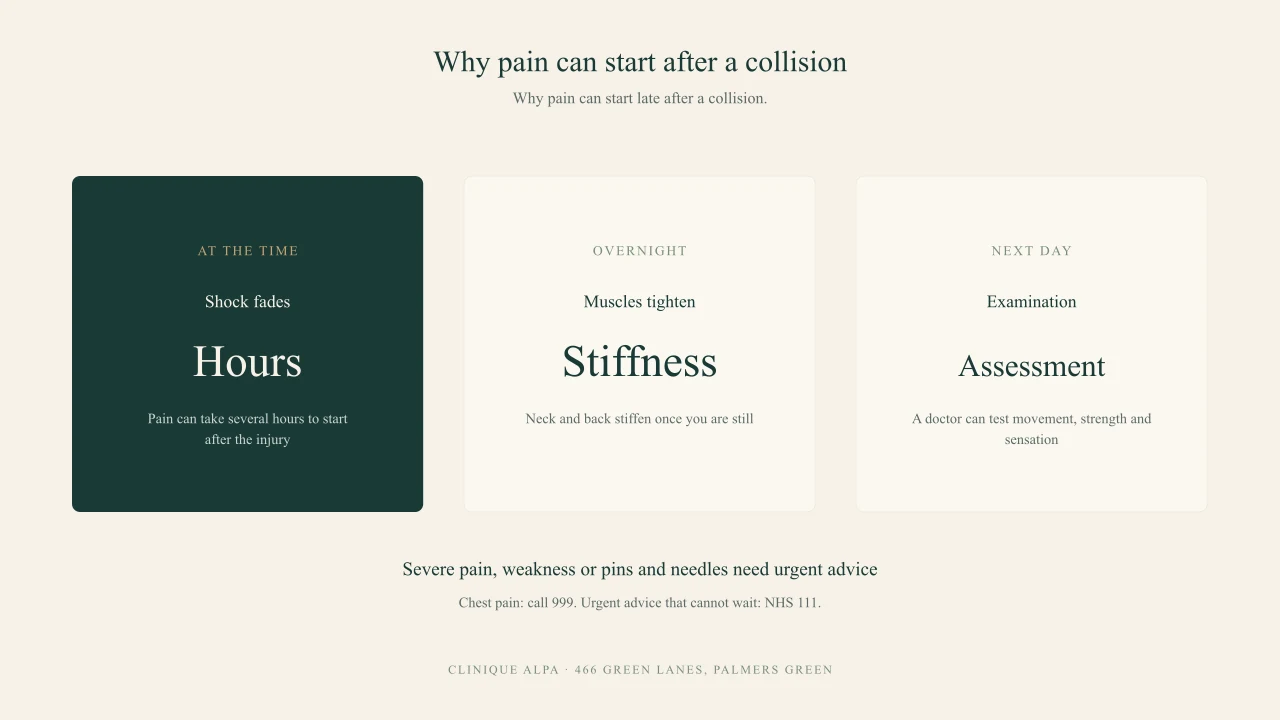
The short version is that the body does not report an injury until it is safe to. At the roadside, adrenaline and shock dull pain and narrow attention to the practical business of the next ten minutes. Once that settles, the muscles, ligaments and joints that were stretched in a fraction of a second begin to swell and guard. Guarding means the muscles tighten around the strained area to protect it, and that tightness is what makes the neck feel locked the next morning.
The NHS describes the same pattern for whiplash: symptoms can take several hours to start. In my experience they sometimes take longer than that, particularly for the back, because lying flat overnight and then getting up stiffens everything at once.
A second point surprises people. The damage to the car is a poor guide to the strain on the person inside it. A bumper that looks barely marked can still have moved the occupant sharply, especially if the head was turned or the body unprepared. Seat position, head restraint height and whether you saw the impact coming all change how the neck and back take the load. That is why I do not dismiss pain simply because the collision was slow.
Delayed neck and shoulder pain after car accident
This is the classic late arrival. Neck pain and stiffness, trouble turning the head, headaches and aching across the shoulders are the usual pattern. The seat belt can add a band of bruising and tenderness across one shoulder and the chest wall. These symptoms are part of what is called whiplash, which can follow a collision, a fall or a sporting injury. I cover recovery times in how long whiplash symptoms usually last, and headaches and dizziness in their own page.
Delayed chest pain after car accident
Chest pain is the one I never treat as routine. Bruising from the seat belt and strained rib muscles are the common causes, but chest pain after a serious collision can also come from the lungs, the heart or organs under the lower ribs. NHS advice is to call 999 or go to A&E for chest pain that follows a serious accident, and not to drive yourself. If you are reading this because chest pain has appeared, that is the route, not a booked appointment. The longer story of ribs and chest wall is in chest wall and rib pain after a car accident.
Delayed leg pain after car accident
Leg pain that appears after a collision often starts in the back. A strained or irritated nerve in the lower spine can send pain, tingling or numbness down the leg, sometimes with little back pain at all. A bruise from the dashboard or the seat is the other common cause, and a doctor tells the two apart by examining the leg and the back together. Pain, numbness or weakness in both legs is not something to wait on, and I explain why in back pain and sciatica after a car accident.
What does a doctor look at when pain starts late?
What I look at in clinic begins with the sequence of events, because the order tells me a lot. I ask what happened, which way you were facing, what you felt at the time and when each symptom first appeared. I ask what pain relief you have used and whether you have been seen anywhere else. Then I ask what you have stopped doing since: driving, lifting, sleeping on one side, the gym. Function is often a truer measure than a pain score.
Next I ask about the quiet history: earlier neck or back trouble, previous injuries, other conditions, work and home demands. A previous problem does not rule out a new injury. It changes the question from whether something happened to what has changed.
The examination is aimed at the neck, shoulders, spine and any area that hurts. I watch how you move before I touch anything, then test the range of movement, feel for tender and tight muscle, and check strength, sensation and reflexes in the arms and legs. If an arm or leg is involved I test for nerve irritation with simple manoeuvres. Blood pressure and pulse matter too, because pain raises both.
Most late onset pain turns out to be soft tissue strain, which improves with time, movement and sometimes physiotherapy. The part people miss is the second layer. Poor sleep, worry about driving and time off work all feed back into pain, and a good assessment notices them. If something suggests more than strain, such as weakness, a stepwise change in the spine or symptoms that are getting worse rather than settling, I say so plainly and arrange the right scan or specialist opinion.
From Dr Mitesh Parmar
Delayed pain is common, because muscle and ligament stiffness can build over a day or two. I examine the neck, spine and limbs, checking nerves and reflexes. I also note when the pain began, which matters for any later report. Weakness, numbness, bladder or bowel changes, or chest pain after a collision needs A&E.
When should you not wait?
Pain after a collision is not always a reason to wait and see. Get urgent help in these situations:
- Back pain after a serious accident, or chest pain: call 999 or go to A&E.
- Pain, numbness or weakness in both legs, numbness around the genitals or bottom, or any change in bladder or bowel control: call 999 or go to A&E.
- Severe neck pain despite pain relief, tingling or pins and needles, weakness in the hands, arms or legs, trouble walking or sitting upright, or a sudden electric shock feeling in the neck or back: get an urgent GP appointment or call NHS 111, and do not drive until you have spoken to someone.
- Pain that has not improved after a week, or that you are worried about: see a GP.
Do not drive yourself to A&E. Ask someone to take you or call an ambulance, and bring your medicines.
How do we approach this at Clinique Alpa?
A clinic consultation at 466 Green Lanes is 30 minutes with a doctor who has the time to take the full sequence of events. If the purpose is a written medical opinion for a legal process, the same examination is recorded in a medico legal report, and I explain how that differs from ordinary care on the medico legal reports page. Either way, a summary can go to your NHS GP with your consent, because this is private care alongside the NHS.
Common questions
Is delayed soreness after car accident normal?
Yes, it is common for muscles to ache and stiffen a day or so after the impact as shock fades. It is still worth being examined if it is severe, spreading or accompanied by any warning sign above.
Can delayed shoulder pain after car accident be the seat belt?
Often, yes. The belt can bruise and strain the shoulder and chest wall, but a doctor should rule out a shoulder or rib injury if movement is limited or pain is sharp.
Sources: NHS: whiplash, NHS: back pain and NHS: broken or bruised ribs.
This is an independent clinical opinion. It cannot be written to a required conclusion and does not guarantee the outcome of any claim, application, exemption or hearing.
All medico-legal assessments and expert reports are independent professional opinions. No particular diagnosis, conclusion, causation opinion, prognosis, consistency assessment, recommendation or outcome can be promised or guaranteed.
More in this series: after a road collision
- How long does whiplash last and what shapes recovery
- Headache and dizziness after a car accident
- Chest wall and rib pain after a car accident
- Anxiety about driving after a car accident
Drafted with AI assistance, clinically reviewed by Dr Mitesh Parmar, MBBS MRCGP, Principal GP and Clinical Director at Clinique Alpa, 466 Green Lanes, Palmers Green, London N13 5PA. This article is general information, not personal medical advice. In an emergency call 999. For NHS advice call 111 or visit nhs.uk.