
The dose has just gone up, and the next question is how long to wait before judging it. Is that heaviness in the head a side effect or the old low mood? Is the better morning a sign of something, or a good day? People leave the appointment with a plan and a lot of small uncertainties.
A depression review is the follow up that deals with those uncertainties. This page explains what usually happens at one, what to expect in the weeks after a change to your treatment, and when not to wait for the next appointment.
If you are at immediate risk of harming yourself or someone else, call 999 or go to A&E. For urgent mental health help, call NHS 111 and choose the mental health option, or call Samaritans free on 116 123, any hour.
What happens at a depression review with a GP?
A review is a structured conversation about what has changed since the last time. The same questions are asked each time, so that change can be seen, and that is one reason a review works better when the same doctor does it.
What I look at in clinic starts with your own sense of how things are, in your words, before any scores. Then I ask about the specific things that low mood changes:
- Mood across the day, and whether the worst times have shifted.
- Interest and enjoyment, and whether small things are becoming possible again.
- Sleep, appetite and energy, including early waking.
- Concentration, and how work or home life is going.
- Worry and tension, because anxiety often travels with depression, as the NHS notes.
- Side effects, and when in the day they come.
- Alcohol, caffeine and any other medicines or supplements, because they can affect both mood and the treatment.
- Thoughts of harming yourself or feeling life is not worth living. I ask this plainly at every review. It is routine, not a sign that I am worried.
Where it helps, I use a brief questionnaire to put numbers against the conversation. The numbers are there to track direction, not to define you. Small changes in sleep or in how much effort mornings take often show before a score moves.
I also check physical things where they matter. The NHS notes that some of these medicines can raise blood pressure, for example, so a reading may be taken, and I ask about weight and appetite changes. If tiredness is a big part of the picture, I ask whether blood tests have been done recently, because other conditions can mimic or deepen low mood.
How soon should you expect to feel a difference?
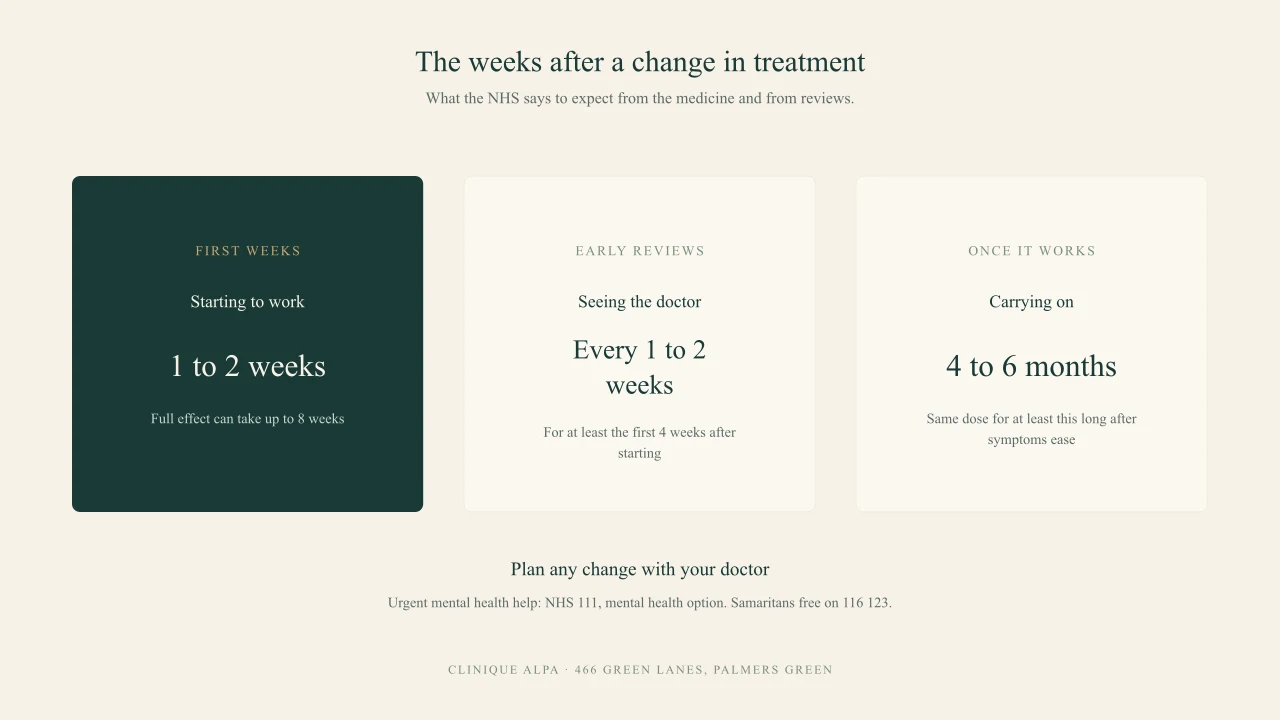
Slowly, and rarely in a straight line. The NHS says these medicines usually take 1 to 2 weeks to begin working and up to 8 weeks to take full effect, and that many side effects fade after a couple of weeks. It also says symptoms should start to improve within about 4 weeks of starting. After a dose is raised, there is often a fresh settling in period.
The NHS describes reviews every 1 to 2 weeks for at least the first 4 weeks after starting a medicine, with appointments arranged as needed afterwards. The page does not set out a timetable for reviews after a dose change, so ask your doctor when you will be seen. I give a specific window before you leave the room, such as 2 weeks or 4 weeks, rather than saying come back if it is no better.
From Dr Mitesh Parmar
I ask about sleep, appetite, energy and enjoyment, and I ask directly about dark thoughts, because people rarely volunteer them. Please do not judge a change in the first few days. If you ever feel you might harm yourself, call 999 or NHS 111 and choose the mental health option, or go to A&E.
What if the change has not helped?
There are several possible next steps. The dose may need more time. A different medicine may suit you better, since the NHS says people respond differently and some need to try more than one. Talking therapy can be added, and for moderate to severe depression the NHS says medicine and talking therapy together often work better than either alone. If several approaches have not helped, a specialist opinion is the next route.
Please agree any change with your doctor at a review rather than making it yourself, and say so plainly if you are thinking of stopping. The NHS says not to stop suddenly, and that a doctor can help you reduce gradually.
How long does treatment usually continue?
The NHS says that when the medicine is working you usually continue the same dose for at least 4 to 6 months after symptoms ease, and that people who have had depression before may need longer term treatment with reviews at least twice a year. A review is also the place to ask what ending would look like, long before it happens.
When should you ask for help sooner?
- You have thoughts of harming yourself or ending your life. The NHS says to contact a GP straight away if feelings of hopelessness or suicidal thoughts start or get worse after starting treatment. If you are in danger, call 999, or use NHS 111 and the mental health option, or Samaritans free on 116 123.
- Side effects are hard to live with.
- You feel agitated, much more anxious or unable to sleep after a change.
- Mood is falling rather than lifting.
The NHS notes that younger people, and anyone who has had these thoughts before, may be at higher risk early in treatment, so ask family or a friend to check in.
How do we approach this at Clinique Alpa?
A clinic consultation is 30 minutes with a named doctor at 466 Green Lanes, for £100. That is long enough to review mood, sleep, side effects and the plan together. With your consent, a summary goes to your NHS GP, because private care here works alongside the NHS. If you want to read about starting with us, see seeing a private GP about low mood, and for the wider mental health service the psychiatry services page. Book through clinic appointments.
Common questions
Is a depression review the same as a medicine check?
They overlap. A depression review looks at mood, sleep, function and risk as well as the medicine and its side effects.
How often should a depression review happen?
The NHS describes reviews every 1 to 2 weeks for at least the first 4 weeks after starting, then as needed, and at least twice a year for those on longer term treatment.
Can I have a depression review without my usual GP?
Yes, and with your consent a summary can go to your NHS GP so everyone has the same picture.
Sources: NHS: treatment for depression and NHS: medicines for depression.
Drafted with AI assistance, clinically reviewed by Dr Mitesh Parmar, MBBS MRCGP, Principal GP and Clinical Director at Clinique Alpa, 466 Green Lanes, Palmers Green, London N13 5PA. This article is general information, not personal medical advice. In an emergency call 999. For NHS advice call 111 or visit nhs.uk.