
The hands are fine until the name is called. Then the paper starts to rattle, the mouth goes dry, the voice thins out and sweat arrives from nowhere. By the time the first sentence is out, it feels as though everyone in the room is watching the shake rather than listening to the words. Afterwards, the replay starts.
These performance anxiety symptoms are common, physical and frightening, and they are easy to mistake for a weakness of character. They are not. This page explains what is happening in the body, how a doctor looks at it, and what helps.
If you are at immediate risk of harming yourself or someone else, call 999 or go to A&E. For urgent mental health help, call NHS 111 and choose the mental health option, or call Samaritans free on 116 123, any hour.
What are the physical signs of performance anxiety?
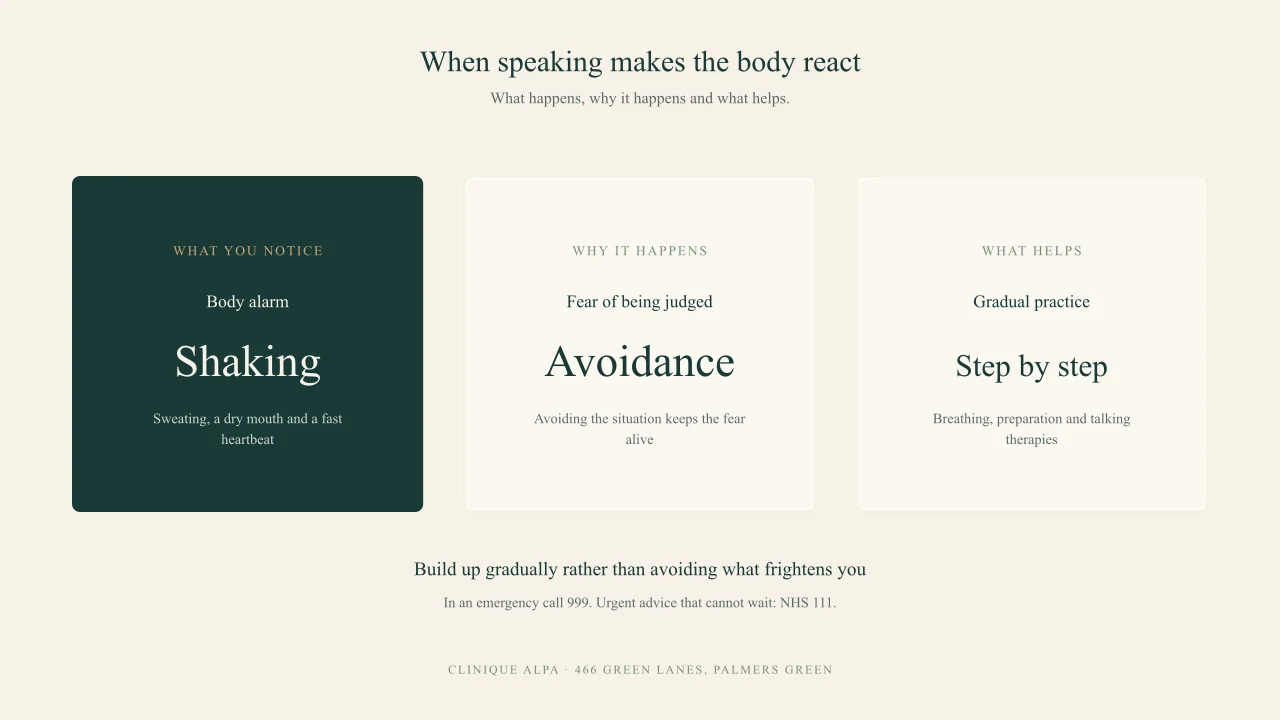
The NHS lists the body symptoms of anxiety as shakiness, increased sweating, a dry mouth, tingling, a heartbeat that feels faster or stronger, shortness of breath and dizziness. Most people who struggle with speaking or being watched recognise the list at once. They also describe a voice that shakes or dries up, a blank mind and tight muscles in the throat and shoulders.
Underneath it all is the same alarm response that sits behind other anxiety. Adrenaline speeds the body up to meet a threat. The threat here is not a physical danger. It is being judged. The body cannot tell the difference, so the hands shake and the sweat arrives all the same.
Why does anxiety in social situations cause shaking and sweating?
Because the fear is of being seen. Once you notice that your hands are shaking, you become more worried that others will notice, which drives the adrenaline higher and makes the shaking worse. Each bad experience then teaches the body to expect the next one. The fear starts earlier, sometimes days beforehand, and shows up in more situations.
Avoidance is what keeps it alive. If you skip the presentation, the relief is immediate and the lesson the brain draws is that the situation really was dangerous. The NHS advice is the reverse: do not avoid the situations that make you anxious, and build up to them gradually. That is simple to say and hard to do, which is why a plan helps.
It also helps to know that performance anxiety sits on a spectrum. At one end is the nervousness almost everyone feels before something that matters. At the other end is a pattern where fear is out of proportion, appears in many situations, and begins to run the choices you make. Wherever you sit on that spectrum, the symptoms are real and worth taking seriously.
What does a doctor look at with shaking and sweating?
What I look at in clinic starts with the pattern. When does it happen, and when does it not? If the shaking only appears when you are being watched, that points one way. If it is there at rest, during the day, or at night, I look for other explanations first.
So I ask about the ordinary things that cause a tremor and sweating. Coffee, tea, cola and energy drinks are the commonest. Then nicotine, alcohol, sleep, other substances, and any medicines or supplements. I ask whether you have lost weight, felt unusually hot, or noticed a racing heart when you are calm. Where the history suggests something physical, such as a thyroid problem, I arrange blood tests. I examine: pulse, blood pressure, oxygen level, a look at the hands, and a listen to the heart and lungs.
I ask about the history of the fear. Has it always been there, or did it begin at a particular time? Has it spread? Is it about speaking, eating in front of others, meeting new people or being examined? Has it cost you anything: a course, a promotion, an invitation turned down?
I ask what you have tried, including things that help only for a moment, such as a drink beforehand. The NHS advises against using alcohol, cigarettes, gambling or drugs to cope with anxiety, and I ask because they can make the next time harder.
I ask about mood and sleep, because low mood and long term worry are often alongside. And I ask what you want. Some people want help to get through one event. Others want the fear to stop deciding what they do. The answer shapes the plan.
From Dr Mitesh Parmar
What you are afraid will happen, and how long it has been going on, is where I begin. The physical symptoms are real, and there are practical steps beyond avoiding the situation. I also check for other causes, such as thyroid trouble or caffeine. Thoughts of harming yourself need a call to 999 or NHS 111.
Is performance anxiety occasional or long term?
It can be either. For some people it is tied to one event, such as an important talk, and it passes once the event does. For others it is a long standing pattern that has been there for as long as they can remember, appears daily, and is worse at some stages of life. The NHS says to see a GP if anxiety is affecting your daily life, if what you are trying yourself is not helping, or if you are struggling to cope. If it has been present for a long time and has never been looked at, that is a good reason to ask.
What helps?
The NHS describes several steps, and they work well together:
- Practise calming breathing and relaxation regularly, not only when the fear arrives.
- Prepare and rehearse in small steps, in front of one person first, then a few.
- Cut back on caffeine, which adds to shaking and a racing heart.
- Keep up regular exercise, sleep and meals.
- Avoid using alcohol to settle your nerves.
- Keep a short diary of when it happens, to spot patterns.
- Think about the problem as you would if a friend were facing it.
For persistent anxiety, the NHS describes cognitive behavioural therapy as usually the first choice of talking therapy, and says adults can refer themselves to NHS talking therapies without seeing a GP. Treatment options can also be discussed with a doctor where they fit, and I will explain the choices and the trade offs before anything is agreed. Medicines are not the first step and are never the whole plan.
One practical point. Many people try to hide the shaking, and hiding it takes effort and keeps attention on the body. It often helps to say out loud, early on, that you are nervous. It rarely lands the way you fear.
When should you ask for help sooner?
- If you are at immediate risk of harming yourself, call 999. For urgent mental health help, call NHS 111 and choose the mental health option, or Samaritans free on 116 123.
- If you are unsure whether shortness of breath or chest pain is anxiety, get it checked, and call 999 for chest pain or severe breathlessness.
- If the fear is making you avoid study, work or friendships.
- If you are drinking before events to cope.
- If low mood or panic is spreading beyond speaking situations.
How do we approach this at Clinique Alpa?
A clinic consultation is 30 minutes at 466 Green Lanes, long enough to look at the pattern, examine, arrange any blood tests that are needed and agree a plan with a follow up. If the problem is mostly about anxiety and no examination is needed, a video consultation is another option. For a wider look at the topic, see the guide to anxiety and panic attacks. With your consent, a summary goes to your NHS GP.
Common questions
Is shaking when speaking in public normal?
It is very common. The body responds to being watched as if to a threat, so shaking, sweating and a dry mouth are expected. If it is stopping you doing things you want to do, it is worth getting help.
Can performance anxiety be treated?
Yes. Gradual practice, breathing, and talking therapies such as cognitive behavioural therapy are the usual starting points described by the NHS.
How do I stop my voice shaking when I speak?
Slow your breathing, pause between sentences, and rehearse in small groups first. Reducing caffeine on the day can also help.
Drafted with AI assistance, clinically reviewed by Dr Mitesh Parmar, MBBS MRCGP, Principal GP and Clinical Director at Clinique Alpa, 466 Green Lanes, Palmers Green, London N13 5PA. This article is general information, not personal medical advice. In an emergency call 999. For NHS advice call 111 or visit nhs.uk.