
For years the explanation was always something else. Low mood that came back, a lot of effort spent working out what other people meant, and a sense of following rules everyone else seemed to know without being taught. Then a sentence somewhere, perhaps from a friend or a therapist, lands differently, and the question changes.
Autism diagnosis in adults is increasingly sought after a long time of treatment for other things. This page explains what leads people to ask, what an assessment involves, and what a diagnosis does and does not change.
If you are at immediate risk of harming yourself or someone else, call 999 or go to A&E. For urgent mental health help, call NHS 111 and choose the mental health option, or call Samaritans free on 116 123, any hour.
Why do some adults only ask about autism later in life?
When this comes up in consultation, the pattern is often one of adaptation. Many adults have worked out ways of coping that hide the difficulty: watching how others behave, rehearsing conversations, copying expressions. The NHS calls this masking, and says it can make signs hard to notice. It adds that autistic women in particular may copy others, appear to cope in social situations and show fewer repetitive behaviours, and that men can mask too.
Another common thread is that other labels came first. The NHS says conditions such as anxiety, depression and ADHD can make the signs of autism harder to see. So a long history of low mood or anxiety, treated with some benefit but never quite resolved, is a very ordinary route into the question.
Life changes also bring it to the surface. A new job with less structure, a move, a relationship, parenthood or a child's own assessment can remove the supports that kept things manageable. The effort is no longer sustainable, and people look for a reason.
What are the signs of autism in adults?
The NHS lists difficulty talking to people and a preference for spending time alone, trouble reading facial expressions, gestures or tone of voice, taking things literally, fixed ways of doing things and distress at changes of routine, repetitive movements, intense focus on special interests, and being unusually sensitive, or less sensitive, to light, sound, smell, taste or touch. Difficulty making friends or with romantic relationships, and problems at school, college or work, are also mentioned.
No one has all of these. The picture that matters is the overall shape across a life.
What happens in an autism assessment for adults?
What I look at in clinic, before any referral for a formal assessment, is whether the question is a reasonable one and whether something else explains it. I ask about early life, school and friendships, special interests, routines, sensory experiences, and how communication works for you now. I ask about work and home, about mood and anxiety, about sleep and about any trauma. I also ask what you want from an answer, because the purpose shapes the route.
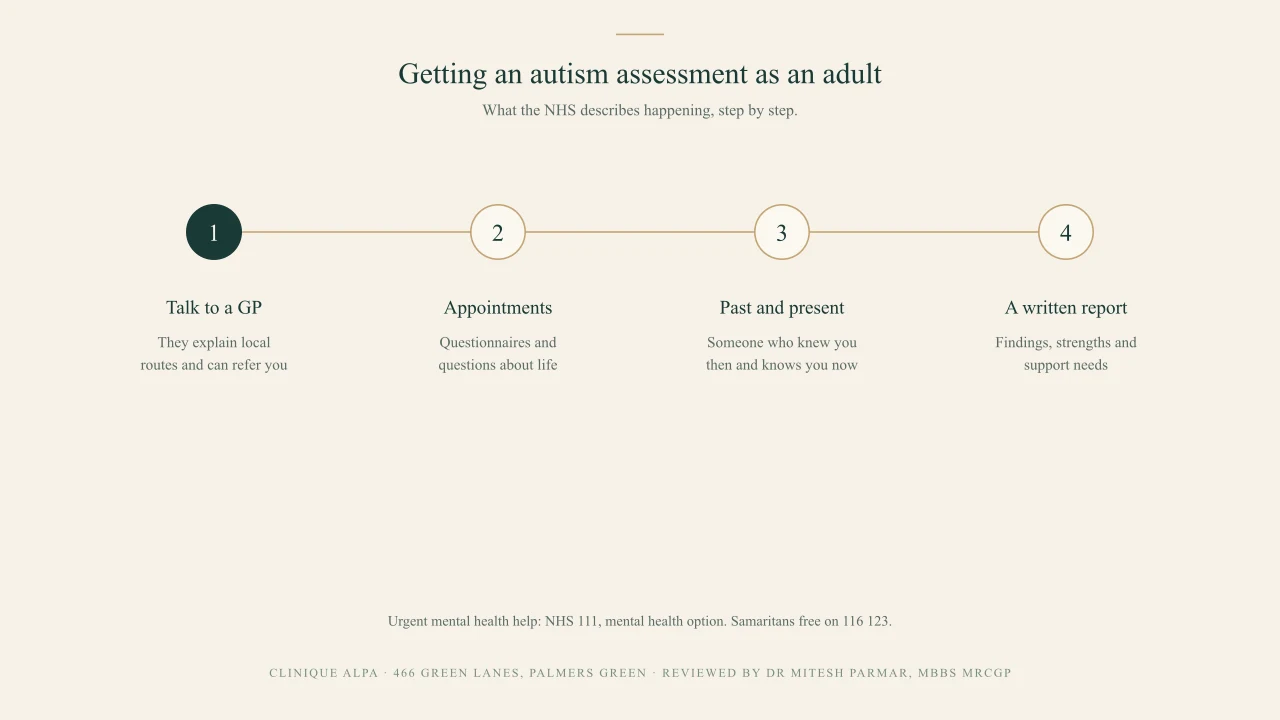
A formal assessment is more structured. The NHS describes one or more appointments with a team of healthcare professionals, who may ask you to complete questionnaires, ask about your behaviour with others, your early life and your home, work or college life, speak to someone who knew you as a child and someone who knows you now, review GP reports and ask for documents such as school reports or workplace assessments. You then receive a report on the findings, which covers strengths and possible support needs.
Information from childhood matters because it shows how long the pattern has been there. Where there is nobody who knew you then, the assessment can still go ahead, and the report says what the history does and does not support.
From Dr Mitesh Parmar
I begin by listening to the whole story, including school years and work. A formal diagnosis usually comes from a specialist team, so I do not pretend otherwise. What I can do is hear you out, rule out other causes of exhaustion or low mood, and help you decide whether referral is the right next step.
What does an autism diagnosis in adults change?
For many people the first change is understanding. Years of effort and confusion get an explanation, and that can be a relief, sometimes mixed with grief for what might have been different.
Practically, a report can support adjustments at work or study. GOV.UK says employers must make reasonable adjustments so that workers with a health condition or disability are not substantially disadvantaged, and gives examples such as doing tasks differently or flexible hours. Whether a given adjustment is agreed is a matter between you and the employer, and a report cannot promise one.
A diagnosis does not remove the need for treatment of anything else. Anxiety or low mood still need attention, and I often find that treating them makes the autism clearer, not less relevant.
What if the assessment does not find autism?
That happens, and a careful assessment says so and says why. The result may point to something else, such as anxiety, trauma or ADHD, or to traits that do not meet the threshold for a diagnosis. That is still useful. Sometimes it gives a better route to the right help than the original question did.
If you disagree with an outcome, the NHS says you can ask the team why they reached their decision, ask for a second opinion through your GP or the assessment team, or pay for an assessment by a professional outside the NHS.
When should you ask for help sooner?
- You have thoughts of harming yourself or ending your life: use the numbers at the top of this page.
- Low mood or anxiety has been present for weeks and is getting worse.
- You are close to losing work or study because of exhaustion.
- You have stopped seeing people altogether.
For any of these, see a GP, or book an appointment with the clinic. A diagnosis can wait a little. Your safety cannot.
How do we approach this at Clinique Alpa?
Start with a 30 minute GP appointment, £100. Use it to talk through why you are asking and whether an assessment is likely to help. Autism diagnostic assessments are led by consultant psychiatrists, and the fee is arranged individually and confirmed before anything is booked. With your consent, a summary goes to your NHS GP. If you want more detail, see adult autism assessment in London and the health library guide on autism and neurodiversity. The clinic's wider mental health work is on the psychiatry services page.
The NHS also says that in England you may be able to choose a clinic with shorter waits through Right to Choose, so it is worth asking your GP about that route too.
Common questions
What are the criteria for an autism diagnosis in adults?
They are based on the pattern of communication, social interaction, routines and sensory experience across a life, assessed by specialists. No single sign decides it.
Is autism diagnosis in adults available near me?
Start with your GP, who can explain how to get an assessment locally. The clinic also arranges consultant psychiatrist led assessments; contact us and we will confirm the route.
Can you be diagnosed with autism with a normal childhood?
Many adults had a childhood that looked ordinary from outside because they adapted. The assessment looks at what it cost and how it showed up.
Sources: NHS: getting diagnosed with autism, NHS: signs of autism in adults and GOV.UK: reasonable adjustments for disabled workers.
Drafted with AI assistance, clinically reviewed by Dr Mitesh Parmar, MBBS MRCGP, Principal GP and Clinical Director at Clinique Alpa, 466 Green Lanes, Palmers Green, London N13 5PA. This article is general information, not personal medical advice. In an emergency call 999. For NHS advice call 111 or visit nhs.uk.