
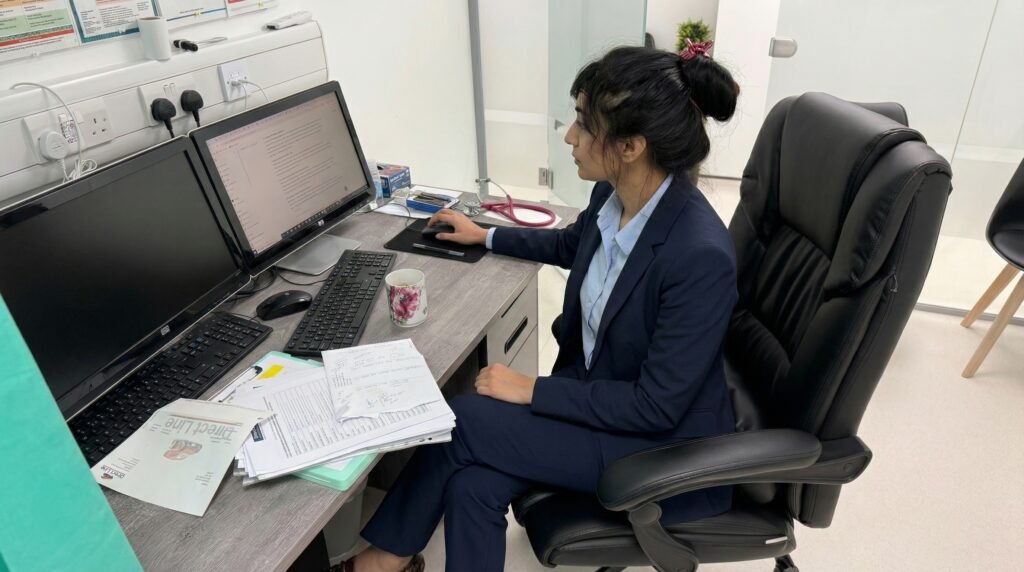
If you are applying for Personal Independence Payment (PIP) and need a detailed, accurate private GP for PIP assessment London report, having the right medical evidence can determine the outcome. I am Dr Mitesh Parmar MBBS MRCGP, Principal GP and Clinical Director at Clinique Alpa in Palmers Green, North London. Over my 21 years of clinical practice, I have helped many patients prepare thorough supporting medical reports for PIP claims, and I understand how the assessment process works from a clinical perspective. In this post, I will explain why a private GP report can strengthen your PIP application, what the process involves, and how to ensure your medical evidence reflects the true impact of your conditions on daily life.
What Is PIP and Why Does Medical Evidence Matter?
Unwell now? See a private GP online from £65 today.
Unhurried video or telephone appointment with a GMC registered doctor, often the same day.
Book Nowor message us on WhatsAppPersonal Independence Payment is a benefit designed to help adults with long term health conditions or disabilities cover the extra costs of daily living and mobility. PIP replaced Disability Living Allowance (DLA) for most adults in England and Wales. The Department for Work and Pensions (DWP) uses a points based system to assess how your condition affects your ability to carry out 12 key daily living and mobility activities.
The assessment is carried out by an independent healthcare professional, usually from providers such as Capita or Atos, on behalf of the DWP. Many patients find this process stressful and feel that the assessment does not fully capture the reality of their condition. Research published by the House of Commons Work and Pensions Committee has repeatedly highlighted concerns about the accuracy and consistency of PIP assessments.
This is where detailed medical evidence becomes essential. A well written report from a private GP who has examined you thoroughly and understands your conditions can provide the DWP decision maker with objective clinical evidence. This evidence can support your claim at the initial application stage, at mandatory reconsideration, or at tribunal appeal.
How a Private GP for PIP Assessment London Can Help Your Claim
When I prepare a PIP supporting letter, I focus on documenting exactly how each of your conditions affects your ability to perform daily activities. This is different from a standard GP consultation letter, which typically summarises your diagnoses and medications. A PIP report needs to address the specific descriptors used in the PIP assessment, linking your clinical findings to the functional limitations you experience.
For example, the PIP assessment considers whether you can prepare food, take nutrition, manage therapy or monitor a health condition, wash and bathe, manage toilet needs, dress and undress, communicate verbally, read and understand signs, engage with other people, make budgeting decisions, plan and follow a journey, and move around. Each descriptor carries a points value, and you need 8 points for the standard rate or 12 points for the enhanced rate in either the daily living or mobility component.
A private GP report that systematically addresses each relevant descriptor, with clinical evidence and specific examples, gives the decision maker a clear picture. NICE clinical guidelines and GMC Good Medical Practice guidance both emphasise the importance of accurate, evidence based medical reporting.
From Our Practice: Supporting a Complex PIP Application
A patient recently attended my clinic seeking support with a Personal Independence Payment application. He had multiple chronic conditions that collectively caused severe functional impairment. These included lower back pain with a previous fracture identified on MRI, bilateral knee arthritis resulting from years of physical work, a frozen left shoulder, and severe depression with mood congruent psychotic features.
During our consultation, he described significant functional limitations. He was unable to prepare food safely due to pain, reduced grip strength, and difficulty standing for more than a few minutes. Personal care tasks such as washing and dressing were extremely difficult because of restricted shoulder movement and knee pain. His mobility was severely limited, and he could not walk more than 20 metres without stopping.
His mental health conditions were equally disabling. He described difficulty managing his finances due to impaired concentration and decision making. He was experiencing suicidal ideation and had turned to alcohol as a coping mechanism. His depression affected his ability to engage with other people or plan and follow journeys independently.
I prescribed an antidepressant, a sleep aid, medication for neuropathic pain, and analgesics for his knee arthritis. I also arranged a crisis team referral for immediate mental health support. Equally important, I began preparing a detailed PIP supporting letter that documented how each condition affected specific daily activities, using the language and descriptors that the DWP assessment process requires.
This is exactly the type of thorough clinical assessment that can make the difference between a successful and unsuccessful PIP application. Without a detailed report linking each condition to functional limitations, the DWP assessor may not fully appreciate the cumulative impact of multiple conditions.
What Does a Private GP PIP Report Include?
When you book a PIP assessment appointment at Clinique Alpa, here is what the process involves.
A Thorough Clinical Assessment
I conduct a detailed consultation lasting 30 to 45 minutes. This is significantly longer than a standard NHS GP appointment, which typically lasts 10 minutes. The extra time allows me to examine each condition properly, observe your mobility and function, and discuss in detail how your conditions affect your daily life. I review your existing medical records, test results, hospital letters, and any medications you are taking.
Functional Impact Documentation
The report goes beyond simply listing your diagnoses. I document how each condition affects specific PIP descriptors. For instance, rather than stating “the patient has bilateral knee arthritis,” I would write “bilateral knee arthritis causes significant pain on weight bearing, limiting the patient’s ability to walk more than 20 metres without stopping and requiring the use of a walking aid. This affects the mobility descriptor ‘moving around’ and is likely to score 12 points.” This level of detail helps the decision maker understand the functional impact.
Clinical Examination Findings
I include objective clinical findings from my examination: range of motion measurements, gait assessment, grip strength, cognitive function observations, and any relevant clinical tests. These objective findings add weight to your subjective account of your limitations.
Prognosis and Variability
PIP assessors need to understand whether your condition is stable, fluctuating, or progressive. I document the variability of your symptoms, noting that you may have good days and bad days, and that the assessment should be based on what you can do reliably, repeatedly, safely, and in a timely manner. This is particularly important for conditions like chronic pain, mental health disorders, and neurological conditions where symptoms fluctuate.
When Should You Get a Private GP PIP Report?
There are several stages where a private GP report can be valuable.
Initial Application
Submitting a detailed medical report with your PIP2 “How your disability affects you” form strengthens your application from the outset. Many claims are decided on paper evidence without a face to face assessment, so having comprehensive medical evidence at this stage is crucial.
Mandatory Reconsideration
If your PIP claim has been refused or you have been awarded fewer points than you expected, you can request a mandatory reconsideration within 1 month of the decision. A private GP report obtained at this stage can provide additional evidence that was not available or not properly considered during the initial assessment.
Tribunal Appeal
If mandatory reconsideration is unsuccessful, you can appeal to the First Tier Tribunal (Social Entitlement Chamber). Statistics from HM Courts and Tribunals Service show that approximately 70% of PIP appeals that reach a tribunal hearing are decided in the claimant’s favour. A detailed medical report is one of the strongest pieces of evidence you can bring to a tribunal.
Common Conditions I Provide PIP Reports For
I regularly prepare PIP supporting letters for patients with a wide range of conditions. These include chronic pain conditions such as fibromyalgia, arthritis, and spinal problems. Mental health conditions including depression, anxiety, PTSD, bipolar disorder, and psychotic disorders. Neurological conditions such as multiple sclerosis, epilepsy, and Parkinson’s disease. Autoimmune conditions, chronic fatigue syndrome, and long term effects of injury or surgery.
Many patients have multiple conditions that interact with each other, making the cumulative functional impact greater than any single condition alone. This is something I pay particular attention to in my reports. If you also need support managing anxiety or other mental health conditions alongside your PIP application, I can address both during your appointment.
Traffic Light Guide: When to Seek Help With Your PIP Claim
🟢 GREEN (Self Care): You have a straightforward condition with clear NHS documentation and feel confident completing the PIP2 form yourself. Your condition is well documented in your medical records and you have recent hospital or specialist letters to submit.
🟠 AMBER (See Your GP): You have multiple conditions, your NHS records do not fully capture your functional limitations, or you have been awarded fewer points than expected. A detailed private GP report can fill gaps in your evidence. You should also seek GP support if your condition has worsened since your last NHS appointment.
🔴 RED (Seek Urgent Care): You are experiencing a mental health crisis, suicidal thoughts, or your conditions are causing you immediate harm. Contact your GP urgently, call NHS 111, attend A&E, or call the Samaritans on 116 123. Your health comes first, and a PIP application can wait until you are safe and supported.
How Much Does a Private GP PIP Report Cost?
The cost of a PIP supporting letter at Clinique Alpa covers the extended consultation, clinical examination, review of your medical records, and preparation of a detailed typed report. You can find current pricing on our appointments and fees page or call us on 020 8882 8088 for details.
Many patients tell me that the investment in a thorough private GP report is worthwhile when compared to the potential PIP award. The standard rate of PIP daily living component is £72.65 per week, and the enhanced rate is £108.55 per week. Over the course of a typical 3 to 5 year award, this represents a significant amount of financial support.
Tips for Preparing for Your PIP Assessment Appointment
To get the most from your appointment, I recommend bringing the following items.
A list of all your current medications, including dosages and how often you take them. Any hospital or specialist letters you have received in the past 2 years. A copy of your PIP2 form if you have already started filling it in. A diary or notes describing how your conditions affect you on a typical day, including your worst days. Details of any aids, appliances, or adaptations you use at home.
It also helps to think about specific examples of things you struggle with. Rather than saying “I find cooking difficult,” describe exactly what happens: “I can only stand at the worktop for 5 minutes before the pain in my knees forces me to sit down, and I have dropped pans twice in the past month because of reduced grip strength in my left hand.”
Why Choose a Private GP for Your PIP Report?
NHS GPs are under enormous time pressure. A typical NHS appointment lasts 10 minutes, which is not enough time to conduct the detailed assessment and prepare the comprehensive report that a PIP claim requires. Many NHS practices charge for medical reports and letters, and the wait can be several weeks.
When you see me at Clinique Alpa, you receive a longer appointment dedicated entirely to your PIP report. I have experience writing medical reports for benefits assessments and understand the specific language and evidence that decision makers and tribunal panels are looking for. The report is typically ready within 5 to 7 working days of your appointment.
Frequently Asked Questions About PIP Assessment Reports
Can a Private GP Report Guarantee a Successful PIP Claim?
No doctor can guarantee the outcome of a PIP claim, as the decision is made by the DWP based on all available evidence. However, a detailed, well structured medical report that addresses the specific PIP descriptors and links your clinical findings to functional limitations significantly strengthens your application. In my experience, patients who submit thorough medical evidence are more likely to receive an accurate assessment of their needs.
Will the DWP Accept a Report From a Private GP?
Yes. The DWP accepts medical evidence from any registered medical practitioner. As a GMC registered GP with MRCGP qualification, my reports carry the same weight as those from an NHS GP. The key factor is the quality and detail of the report, not whether the doctor works in the NHS or private sector.
How Long Does the PIP Assessment Appointment Take?
I allocate 30 to 45 minutes for a PIP assessment appointment at Clinique Alpa. This gives us enough time for a thorough clinical examination, a detailed discussion of your functional limitations, and a review of your existing medical records. If you have multiple complex conditions, the appointment may take slightly longer.
Can You Help With PIP Mandatory Reconsideration or Tribunal Appeals?
Yes. I regularly provide medical reports for patients at all stages of the PIP process, including initial applications, mandatory reconsiderations, and tribunal appeals. For tribunals, I can prepare a report that specifically addresses the reasons your claim was refused and provides additional clinical evidence to counter the original assessment.
Do I Need to Bring My Medical Records?
Bringing any available medical records, hospital letters, or specialist reports is extremely helpful. These allow me to reference and corroborate your medical history in my report. If you do not have copies, I can still prepare a thorough report based on my own clinical assessment and your account of your conditions, but having supporting documentation strengthens the evidence.
If you are preparing for a PIP application or need support with a mandatory reconsideration or tribunal appeal, call Clinique Alpa on 020 8882 8088 or book a PIP assessment appointment online. I am here to ensure your medical evidence accurately reflects how your conditions affect your daily life.
Unwell now? See a private GP online from £65 today.
Unhurried video or telephone appointment with a GMC registered doctor, often the same day.
Book Nowor message us on WhatsApp