
The cold itself has gone. The streaming nose and the sore throat were over days ago, and the family has moved on. What is left is a chest that whistles on the stairs, a cough that rattles first thing in the morning, and a tiredness that does not match how well you are meant to be.
A wheezy cough after cold symptoms have cleared is one of the most common reasons people book. The honest question is how long it is reasonable to wait, and what changes the answer.
Chest pain, signs of a stroke, severe breathlessness, heavy bleeding, a severe allergic reaction or symptoms of sepsis need 999 or A&E immediately. For urgent advice that cannot wait, call NHS 111.
Is a wheezy cough after cold symptoms normal?
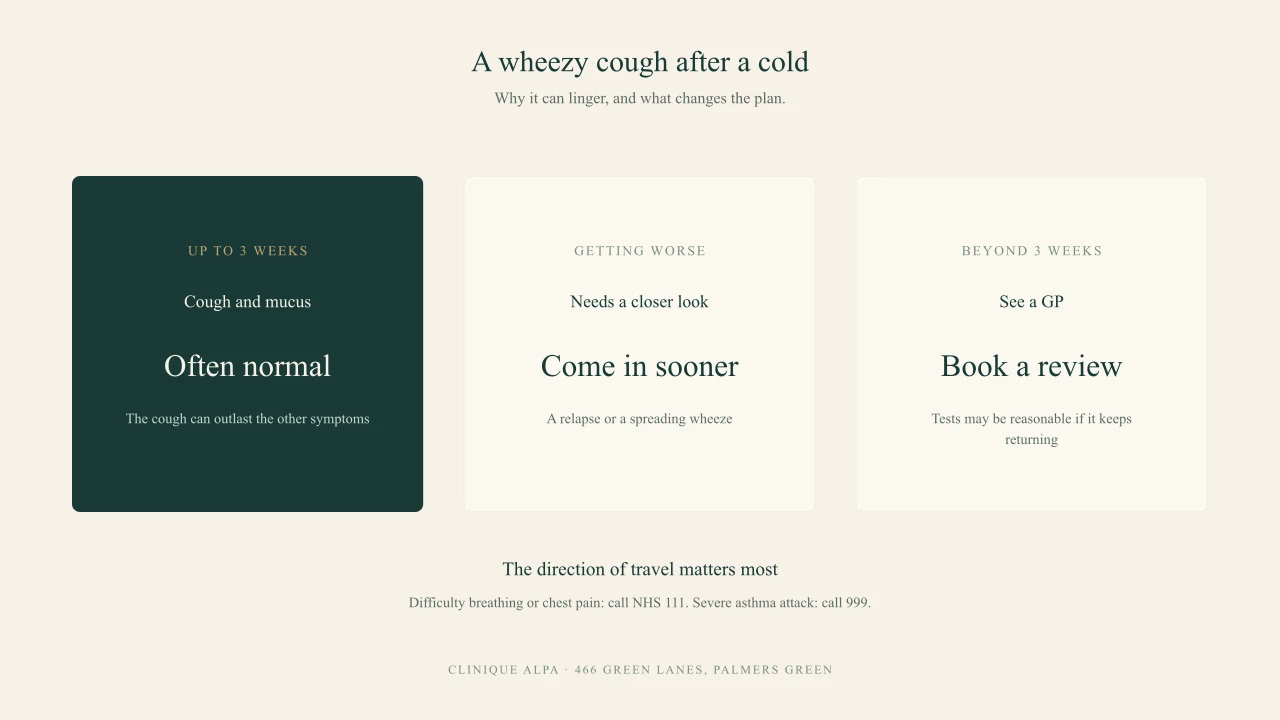
Often it is. A cold or a chest infection inflames the lining of the airways, and that lining stays sensitive for a while after the germ has gone. Cold air, a laugh, a flight of stairs or a dusty room can set off a cough or a whistle that would not have bothered you before. NHS advice on chest infections says the cough and mucus can last up to 3 weeks, and that most other symptoms improve within about 7 to 10 days.
So a wheeze at the end of the first week is not alarming by itself. What matters is the direction. A cough that is slowly loosening, with the wheeze fading, is behaving as expected. A cough that is getting worse, or a wheeze that is spreading from the mornings into the whole day, is asking for a closer look.
What makes a wheezy cough linger?
When this comes up in consultation, the lingering usually has one of a handful of explanations, and they overlap.
- Sensitive airways after infection. The common one. It settles with time, and sometimes with a short course of reliever treatment so you can breathe and sleep comfortably.
- Asthma that was there already. A cold can unmask it. People often say they were always a bit chesty and never thought about it.
- A drip from the nose. If the nose and sinuses are still inflamed, mucus runs down the back of the throat and sets off the cough again and again.
- A bacterial chest infection on top of the cold. This is less common than people expect, and it has a different pattern: feeling worse after a few days of improving, a high temperature, coloured mucus that is increasing rather than easing.
- A treatment that is not working as intended. Missed doses of a regular inhaler, a device that is hard to use, or a reaction to one preparation that can be swapped for another.
What I look at in clinic
The first thing I want is the timeline. How did it begin, how did it change, and was there a point when you were better before you got worse? A relapse after a few good days points one way. A cough that never really lifted points another. I ask about the colour and amount of mucus, but I put less weight on the colour than most people expect, because green or brown mucus alone does not prove an infection that needs antibiotics.
I ask about wheeze and breathlessness: when it happens, whether it wakes you, whether you can speak in full sentences, whether you can climb a flight of stairs. I ask what you have been using, how often, and how you use it. Many people have been given a device with no one watching them use it. I ask about previous chest troubles, hay fever or eczema, smoking and vaping, work, home and what else is going round the household.
Then the examination. Temperature, pulse, breathing rate and an oxygen level on a finger probe, which we have on site. Then the chest, front and back. I am listening for a wheeze on breathing out, for crackles that suggest fluid or infection in one area, and for whether the two sides sound alike. A forced breath out shows a wheeze that quiet breathing hides. I look at the nose and throat as well, because the chest is not always where the trouble is.
This is also where I decide whether tests would change anything. For most people they would not, and the right plan is treatment for the airways, a clear review date and plain safety netting. If the story is unusual, if the chest sounds different on one side, if the cough has gone past 3 weeks or the illness keeps returning, a chest X ray or breathing tests become reasonable. I explain what the result would change before anything is arranged. If a different kind of treatment is likely to suit you better, I say what and why.
From Dr Mitesh Parmar
Wheeze that lingers after a cold may be a sensitive airway, not infection. I listen, measure peak flow and ask about night cough, exercise and family allergies. A trial of the right treatment, then a recheck, tells me a lot. Struggling to speak, blue lips or exhaustion means 999.
When is it worth waiting, and when should you come in sooner?
Waiting makes sense when the cough is slowly easing, you feel better in yourself, you are eating and drinking and sleeping reasonably, and there is no fever. Rest, fluids, an extra pillow at night and avoiding smoke are the NHS suggestions, and they are sensible.
Come in sooner if the cough or wheeze is getting worse, if you feel very unwell, if you cough up blood or blood stained mucus, or if you live with a long term heart, lung or kidney condition, a weakened immune system, or are pregnant or an older adult. The NHS lists these as reasons to see a GP rather than wait. A cough that has lasted more than 3 weeks also needs an appointment.
Get urgent help from NHS 111 or an urgent appointment for difficulty breathing, chest pain, a cough that is very bad or worsening quickly, or swollen painful glands in the neck. If you have asthma and a bad attack does not ease after the maximum dose of your reliever inhaler, call 999 and do not drive yourself to A&E.
How do we approach this at Clinique Alpa?
A clinic consultation with a named doctor is 30 minutes and £100. That time is for listening to the whole story, examining the chest and agreeing a plan with a date to review, so you know what to do if it does not go as expected. With your consent, a summary goes to your NHS GP. For an illness that began with a cold, the sibling articles on a cough that keeps you awake at night and on when chest infection treatment helps cover the other halves of the question.
Common questions
Why do I have a dry wheezy cough after a cold?
Airways stay irritable for a while after an infection, so a dry cough with a whistle can follow a cold by a week or two. If it is getting worse rather than easing, or it wakes you at night, have it listened to.
How long should a wheezy cough with a cold last?
NHS advice is that most symptoms of a chest infection improve in 7 to 10 days, with the cough and mucus sometimes lasting up to 3 weeks. See a GP if it goes beyond that.
Is a wheezy cough post cold asthma?
It can be, particularly if it keeps coming back or is worse at night. Asthma is diagnosed from the pattern of symptoms and an examination, not from a single episode.
Sources: NHS: chest infection, NHS: cough and NHS: asthma symptoms.
More in this series: cough that will not settle
- Cough keeping me awake at night: what to know
- Hay fever wheeze and cough
- What makes a cough worse smoke vapour and heat
- Cough lasting a week: what a doctor checks
Drafted with AI assistance, clinically reviewed by Dr Mitesh Parmar, MBBS MRCGP, Principal GP and Clinical Director at Clinique Alpa, 466 Green Lanes, Palmers Green, London N13 5PA. This article is general information, not personal medical advice. In an emergency call 999. For NHS advice call 111 or visit nhs.uk.