
The cough starts when the light goes off. It builds through the first hour in bed, sends you to the kitchen for water, then to the sofa with extra cushions, and by the small hours the whole household knows about it. That is the common version of a cough keeping me awake at night: quiet in the afternoon, worse lying flat, worse again just before dawn.
The question behind it is rarely whether this is serious. It is why the night, and what will make it stop. Both have answers, and they depend on what kind of cough it is.
Chest pain, signs of a stroke, severe breathlessness, heavy bleeding, a severe allergic reaction or symptoms of sepsis need 999 or A&E immediately. For urgent advice that cannot wait, call NHS 111.
Why is a cough worse at night?
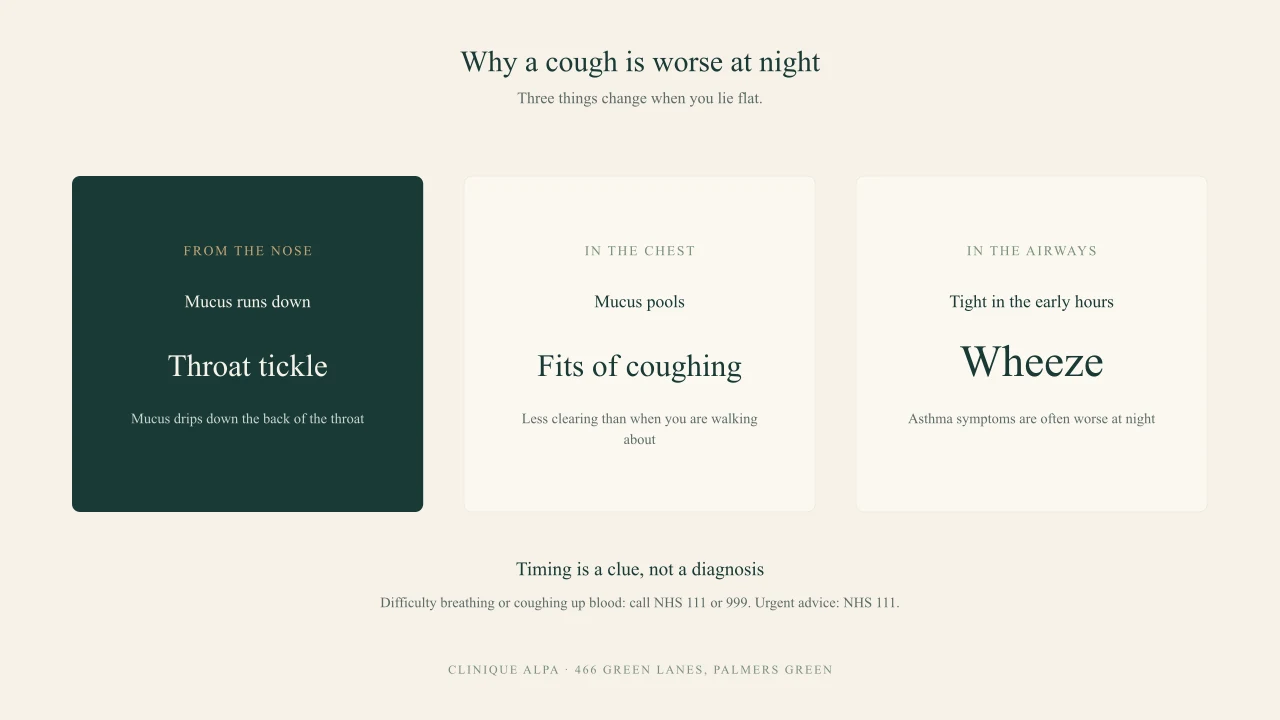
Lying flat changes three things at once. Mucus from the nose and sinuses runs down the back of the throat instead of draining forward. Mucus in the chest pools instead of being cleared by walking about. And the airways, which tighten and relax over a 24 hour cycle, are often at their most irritable in the early hours.
So a cough that is mild by day can become relentless at night without anything having got worse. NHS advice on asthma says symptoms may be worse at night and early in the morning, and the same pattern turns up with colds, hay fever and lingering chest infections. The timing is a clue, not a diagnosis.
What kinds of night cough do people describe?
When this comes up in consultation, people usually fall into one of a few patterns, and most describe a blend.
- Wet and chesty. Mucus that is thick and coloured in the morning and thinner through the day, often after a cold. Sleep is broken by fits of coughing and by the effort of clearing the chest.
- Wheezy and tight. A whistle on breathing out, or a feeling of tightness, with a cough that comes in spasms. Sometimes a reliever inhaler helps a little and is then followed by more coughing.
- Tickly and dry. A cough that starts with a tickle in the throat. It is often tied to a blocked nose or mucus dripping from behind it.
- Every night, in a pattern. It arrives at the same hour, week after week, with good days in between. Pattern matters more than any one bad night.
What I look at in clinic
I start with the shape of the cough rather than the cough itself. When did it begin, and did it follow a cold? Is it dry or does it bring up mucus, and what colour is it? Is it worse lying flat, worse when you wake, worse in certain rooms? Does anything make it ease: sitting up, a hot drink, a reliever inhaler?
Then the background. Past chest problems, childhood wheeze, hay fever or eczema, smoking or vaping, dust or fumes at work, current medicines, and what has already been tried.
The examination is short and specific. Temperature, pulse and oxygen level with a finger probe, which we have on site. A look at the throat and nose. Then the chest, listened to front and back, with the breath held and then breathing hard out. A wheeze that only shows on a forced breath is easy to miss when someone is simply asked to breathe normally.
What I am quietly ruling out matters as much as what I find. A night cough that is not chesty at all, a cough with weight loss, or one that has gone past 3 weeks needs a different line of thought than a cough that has followed a cold by a few days. NHS guidance is to see a GP for a cough that lasts more than 3 weeks, or if you have lost weight without trying.
The plan depends on the pattern. A wet cough after a cold often needs time, fluids and a few practical changes, and antibiotics are not usually the answer. A wheezy, spasmodic cough may need a trial of treatment for the airways and a proper review of how a reliever is being used. A tickly cough with a blocked nose often needs the nose treated first. I give a clear time to review, usually within a week or two, so the plan is tested against what actually happens.
From Dr Mitesh Parmar
The timing tells me a lot. A cough that begins when lying flat points one way, wheeze at dawn another, and a tickle after a meal another again. I also ask about reflux, nasal drip and any tablets you take. Coughing blood or breathlessness at rest needs NHS 111 or 999.
What can help at home while you wait?
The NHS suggests rest, plenty of fluids, and extra pillows so your head is propped up when you sleep. A pharmacist can suggest cough medicines that may help you cough less, but they will not stop the cough.
If you wheeze or know you have asthma, your inhaler plan matters more than any of these. Keep to the doses you were shown and check that the device is actually delivering the medicine. The persistent cough article covers what happens when a cough runs beyond a few weeks, and the health library has plain guides to the common conditions.
When should you come in sooner?
Get an urgent appointment or call NHS 111 if the cough is very bad or getting worse quickly, you cannot stop coughing, you feel very unwell, or you have chest pain or difficulty breathing. The same goes for coughing up blood and for swollen, painful glands on the side of the neck, which are listed in NHS advice on coughs.
If you have asthma and your symptoms get worse during an attack, or do not improve after the maximum dose of your reliever inhaler, call 999. Do not drive yourself to A&E. Book a routine appointment if the cough has gone past 3 weeks, if it wakes you at night more than once or twice, or if you are using your reliever more often than you used to. If you are pregnant, or have a long term heart, lung or kidney condition, or a weakened immune system, do not wait for 3 weeks.
How do we see a night cough at Clinique Alpa?
You will see a named doctor at 466 Green Lanes for 30 minutes, with time to listen to the whole story and to examine you properly. A clinic consultation is £100 and the fee is shown before you pay. With your consent, a summary goes to your NHS GP, because this care sits alongside the NHS rather than replacing it.
The next article in this series, on a wheezy cough after a cold, covers a cough that lingers once the cold itself has gone.
Common questions
Why is my tickly cough worse at night?
A tickly cough often comes from the nose and throat, where mucus drips down when you lie flat. Treating a blocked nose and keeping your head propped up can help, and a doctor can check whether the chest is involved too.
Is a cough keeping me up at night a sign of asthma?
It can be, because asthma symptoms are often worse at night and early in the morning. A wheeze, tightness or a cough that comes in spasms is worth having listened to rather than guessed at.
What if the cough is keeping me up at night and I am pregnant?
NHS advice is that anyone who is pregnant should see a GP about a chest infection or a cough that is not settling. Do not wait for 3 weeks, and say you are pregnant when you book.
Sources: NHS: cough, NHS: asthma symptoms and NHS: chest infection.
More in this series: cough that will not settle
- Wheezy cough after a cold
- Hay fever wheeze and cough
- What makes a cough worse smoke vapour and heat
- Cough lasting a week: what a doctor checks
Drafted with AI assistance, clinically reviewed by Dr Mitesh Parmar, MBBS MRCGP, Principal GP and Clinical Director at Clinique Alpa, 466 Green Lanes, Palmers Green, London N13 5PA. This article is general information, not personal medical advice. In an emergency call 999. For NHS advice call 111 or visit nhs.uk.