
The review after starting a medicine for a fast heart rate is often the shortest appointment of the whole process, and one of the most useful. The episodes have changed, or not. Something about how you feel on the medicine has changed, or not. People walk in expecting a quick yes or no, and what I want is a few details they have not realised matter.
This article is about tachycardia follow up: what we review once treatment has started, how we judge whether it is working, and what happens next if it is not.
Chest pain, signs of a stroke, severe breathlessness, heavy bleeding, a severe allergic reaction or symptoms of sepsis need 999 or A&E immediately. For urgent advice that cannot wait, call NHS 111.
What is tachycardia, and how long does a tachycardia episode last?
Tachycardia means a heart rate that is faster than normal. The NHS describes supraventricular tachycardia (SVT) as a heart that suddenly beats much faster than normal, above 100 beats a minute when a normal resting rate is 60 to 100, because of a problem with the heart's electrical system. Episodes usually last a few minutes but can sometimes last several hours. They may happen several times a day or once a year, and caffeine, alcohol or drugs can trigger them, though often there is no obvious trigger.
The NHS describes it as usually not serious. Some people have no other symptoms, while others have chest discomfort, weakness, breathlessness, light headedness, dizziness or tiredness. The first work up is an ECG, which is covered in the first article of this series on palpitations and fainting.
What happens after tachycardia is diagnosed?
That depends on how often and how long the episodes are, and how much they bother you. The NHS says that if episodes are brief and do not bother you, you may not need treatment, and that cutting back on caffeine and alcohol, and on smoking, may reduce them. A doctor can also teach techniques to stop an episode. For frequent or long episodes, treatment can include medicines, a procedure to restore a normal rhythm, or catheter ablation, which a heart specialist can discuss with you.
Many people are started on a daily medicine for a fast heart rate, often with the aim of reducing how often it comes and how long it lasts. A follow up appointment is how we find out whether that aim has been met.
What I look at in clinic
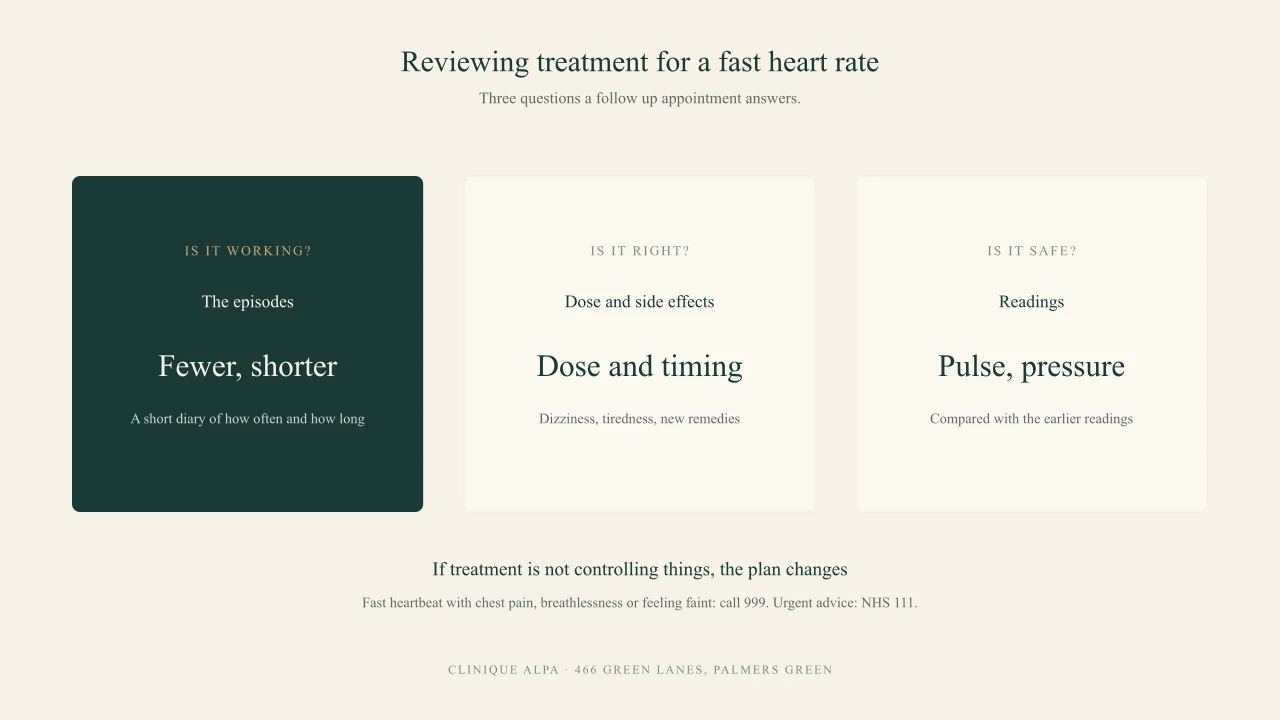
I begin with the thing you care about: how have the episodes changed? How many since I last saw you, how long did each one last, and how bad did it feel? A diary is the most helpful thing you can bring, even a few lines on a phone. Fewer, shorter or milder episodes mean the treatment is helping. Episodes that are unchanged or worse tell me something just as useful.
When this comes up in consultation, a common pattern is someone who reports that the main symptom has improved or gone, that they take the medicine once a day instead of several times, and who asks whether that is enough or whether they are doing something wrong. A simpler routine that works is a good outcome. The question I ask is whether symptoms are controlled throughout the day, not just at the time of the dose.
Then the dose and how it is taken. I check what you take, how much, at what time, and what happens when a dose is late or missed. I ask about side effects, in particular dizziness, tiredness, feeling faint, cold hands and feet, breathlessness or low mood. I ask about anything new that you have started, including over the counter remedies, caffeine, energy drinks and alcohol, because these can bring episodes back.
I measure your pulse and blood pressure, and your oxygen level, and compare them with the earlier readings. I want a resting pulse and blood pressure that are comfortable, not too high and not too low, and I want to see them change in the direction I expect. I listen to the heart and lungs, and look at the ankles. If the pulse is irregular or I have any doubt about the rhythm, I record an ECG.
Finally, a plan for the gaps. What to do if an episode comes through the treatment, when to measure the pulse, which techniques to try, and at what point to call. If the treatment is not controlling things, I do not simply increase the dose until it does. I think about a referral to a heart specialist, who can record the rhythm during an episode and discuss ablation. I never advise stopping or changing a heart medicine without a conversation, and I ask you not to either.
From Dr Mitesh Parmar
Bring a record of your episodes: when they started, how long they lasted, what you were doing, and your pulse if you could take it. I check pulse, blood pressure and the tracing. I also ask about caffeine, sleep and any new treatment. Fainting, chest pain or breathlessness with palpitations is a 999 call.
When to come in sooner
Call 999 if you have been diagnosed with SVT and an episode lasts longer than usual, or if the fast heartbeat arrives alongside breathlessness, chest pain or feeling faint. The NHS also advises 999 for a fast or irregular heartbeat with sweating, feeling or being sick, fainting, dizziness or falling, severe headache, weakness or numbness on one side, blurred vision, confusion or difficulty speaking. Do not drive yourself to A&E.
See a doctor if the fast heartbeats keep coming back, are getting worse, or are not controlled by treatment. Tell us about any new side effect rather than waiting for the next review.
How do we approach this at Clinique Alpa?
A face to face consultation at 466 Green Lanes is 30 minutes with a named doctor and costs £100. That is time to go through your diary, check your pulse, blood pressure and oxygen level, and look at the dose and your side effects. ECGs and blood tests are carried out on site, as described on the investigations page. A referral is written where clinically appropriate after assessment and is included in the consultation fee. With your consent, a summary goes to your NHS GP.
This is part 3 of 3 on palpitations and heart rhythm. Part 1 covers palpitations and fainting, and part 2 covers a heart murmur and the echocardiogram. The clinic also keeps guides to palpitations and medication review.
Common questions
How long does a tachycardia episode last?
The NHS says episodes of SVT usually last a few minutes but sometimes several hours. If an episode lasts longer than usual, or arrives alongside breathlessness, chest pain or feeling faint, call 999.
What to do after tachycardia has been diagnosed?
Keep a short diary of episodes, take any treatment as agreed, and cut back on caffeine and alcohol. Arrange a review so a doctor can check the benefit and the dose.
Do I need follow up if I feel better on treatment?
Yes, usually. Feeling better is the aim, but a review checks that your pulse and blood pressure are comfortable and that the dose is right.
More in this series: palpitations and heart rhythm
Drafted with AI assistance, clinically reviewed by Dr Mitesh Parmar, MBBS MRCGP, Principal GP and Clinical Director at Clinique Alpa, 466 Green Lanes, Palmers Green, London N13 5PA. This article is general information, not personal medical advice. In an emergency call 999. For NHS advice call 111 or visit nhs.uk.