
Palpitations and fainting together are one of the combinations that makes a doctor slow down. A heart that races or thumps is common and usually harmless. A brief loss of consciousness is common too, and usually has an ordinary cause. When the two happen close together, the question is whether the heart rhythm is the link.
This article is about the first steps: what I ask, what I examine, which tests come first and which signs mean you should not wait for an appointment.
Chest pain, signs of a stroke, severe breathlessness, heavy bleeding, a severe allergic reaction or symptoms of sepsis need 999 or A&E immediately. For urgent advice that cannot wait, call NHS 111.
What can palpitations and fainting have in common?
Several things, and most of them are not dangerous. The NHS lists common causes of fainting as standing up too quickly, not eating or drinking enough, being too hot, strong emotion or severe pain, and also heart problems, drugs and heavy alcohol use. Common triggers of palpitations include stress, lack of sleep, caffeine, alcohol, nicotine and some medicines, with iron deficiency anaemia, an overactive thyroid, heart rhythm problems and heart valve disease among the medical causes.
Some of those overlap. A person who is dehydrated, anaemic or running on little sleep may feel the heart race and then feel faint on standing, both from one underlying cause. A heart rhythm problem can produce a racing heart and a faint, and it is the one I want to be sure about.
What is the link between arrhythmia and fainting?
A heart rhythm that is too fast, too slow or disorganised can reduce the blood reaching the brain for a short time. The result is a faint, often with little warning, sometimes with a few seconds of palpitations before it. Fainting during exercise, or while lying down, or with palpitations or chest pain, is exactly the situation in which the NHS advises calling 999, because those are the features that point to the heart.
That does not mean most faints are rhythm problems. Most are not. It means the details of the episode decide how seriously and how quickly I look.
What I look at in clinic
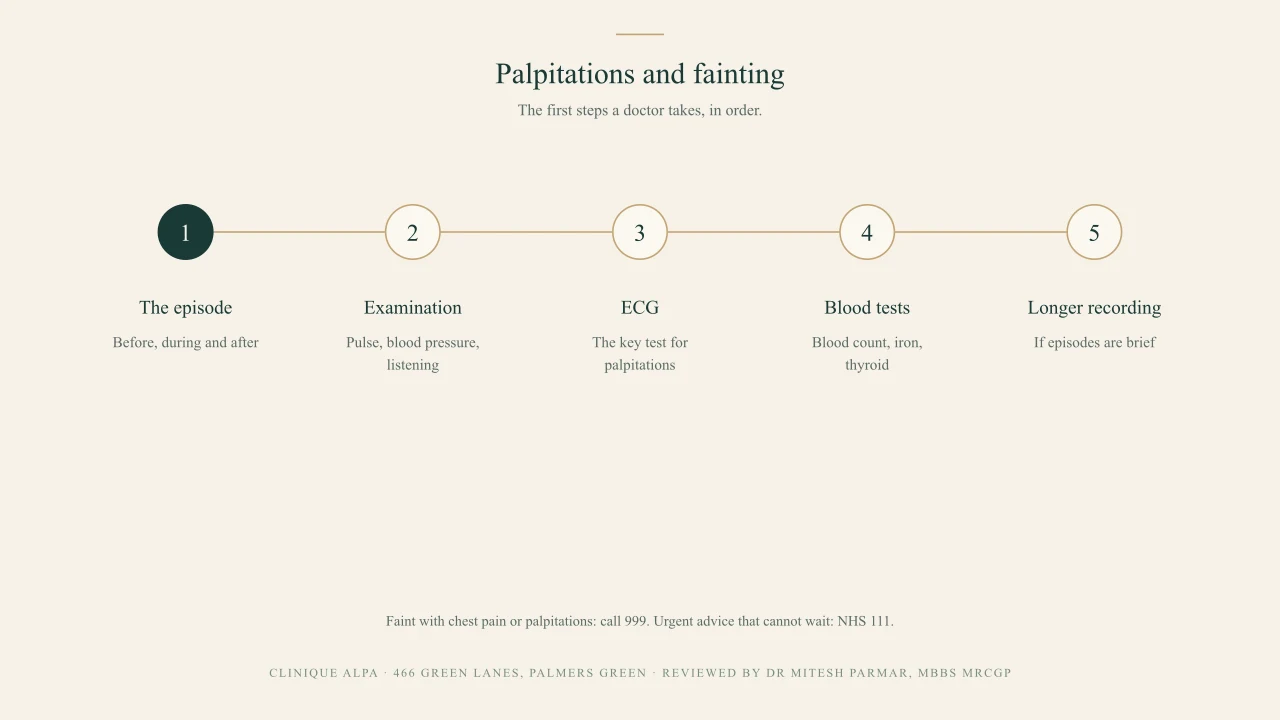
I start with the episode itself, in as much detail as you can give me. What were you doing? Were you standing, sitting or lying? Was there a warning, such as feeling hot, sick, sweaty or tunnel vision, or did it come without notice? Did you feel the heart race beforehand? How long were you out, and how did you recover: quickly, or confused and slow? Someone who saw it can tell me things you cannot, so I ask whether a witness can describe it or whether someone filmed it.
When this comes up in consultation, a common pattern is someone who has felt the heart race on and off for a long time, who then has a faint that seems separate, and who is unsure whether the two belong together. The sequence, not the symptoms, is what I am after. A faint that follows a hot room and a long wait standing is a different story from a faint during effort or one that arrives with no warning.
I ask about family history, especially sudden unexplained death or heart rhythm problems in close relatives, about medicines and over the counter remedies, caffeine and alcohol, and recent illness, bleeding or poor intake. I measure pulse and rhythm, blood pressure sitting and then standing, oxygen level, and listen for a heart murmur. I look for anaemia and for signs of thyroid disease, and I note whether the faint caused an injury.
The first test is an ECG, which the NHS names as the key test for palpitations. A normal tracing taken between episodes does not exclude a rhythm problem, so when the story is suggestive I discuss a longer recording, which a heart specialist can arrange. Blood tests look for the common medical causes: a full blood count, iron, thyroid function, blood sugar and kidney function with salts. An echocardiogram, a heart ultrasound, is considered if I hear a murmur or the story suggests a structural cause, and the NHS notes that a cardiologist may arrange it.
If a faint was brief and has an obvious trigger, the work up can be short and reassuring. If it was unexplained, or came with palpitations, I arrange the tests for it promptly and discuss other measures with you in the meantime.
From Dr Mitesh Parmar
What I want to know is exactly what happened: did it come on lying down, on exertion, or on standing? I check a heart trace and blood pressure sitting and standing. Fainting during exercise, or with chest pain, is a reason for 999 and not a booking.
When to come in sooner
Call 999 if someone faints and has chest pain or palpitations, fainted while exercising or lying down, has not fully recovered, has trouble speaking or moving, was seriously injured, has a seizure, or cannot be woken within 1 minute. The same applies if palpitations do not go away, or come with chest pain, breathlessness or feeling faint. Do not drive yourself to A&E.
See a doctor after any faint so the cause can be found. Get an urgent appointment, or call NHS 111, if palpitations keep coming back, last longer than a few minutes, or happen on top of a known heart condition or a family history of heart problems. The NHS says you must tell the DVLA if you faint regularly, and not to drive while waiting to be assessed by a specialist.
How do we approach this at Clinique Alpa?
A face to face consultation at 466 Green Lanes is 30 minutes with a named doctor and costs £100. ECGs and blood tests are carried out on site, as described on the investigations page, and longer recordings or heart ultrasound scans are arranged through other services when needed. A referral is written where clinically appropriate after assessment and is included in the consultation fee. With your consent, a summary goes to your NHS GP.
This is part 1 of 3 on palpitations and heart rhythm. Part 2 covers a heart murmur and the echocardiogram, and part 3 covers follow up after a fast heart rate. If chest pain is the main worry, I have also written about chest pain and anxiety, and the clinic keeps guides to palpitations and fainting.
Common questions
Can heart palpitations and fainting spells be harmless?
Often, yes, particularly when there is a clear trigger such as standing up quickly or being dehydrated. A doctor still checks, because the same symptoms can come from a rhythm problem.
What tests come first for palpitations and fainting?
Usually the history, a pulse and blood pressure check, an ECG and blood tests. A longer rhythm recording or a heart ultrasound follows if the story calls for it.
Should I see a doctor after a single faint?
Yes. The NHS advises seeing a doctor after any faint so the cause can be found, and urgent help if there was chest pain or palpitations.
More in this series: palpitations and heart rhythm
Drafted with AI assistance, clinically reviewed by Dr Mitesh Parmar, MBBS MRCGP, Principal GP and Clinical Director at Clinique Alpa, 466 Green Lanes, Palmers Green, London N13 5PA. This article is general information, not personal medical advice. In an emergency call 999. For NHS advice call 111 or visit nhs.uk.