
Most people who come to talk about self harm have been carrying it for a long time before they say the word out loud. They often arrive with a long sleeve down over the hand, or a bag held in front, ready to be told off. The sentence they have rehearsed in the car park is usually shorter than the one they say.
This page is about the self harm GP appointment: what a doctor asks, what happens to any injury, and what support follows. It is written for the person who is thinking about booking, and for the person who loves them.
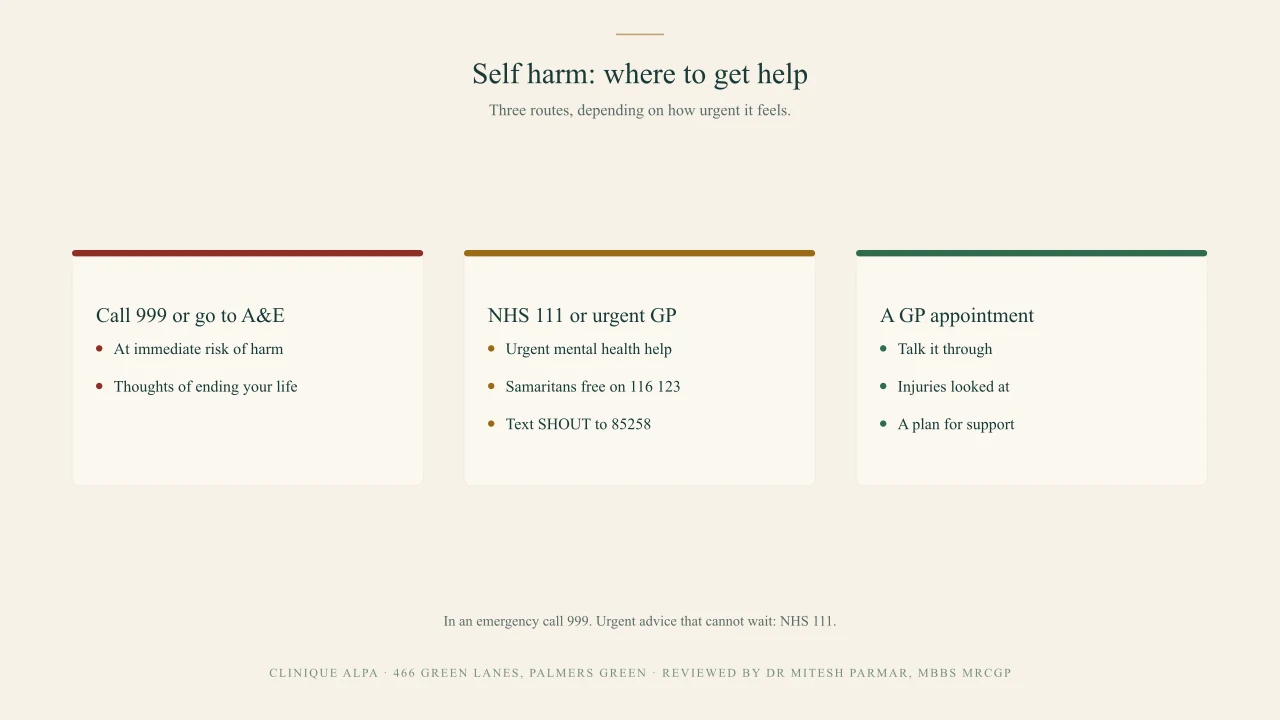
If you are at immediate risk of harming yourself or someone else, call 999 or go to A&E. For urgent mental health help, call NHS 111 and choose the mental health option, or call Samaritans free on 116 123, any hour.
What does a self harm GP appointment involve?
The NHS defines self harm as somebody intentionally damaging or injuring their body. It says support is available for people who self harm or think about it, and for their friends and family. A GP appointment is one way into that support, and for many people it is the first.
The first thing to say is that you will not be told off. A doctor is not there to judge the self harm, to take control of the decision, or to ask you to stop on the spot. The aim is to understand what is behind it, make sure you are safe, look after any injury and agree what happens next. The NHS advises being honest with the GP, even if you do not know why you self harm. You do not need to have a tidy explanation. Not knowing is a fair answer.
What does a doctor ask?
What I look at in clinic starts with listening. I let you say as much or as little as you want, and I follow, not lead. After that I ask, gently and plainly, the questions that help me keep you safe and plan well.
I ask what has happened, and how recently. I ask whether it is something you do often, or whether things have changed lately. I ask what it does for you: whether it releases pressure, numbs something, punishes something or helps you feel anything at all. Those answers tell me more about what would help than any label.
I ask directly about thoughts of suicide. I ask every time, because the question does not plant the idea. It lets a person say what they are carrying. The NHS notes that some people who self harm are at higher risk of suicide, which is why getting support as soon as possible matters. If you do have those thoughts, please say so. It changes how quickly we act, and not how kindly.
I ask about the rest of life: sleep, mood, worry, alcohol and drugs, relationships, work, money, and any history of being hurt. I ask what has helped before, and who knows. I ask whether anyone at home is at risk or worried. I ask what help you have already had, and what you found unhelpful, because a poor experience in the past is common and I would like not to repeat it.
Then I look after the body. The NHS says a GP can treat minor injuries, and that untreated small cuts or burns can become infected. If there is a wound, I look at it, with a chaperone if you want one, and I tell you what to watch for as it heals. Nothing is done without your agreement.
Finally, I talk about safety. That might be a safety plan: a short written list of what to do and who to contact when the urge comes. The NHS points to the Staying Safe website for guidance on making one. We build it together, in your words.
Confidentiality matters here. What you tell me stays between us, and with your consent a summary goes to your NHS GP. If I believed someone's life was at immediate risk, I would tell you first about any step I needed to take.
From Dr Mitesh Parmar
You do not need to find the perfect words. I will ask calmly, listen first and not lecture. What I need to understand is how safe you feel now. If you have hurt yourself badly, taken too much of anything or feel you might act tonight, call 999, or go to A&E, or call NHS 111.
What support follows?
The NHS says a GP listens and discusses the options, which may include self help or support groups, and may refer you to a local community mental health team for assessment. An assessment helps your care team build a treatment plan, such as talking therapy. Under 18s are referred to children and young people's mental health services, which are separate from adult services. Adults can also refer themselves to NHS talking therapies without a GP.
What I add is continuity. I would like to see you again soon, not in months, so that the plan is checked and adjusted. A plan that is not revisited rarely holds. Talking about it once does not fix it, but it is where the next step starts.
If you want to talk to someone right now, the NHS lists several places:
- Samaritans on 116 123, free, any hour.
- Shout: text SHOUT to 85258.
- Mind on 0300 123 3393, 9am to 6pm on weekdays.
- Childline on 0800 1111, for anyone under 19.
What if it is someone you love?
Listen first. Try not to react with panic or anger, even if you feel both. Ask what would help, and offer to come to an appointment. You do not have to fix it, and you do not have to promise to keep it secret if you think they are in danger. If you are worried about their immediate safety, call 999. For urgent help that cannot wait, NHS 111 has a mental health option. Looking after the person who is looking after them matters too.
When should you ask for help sooner?
- If you are at immediate risk of harming yourself, call 999 or go to A&E.
- If you have thoughts of ending your life, call NHS 111 and choose the mental health option, or Samaritans free on 116 123.
- If an injury is getting worse, for example more painful or swollen, get it looked at promptly.
- If you have harmed yourself and are unsure how serious it is, ask for urgent advice rather than waiting.
How do we approach this at Clinique Alpa?
A clinic consultation is 30 minutes at 466 Green Lanes, with Dr Parmar, whose special interest is psychological medicine. There is time to talk, to look after any injury and to agree a plan and a follow up. This is private care alongside the NHS, and not an emergency service, so if you are in danger the answer is 999. For the wider picture of low mood and how we help, see our guide to low mood.
Common questions
Do I have to explain why I self harm?
No. The NHS advises being honest with the GP, even if you do not know why. A doctor can work with that.
Can a GP treat a wound from self harm?
The NHS says a GP can treat minor injuries. Untreated small cuts or burns can become infected, so it is worth having them looked at.
Will I be judged?
You should not be. The appointment is about understanding, safety and support, and not about blame.
Drafted with AI assistance, clinically reviewed by Dr Mitesh Parmar, MBBS MRCGP, Principal GP and Clinical Director at Clinique Alpa, 466 Green Lanes, Palmers Green, London N13 5PA. This article is general information, not personal medical advice. In an emergency call 999. For NHS advice call 111 or visit nhs.uk.