
The flakes show on a dark collar and settle on the shoulders before the day has started. The scalp itches, sometimes goes red after scratching, and the hair at the crown and sides seems to be thinning. There is a shelf of shampoos at home, one or two of which made things worse, and a growing suspicion that the flaking and the thinning are linked.
Scalp flaking hair thinning is one of those combinations where the right answer lies in telling the two apart before treating either. This article is about how I separate them, why the usual shampoos sometimes stop working, and when a different level of treatment is worth considering.
Chest pain, signs of a stroke, severe breathlessness, heavy bleeding, a severe allergic reaction or symptoms of sepsis need 999 or A&E immediately. For urgent advice that cannot wait, call NHS 111.
Does dandruff cause hair thinning?
The NHS does not say that dandruff itself causes hair loss. It describes dandruff as often linked to a yeast that lives naturally on the skin, or to skin conditions such as eczema, with stress and cold weather making it worse. It also lists seborrhoeic dermatitis as a possible cause of scaly, itchy, red patches on the scalp, face and other parts of the body.
Hair thinning has its own causes. The NHS describes permanent patterns such as male and female pattern baldness, which usually run in families, and temporary causes such as illness, stress, cancer treatment, weight loss or iron deficiency. Normal shedding is 50 to 100 hairs a day, often without noticing. So the two problems can sit side by side without one causing the other, and treating the flakes will not always change the thinning.
There is one important exception. A red or silver scalp rash with patchy hair loss can be a fungal infection of the scalp, known as scalp ringworm, and the NHS advises seeing a GP for that, because it usually needs antifungal medicine from a doctor rather than shop treatments.
What I look at in clinic
I begin with the history of each problem separately. How long have the flakes been there, and have they come and gone. Where is the itch, and is the skin red, greasy or dry. Has anything made it worse, such as a particular shampoo or styling product. Is the hair coming out in handfuls or thinning slowly, and in which areas. Is it patchy, or all over, or in a pattern at the crown and temples. Has anyone in the family had thinning hair.
Then the context around it. Recent illness, a period of stress, weight change, a change in diet, a change in medicines. Heavy periods or a low iron intake in someone who could be iron deficient. Tiredness or feeling cold. These are the second layer, and they are why a conversation about hair can turn into a conversation about blood tests.
Then I look closely at the scalp in good light. I part the hair and look at the skin: whether it is scaly, whether the scale is greasy or dry, whether it is red or swollen, whether there are bald patches and whether the skin in them looks healthy or inflamed. I look at the hairline, behind the ears, the eyebrows, the sides of the nose and, if relevant, the beard area, because seborrhoeic dermatitis likes those places. I look at the pattern of thinning, and at the texture of the hair itself.
If the scalp is red and scaly with patchy loss, I think about a fungal cause and may take a sample of the scale to confirm it, because treating a fungal infection as dandruff does not work. Where the skin looks normal and the thinning follows a pattern, the question is about the cause of the thinning, and blood tests such as a full blood count, which the NHS says can pick up conditions such as iron deficiency anaemia, and a check of thyroid function, may be useful depending on the story.
I also ask what has been tried and for how long. The NHS advises an anti dandruff shampoo for up to 4 weeks, trying more than one type if needed. If that has been done and the problem persists, that is the point at which the next step is a clinical one, not another shampoo.
From Dr Mitesh Parmar
Scalp skin, the pattern of hair loss and the hair that sheds when you comb all tell me something. Dandruff and thinning are often separate problems. I also check iron, thyroid and recent illness, because these can cause shedding months later. Patchy, scarring or sore areas need a different approach.
Why do shampoos sometimes stop working or make it worse?
There are several common reasons. The shampoo may not have been left on the scalp long enough or used often enough. The skin may be reacting to an ingredient, so that what should help is irritating it. The problem may not be dandruff at all, which is the most important one: an eczema type rash, a fungal infection and an inflammatory scalp condition can all flake, and each needs something different. The NHS advises seeing a GP if symptoms continue after at least 4 weeks of anti dandruff shampoo, if the scalp is red or swollen, if it is very itchy, or if you also have flaky, itchy patches on the face or elsewhere.
Skin conditions that last for years, like seborrhoeic dermatitis, tend to come and go. Treatment is about calming a flare and then keeping control with the least that works. If a stronger or longer treatment is being considered, a doctor weighs the benefit against the checks it needs, and some treatments need blood tests to be done while taking them. Never stop or start those without talking to a doctor.
What can be done about the thinning?
That depends on the cause. Where it is temporary, such as after illness, stress or low iron, treating the cause and waiting is often right, and hair recovers over months. Where it is a pattern that runs in the family, there are options a doctor can discuss, and it is wise to get a doctor's view on the cause before paying a commercial hair clinic, as the NHS advises. If the hair loss affects your wellbeing, say so. It is a fair reason for an appointment on its own. More background is in our hair and scalp guide, and if blood tests are part of the plan, the blood test prices page lists costs.
When should you come in sooner?
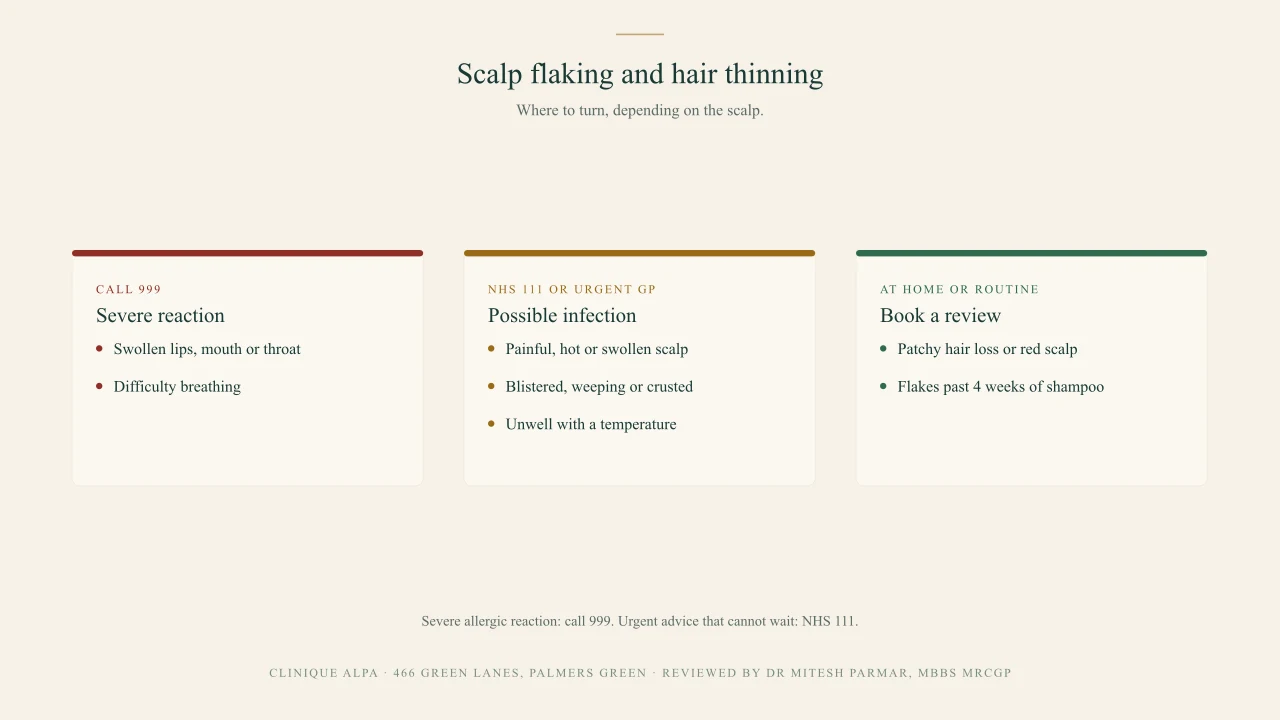
Call 999 for a severe allergic reaction with swelling of the lips, mouth or throat or difficulty breathing. Ask for an urgent GP appointment or NHS 111 advice if the scalp becomes painful, hot, swollen, blistered, weeping or crusted, or you feel unwell with a temperature. Book promptly if you notice patchy hair loss, a red or scaly scalp patch, or hair loss with other changes such as tiredness or feeling cold. Book a routine appointment if flakes continue after at least 4 weeks of an anti dandruff shampoo.
How do we approach this at Clinique Alpa?
You see a doctor for 30 minutes at 466 Green Lanes. A clinic consultation is £100. We examine the scalp, discuss what has been tried, decide on tests only where they would change the plan and agree a review date. With your consent, a summary goes to your NHS GP. See also getting a second opinion if you have already had advice.
Common questions
Can a flaky scalp cause hair loss?
Flaking alone does not usually cause it, but a red scaly scalp with patchy loss can be a fungal infection, which needs a doctor.
How long should I use dandruff shampoo?
The NHS says up to 4 weeks. If it has not helped after that, see a GP.
What is the treatment for flaky scalp and hair loss?
It depends on the cause of each, which is why the scalp needs examining first. Treatments range from the right shampoo to treatment for infection or checks for an underlying cause.
Sources: NHS: dandruff and NHS: hair loss and NHS: ringworm.
Drafted with AI assistance, clinically reviewed by Dr Mitesh Parmar, MBBS MRCGP, Principal GP and Clinical Director at Clinique Alpa, 466 Green Lanes, Palmers Green, London N13 5PA. This article is general information, not personal medical advice. In an emergency call 999. For NHS advice call 111 or visit nhs.uk.