
Repeated chest infections cause a particular kind of weariness. Each one starts with a cold that moves down, a cough that turns thick and coloured, and a course of treatment that works well enough for a week. Then the cough returns, and everyone, including the doctor, begins to wonder whether this is a new infection or the old one coming back.
By the third or fourth round the practical question changes. It is no longer which treatment to try next. It is why this chest keeps getting infected, and what has not yet been looked for.
Chest pain, signs of a stroke, severe breathlessness, heavy bleeding, a severe allergic reaction or symptoms of sepsis need 999 or A&E immediately. For urgent advice that cannot wait, call NHS 111.
When do repeated chest infections need a closer look?
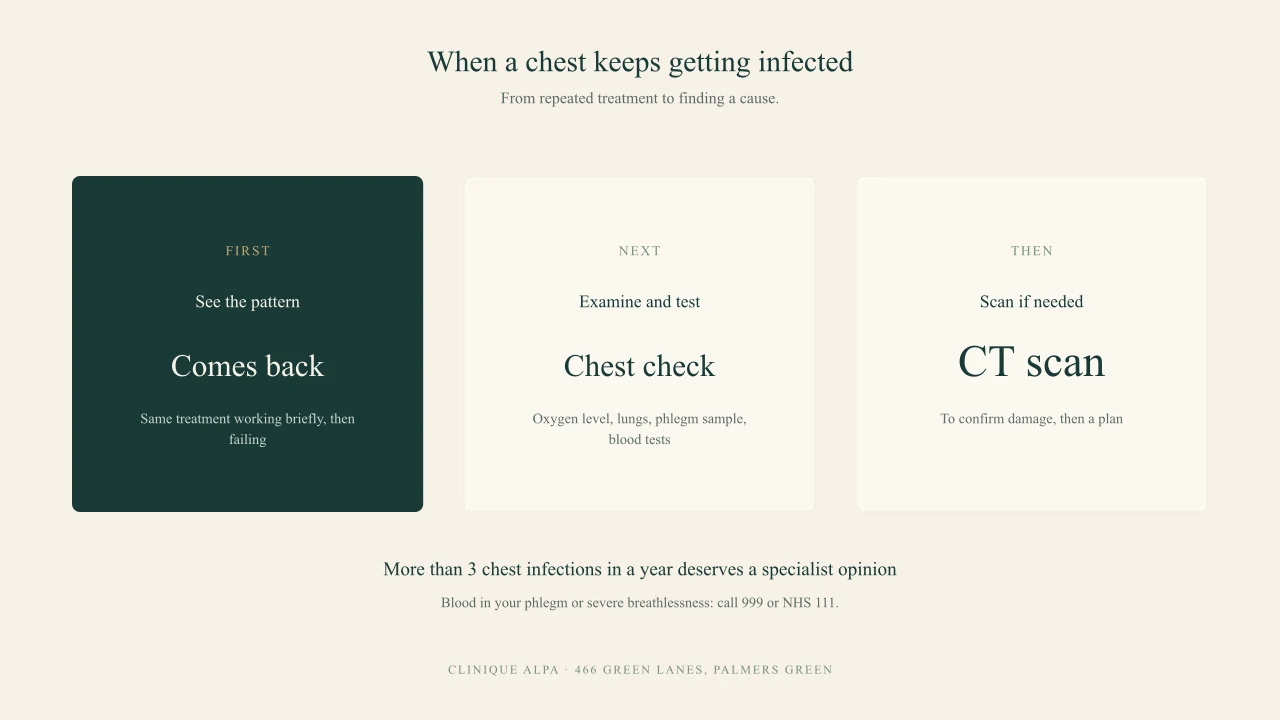
One chest infection after a cold is common and usually passes by itself. The NHS says symptoms normally improve within 7 to 10 days, and that the cough and mucus can last up to 3 weeks. I start to look harder when infections come back in a pattern: the same treatment working briefly and then failing, a cough that never fully clears between episodes, or a new breathlessness that was not there before.
The NHS bronchiectasis page puts a number on it. More than 3 chest infections in a year is the point at which a specialist may discuss long term preventive treatment. I use that as a marker for when a pattern deserves proper investigation, not as a rule that waits for the third infection. A person who is over 65, has diabetes or has a long term heart, lung or kidney condition should be seen sooner, as the NHS chest infection page advises.
Repeated chest infections cause: what do doctors look for?
The search is for something that makes the lung easy to infect or slow to clear. The NHS lists the main possibilities for bronchiectasis, where the airways become wider than normal and hold on to mucus: damage from an earlier severe infection such as pneumonia, tuberculosis, whooping cough or COVID 19; asthma or COPD; inhaled substances that harm the lungs; immune system problems; and conditions such as rheumatoid arthritis and inflammatory bowel disease. For many people no cause is ever found.
That is the honest answer to what causes recurrent chest infections. There is rarely one cause. It is a list of possibilities to work through, and the work is mostly a matter of asking the right questions in the right order and then choosing the tests that answer them.
Can repeated chest infections cause lung damage?
They can, and this is the reason I do not like to see the same treatment repeated without a pause to think. Bronchiectasis is itself a form of lasting damage to the airways, and it often follows a severe infection. The damage then makes further infections more likely, which is the loop I am trying to break. The NHS says bronchiectasis usually cannot be cured but can be managed, and managing it well depends on recognising it.
I would not want anyone to read that and assume the worst. Most people with frequent chest infections do not turn out to have it. The point is that the question is worth asking early, because the answer changes what we do.
What do I look at in a constant chest infection?
I begin with the sputum. Colour, thickness, how much, and whether it varies through the day all tell me something. A cough that produces a lot of mucus every morning is a different conversation from a dry cough that comes in bursts. I ask what each earlier course of treatment did, for how long, and how quickly things changed after it finished.
Then the background that shapes risk: asthma or breathing problems since childhood, smoking now or in the past, earlier pneumonia, other long term illnesses, the medicines taken for them, and whether there are signs of a weaker immune system such as unusual infections elsewhere. I ask about weight loss, night sweats and fevers, because those change how fast I want answers. People often mention them as an afterthought, so I ask directly.
The examination covers the oxygen level on a pulse oximeter, pulse, temperature and blood pressure, then both lungs with a stethoscope. Crackles that sit in the same part of the chest visit after visit tell a different story from wheeze across the whole chest. I look at the fingers, the neck and the legs as well, since the chest is only one part of the picture.
After that comes the decision about tests, and this is where I think a private appointment adds the most. The NHS describes a phlegm sample taken while you are unwell, a chest X ray, spirometry and blood tests as the first steps, and a CT scan to confirm bronchiectasis if those point that way. I explain which of these I would choose, what each would show and what the result would change. Blood tests are priced on the blood test prices page, and the scans we can arrange are on the investigations page.
If the tests point to something that needs a specialist, I say so plainly and write up what I found so that the next person does not start from the beginning. If they do not, we agree what to watch and when to look again, with a date rather than the vague advice to return if it gets worse.
From Dr Mitesh Parmar
I want to know whether each episode showed up on an X ray, how long it took to settle, and whether smoking, reflux or swallowing trouble play a part. A repeat infection in the same area needs a scan. Coughing blood, weight loss or night sweats needs prompt review.
When should I come in sooner?
Seek help without waiting for a routine slot if you notice:
- Blood in your phlegm: ask for an urgent GP appointment or call NHS 111. More than a few streaks of blood, or severe difficulty breathing, needs 999.
- You are more breathless than usual, or a cough that was settling is getting worse.
- A high temperature with chest infection symptoms, particularly if you already have a lung condition.
- A cough that has lasted more than 3 weeks.
- Weight loss you cannot explain, or night sweats.
If a single infection is what you are dealing with today, my article on when chest infection treatment actually helps covers that, and the page on a chest that reinfects on one side looks at one particular pattern.
What can I do to reduce the chance of another infection?
The NHS suggests asking your GP about the yearly flu vaccine and the pneumococcal vaccine, stopping smoking if you smoke, and cutting down on alcohol. These are modest steps but they are the ones with evidence behind them, and they sit alongside finding the cause rather than instead of it.
How do we approach this at Clinique Alpa?
A clinic consultation is 30 minutes with a doctor at 466 Green Lanes for £100. The time is the point: enough to go back through every earlier course of treatment, listen properly to the chest and decide on tests without hurrying. With your consent, a summary goes to your NHS GP so that nothing is repeated twice. See appointments and fees for every price.
Common questions
What causes recurrent chest infections?
Often an earlier severe infection, asthma, COPD, a weaker immune system or another long term condition. In many people no single cause is found.
Why does a chest infection keep coming back?
It may not be a new infection each time. The airways may be holding on to mucus, or the first one may never have fully cleared, which is why a pattern is worth investigating.
Do repeated lung infections always mean lung damage?
No. Most people with frequent chest infections do not have lasting damage, but it is worth ruling out early because the treatment changes.
Drafted with AI assistance, clinically reviewed by Dr Mitesh Parmar, MBBS MRCGP, Principal GP and Clinical Director at Clinique Alpa, 466 Green Lanes, Palmers Green, London N13 5PA. This article is general information, not personal medical advice. In an emergency call 999. For NHS advice call 111 or visit nhs.uk.