
The treatment worked, so it was stopped. A few weeks later the old pattern crept back: a poo only every few days, a tummy that swells by the evening, an occasional complaint of pain that eases after a visit to the toilet. Now there is a long list of things that have been tried, and your child has become wary of the bathroom.
Recurrent constipation in children is common, and it is common for the explanation to be simpler than the family fears. It is also common for the plan to end too early. This article explains what I look at, and when bloating and constipation together need a closer look.
Chest pain, signs of a stroke, severe breathlessness, heavy bleeding, a severe allergic reaction or symptoms of sepsis need 999 or A&E immediately. For urgent advice that cannot wait, call NHS 111.
Why does constipation keep coming back in children?
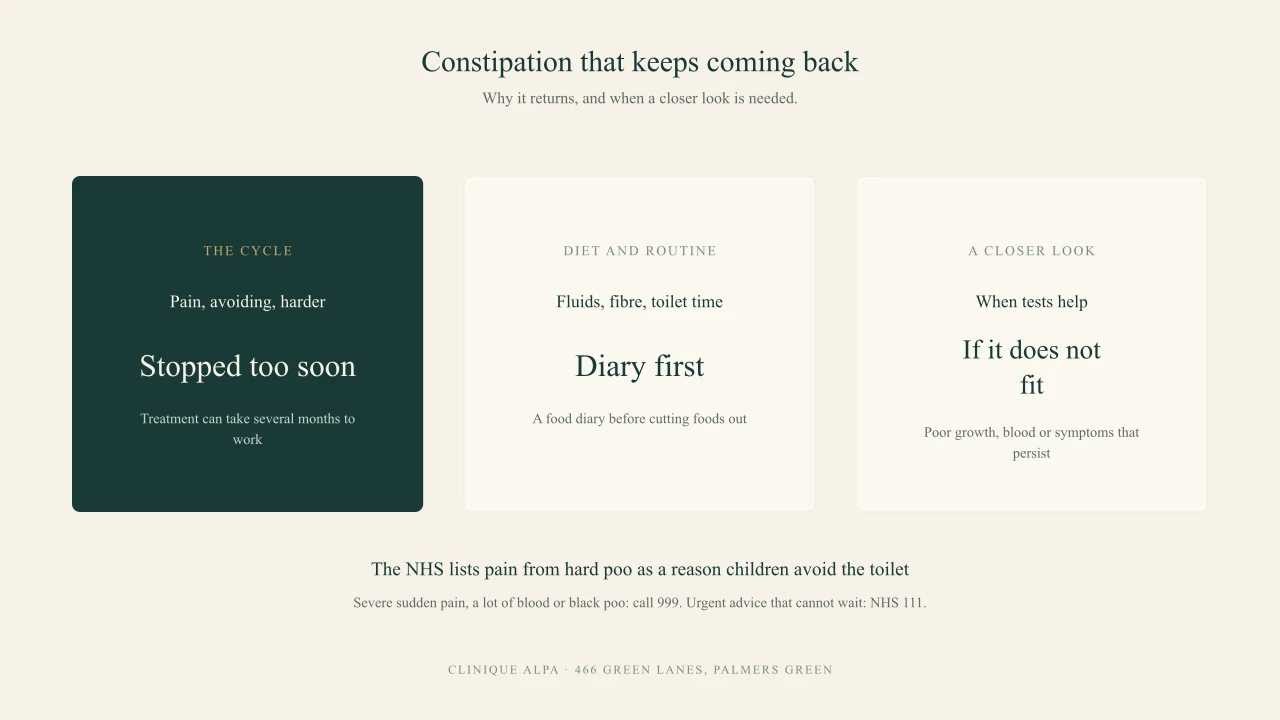
Most often because the underlying cycle was never fully broken. A hard, painful stool makes a child avoid the toilet. Avoiding it makes the stool harder. The NHS describes exactly this: pain from hard poo can make a child avoid pooing, which makes constipation worse. Then the bowel stretches, the child stops feeling the urge, and the cycle sustains itself.
The NHS also says treatment can take several months, that a GP may advise continuing laxatives for a while after the constipation clears to keep stools soft and prevent it returning, and that laxatives may make overflow soiling worse at first. Stopping too soon is one of the commonest reasons for relapse. That does not mean treatment must be endless. It means the pace of stopping should be agreed, not improvised.
What does a doctor check in chronic constipation in children?
What I look at in clinic starts with what a normal day looks like. How often, what type, how much effort, and whether there is any pain. Whether the child sits on the toilet regularly, for how long, with feet supported, and whether the toilet routine is calm. What they eat, what they drink, and how much they move. What has changed recently: a new school, a new baby, a house move, since the NHS names worry and anxiety as causes.
I ask about the signs that suggest overflow. Soiled pants in a child who is old enough to be dry can be liquid stool leaking around a hard mass, which is why a family can be told a child has diarrhoea when the real problem is the opposite. I ask what has been tried: diet changes, medicines, probiotics, supplements, and how long each was used. And how the child feels about all of it, because a child who is embarrassed or frightened will often hide the problem.
Then the examination. I check growth, hydration and general health. I feel the tummy for a hard, loaded bowel and for tenderness. I look at the skin around the bottom for tears, redness or soiling. I check the back and legs briefly where it is relevant. A rectal examination is not routine and is done only when the picture requires it, with the child and parent fully informed.
The question underneath is whether this is simple functional constipation, or whether something else is contributing. Bloating on its own is often trapped wind or constipation, as the NHS notes. But persistent symptoms deserve more thought. The NHS lists constipation, bloating, stomach aches and diarrhoea among the gut symptoms of coeliac disease, and says children with it may not grow at the expected rate. That is not a reason to test every constipated child, which would be wrong. It is a reason to ask about growth, family history and other symptoms, and to test when the story calls for it.
Diet is the other area. A varied diet with plenty of fruit and vegetables, enough fluid and regular activity is the foundation. A food and symptom diary is a sensible first step when parents suspect a trigger, and the NHS recommends one. It also advises against home tests that claim to diagnose food intolerance, because there is limited evidence they are accurate, and against cutting out foods without advice from a GP or dietitian, as children can miss essential vitamins and minerals. If a restricted diet has been started already, I would rather review it than reverse it blindly.
From Dr Mitesh Parmar
The treatment often stops too soon. I ask about diet, drinks, toilet routine, school toilets and whether the child holds on. I also feel the tummy and check for soiling. Children need reassurance, not pressure. Blood in the stool, vomiting, a swollen tummy or severe pain needs prompt review or A&E.
When does constipation and bloating in a child need tests?
When the picture does not fit simple constipation. Poor growth, a family history of coeliac disease, ongoing diarrhoea, blood in the poo, or symptoms that persist despite a proper trial of treatment are the kinds of features that move tests up the list. The tests are chosen to answer a specific question, such as a blood test for coeliac disease, and explained to you beforehand. If coeliac disease is a possibility, I explain the sequence before any diet is changed. Stool tests have a limited place, and I use them when they would change the plan.
What is the treatment for constipation in children?
In outline: soften the stool, keep it soft until the bowel has recovered, and make the toilet a calm place. That means fluids, fibre, activity, a regular routine after meals and a footrest so the feet are flat. It usually means a medicine to soften the stool for a period, which I discuss with you after examination. Praise your child whether or not they poo, and do not get cross about soiling, because it is not deliberate. ERIC, the children's bowel and bladder charity, offers support, and the NHS lists it.
Chronic constipation in children: when to worry?
See a GP if the constipation is not responding, if pain or bloating keeps returning, or if you notice a lump in the tummy. Get an urgent GP appointment or call NHS 111 if the pain suddenly gets much worse, or there is blood in the poo. Call 999 or go to A&E if the pain started suddenly and is severe, your child is vomiting blood or green fluid, there is a lot of blood from the bottom or the poo is black and sticky, your child cannot poo or pass wind, or there is a rash that does not fade when pressed. Do not drive to A&E yourself.
How do we approach recurrent constipation at Clinique Alpa?
You see Dr Parmar for 30 minutes at Palmers Green, with a parent present throughout. The fee is £100 and is shown before you book. We go through the pattern, the treatment history and the diet, examine your child, and agree a plan with a pace for stopping treatment. A follow up within 14 days is available. With your consent, a summary goes to your NHS GP.
If your baby is the one with the problem, read constipation in babies first. The basics are in our constipation guide, and the wider service is on the children's health page.
Common questions
Is it normal for a child to need treatment for months?
Yes. The NHS says treatment can take several months, and a GP may continue it for a while after the constipation clears.
Can probiotics or a food diary fix it?
A diary can help find triggers. The foundation is still fluids, fibre, activity, a calm toilet routine and, where needed, a stool softener.
More in this series: constipation in young children
Drafted with AI assistance, clinically reviewed by Dr Mitesh Parmar, MBBS MRCGP, Principal GP and Clinical Director at Clinique Alpa, 466 Green Lanes, Palmers Green, London N13 5PA. This article is general information, not personal medical advice. In an emergency call 999. For NHS advice call 111 or visit nhs.uk.