
The nappy bin has been quiet for days. Your baby is feeding, passing wind and smiling at you, but the poo you were braced for has not arrived, and a day or two on, you have started to count. Someone has told you it is normal for breastfed babies. Someone else has told you it is not. Both are partly right, and that is the problem.
Baby constipation is one of those worries where the number of days is the least useful fact. What matters is what comes out when it finally does, how your baby feels meanwhile, and what is happening with feeding. That is what this article is about.
Chest pain, signs of a stroke, severe breathlessness, heavy bleeding, a severe allergic reaction or symptoms of sepsis need 999 or A&E immediately. For urgent advice that cannot wait, call NHS 111.
What is normal for a breastfed baby?
Stool patterns in the early months vary a great deal, and a breastfed baby can have a pattern that looks nothing like a formula fed baby's. Some pass something every feed, and some go several days between motions and then pass a large soft stool without any fuss. If the stool is soft, your baby is comfortable, feeding well and passing plenty of wet nappies, an infrequent pattern on its own is not what I would call constipation.
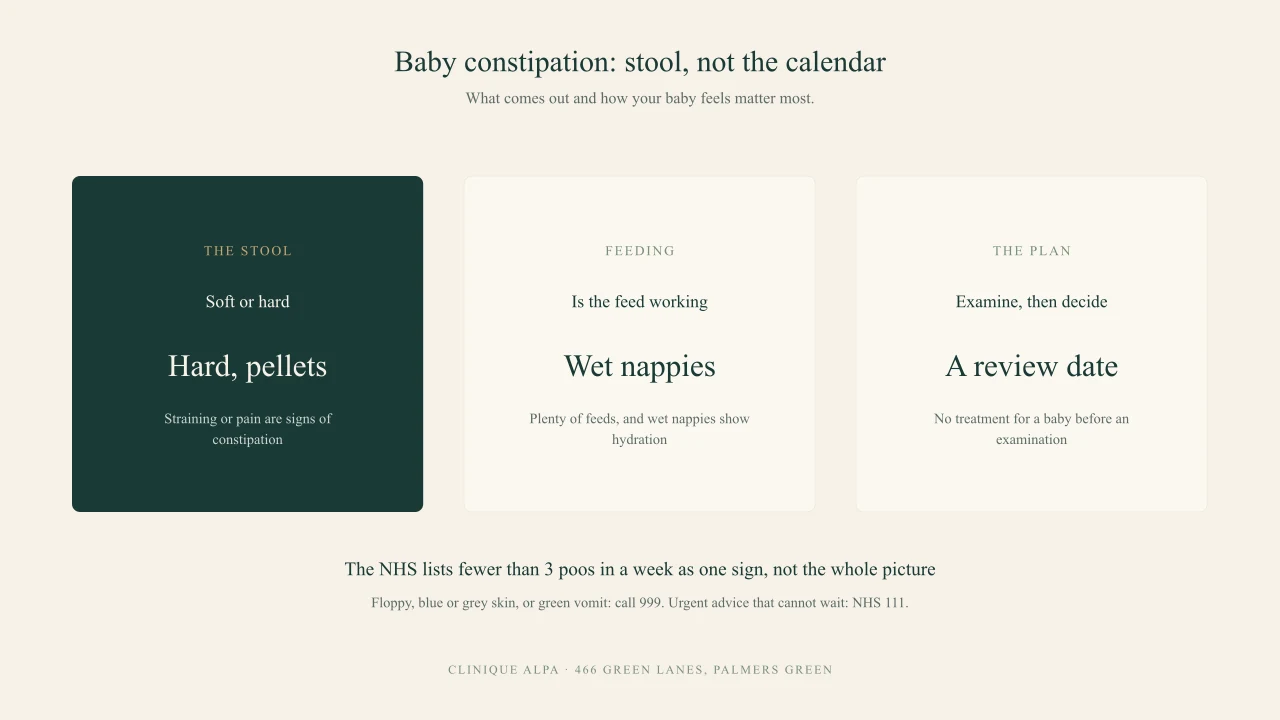
Constipation is about the stool and the baby, not the calendar. The NHS lists fewer than 3 poos in a week, large hard stools or small pellets, straining or pain on passing, bleeding from a hard stool, and poor appetite or tummy pain that eases after a poo as signs of constipation in babies and children. A baby who goes a week between soft nappies and a baby who strains and cries over small hard ones are very different cases.
What does a doctor check when a baby is constipated?
What I look at in clinic starts with feeding, because it explains more than any other single thing. Is your baby on the breast, the bottle or both? How often do they feed, and how long does each feed last? Does the feed seem effective, with swallowing you can hear and a baby who settles afterwards? If formula is part of the picture, how is it made up and what is the water? The NHS says that formula fed babies can have extra water between feeds, and that for babies under 6 months it must be cooled boiled water. A breastfed baby who is not yet on solids needs plenty of feeds. Weaker or stronger formula than the tin recommends changes stools in ways parents do not expect.
Then output. How many wet nappies in a day, because that is how I judge whether hydration is adequate. What the poo is like when it comes: colour, consistency, size, any blood. Whether there is passing of wind, and whether the baby draws up their legs, goes red in the face or cries with it. What happened in the first days of life, and whether this has been the pattern since birth or a change. A change after a switch in feeding, after starting solids, or during an illness points to a different explanation from a lifelong pattern.
I ask about regurgitation, which is common and often normal in young babies, and how much weight the baby has gained. I ask who is looking after the baby and how the household is coping, because a worry that has run on for days affects feeding.
Then I examine. I look at the baby as a whole: alertness, tone, colour, hydration, the soft spot on the top of the head. I feel the tummy, which should be soft, and I look at the nappy area and the bottom, since a small crack or tear from a hard stool can cause pain and make a baby hold on. I check the skin elsewhere, because it often gives clues to feeding or allergy.
The aim is to separate three things. A normal pattern in a thriving baby, where the right answer is reassurance and a plan to watch. Constipation from feeding or fluid issues, where small changes help. And the occasional baby where something else needs looking at, in which case I say so and arrange it. I do not start treatment for constipation in a baby without examining them. The NHS notes that a GP may recommend laxatives for children eating solid foods, and that is a different situation from a young baby on milk alone.
From Dr Mitesh Parmar
What matters is consistency, not the number of nappies. Soft, even if infrequent, is usually fine. I ask about feeding, straining with hard pellets, and any blood. A baby with a swollen tummy, green vomit, or who simply seems unwell needs urgent care: NHS 111, A&E or 999.
What are the baby constipation home remedies that actually help?
Few of the remedies passed around online are well supported, and some are unsafe. What does help is simple. Feed on demand, check the feed is effective, and make sure formula is made up exactly as directed. For a baby on formula, extra cooled boiled water between feeds. Gentle movement, such as bicycling the legs, and a warm bath can ease discomfort for some babies. Once solids have started, fruit, vegetables and fibre in the diet. Do not give honey to a baby under 12 months. Do not add medicines or herbal products without advice.
Is there baby constipation treatment at home?
For a young baby, treatment is a conversation, not a purchase. If feeding changes do not work, I discuss the options with you after an examination and decide what is safe for your baby's age. Treatment can take time. The NHS says treatment in children can take several months to work, which is more relevant to older children than to a baby, but it is a reminder not to expect an instant change.
When should a constipated baby be seen sooner?
Call NHS 111 or get an urgent appointment if:
- you are worried about a baby under 12 months
- your baby is feeding much less, or refusing feeds
- there has been no wet nappy for 12 hours or more
- the tummy looks swollen or the pain suddenly gets much worse
- there is blood in the poo
Call 999 or go to A&E if your baby is vomiting green or yellow green fluid, or blood, is floppy or hard to wake, has blue, grey or pale skin, lips or tongue, struggles to breathe, or has a rash that does not fade under a glass. The NHS also says a baby under 3 months with a temperature of 38C or higher, or 3 to 6 months with 39C or higher, needs urgent help. Do not drive yourself to A&E.
How do we approach baby constipation at Clinique Alpa?
You see Dr Parmar for 30 minutes at Palmers Green, with a parent present throughout. The fee is £100 and is shown before you book. I go through feeding and output, examine your baby, explain what I find and agree a plan, with a clear point to review. A follow up within 14 days is available. With your consent, a summary goes to your NHS GP. If a doctor needs to see your baby urgently elsewhere, I will say so and help arrange it.
If constipation continues into the toddler years, see recurrent constipation in children. The wider basics are in our constipation guide, and we explain how we see babies on our children's health page.
Common questions
How long can a breastfed baby go without a poo?
It varies, and a soft stool in a comfortable, feeding baby is not constipation. If the poo is hard, your baby strains, or you are worried, have them checked.
Can I give my baby water for constipation?
For a baby on formula, small sips of cooled boiled water between feeds are fine. A breastfed baby not yet on solids needs plenty of feeds, so ask a doctor first.
More in this series: constipation in young children
Drafted with AI assistance, clinically reviewed by Dr Mitesh Parmar, MBBS MRCGP, Principal GP and Clinical Director at Clinique Alpa, 466 Green Lanes, Palmers Green, London N13 5PA. This article is general information, not personal medical advice. In an emergency call 999. For NHS advice call 111 or visit nhs.uk.