
It usually starts with someone else's news. A brother, a colleague or a man from the same football team has been told he has prostate cancer, and it was found on a blood test he asked for. Within a week the question has moved from his life to yours. You feel well, nothing has changed, and you would still like to know.
The question is whether to have a PSA test, and it is a fair one. It is also less simple than a cholesterol check, because the conversation before this test matters as much as the number after it. Here is how I have that conversation in clinic.
Chest pain, signs of a stroke, severe breathlessness, heavy bleeding, a severe allergic reaction or symptoms of sepsis need 999 or A&E immediately. For urgent advice that cannot wait, call NHS 111.
What can a PSA test tell you, and what can it not?
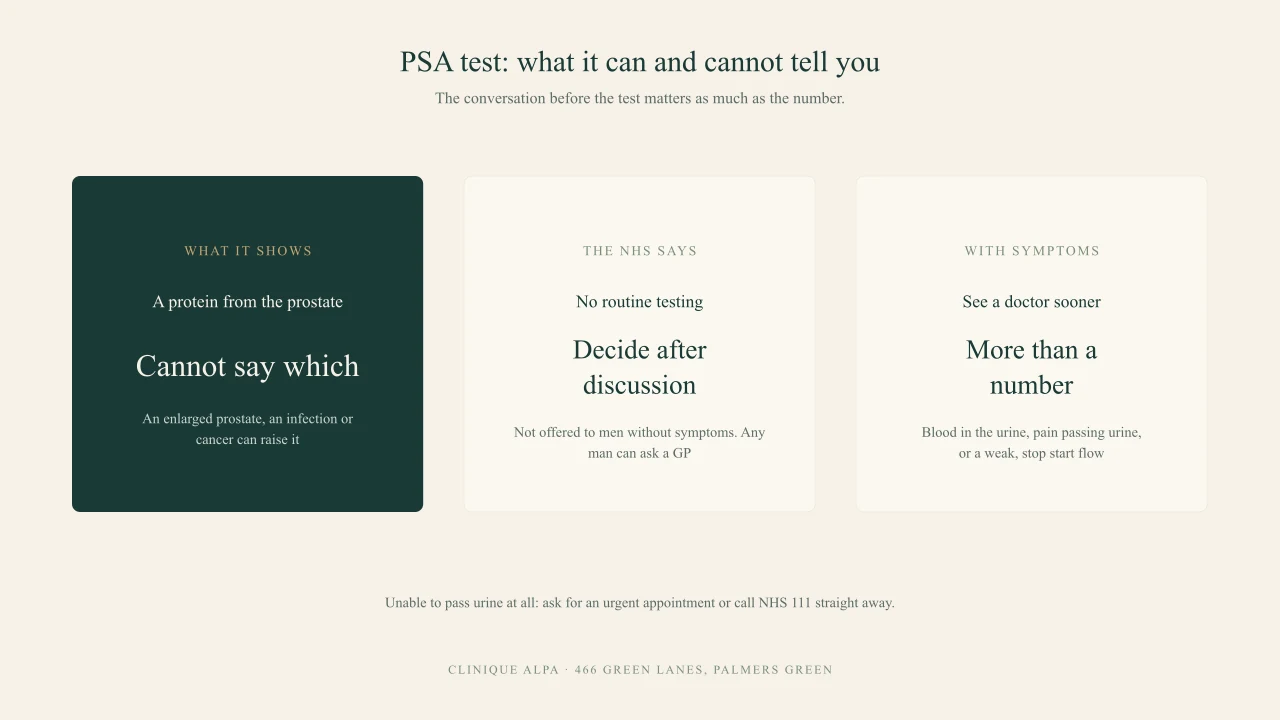
PSA stands for prostate specific antigen, a protein made by the prostate gland. A little of it reaches the blood, and the test measures how much. A raised level can be a sign of a prostate problem. It cannot say which one. An enlarged prostate raises it, a urine infection raises it and prostate cancer can raise it, and the number alone does not separate them. The NHS puts it in one line: a high PSA does not mean you have cancer.
The reverse holds as well. A result inside the laboratory's range is reassuring, but it cannot settle every concern, which is why symptoms still need assessing after a normal result.
That is the reason routine testing is not currently offered on the NHS to men without symptoms. The NHS page on the test sets out the trade. The possible benefit is that finding a cancer early may make it easier to treat. The risks are that the result may not be accurate, and that it may lead to tests and treatment you did not need. Any man, and anyone with a prostate, can ask a GP about it and decide after that discussion. Our guide to what PSA can and cannot tell you covers the background. This article is about the decision itself.
What do I ask before arranging the blood test?
What I look at in clinic is the reason behind the request, because it decides what kind of test this is.
Whether there are symptoms. Passing urine more often, a sudden urge, getting up several times a night, a weak or stop start flow, blood in the urine, or new difficulty with erections. Men often put these down to age and mention them only when asked. If any are present, this is no longer a screening question. It is a symptom that needs working out, and the blood test becomes one part of an assessment that also includes a urine test and, with your agreement, an examination of the prostate. A chaperone is available for that examination.
Where your risk sits. Prostate cancer mostly affects men over 50. The NHS names several things that raise the risk: a Black African or African Caribbean background, a father or brother who has had prostate cancer, close relatives with breast or ovarian cancer, and an inherited fault in the BRCA2 gene. If one of these applies to you, the balance of the decision shifts, and I would rather you asked early than waited for a symptom.
What you would do with a raised result. This is the piece most people miss. A raised level is usually followed by a repeat test. If it stays high, the next step is a referral to a specialist for further tests, such as an MRI scan and sometimes a biopsy. Most men, once this is laid out, still want the test. A few realise they are not ready for what a borderline result would set in motion, and choose to wait and look again in a year. Both are reasonable decisions. What I try to prevent is the blood being taken before that thought has happened.
What might falsely raise it. For 48 hours before the sample, the NHS advises avoiding ejaculation, anal sex, exercise that leaves you out of breath and cycling. After a urine infection, wait until 4 to 6 weeks after it has cleared. I ask about all of this before the blood is taken, because a result pushed up by a long bike ride costs weeks of worry and a repeat that need not have happened.
What is underneath the request. Often it is the friend. A man who has watched someone his own age go through treatment is not really asking about a protein. He is asking whether the same thing is quietly happening to him. That deserves a direct answer, including the uncomfortable part: one blood test narrows the question but does not close it.
Then there is how I read the result. I do not read it as a pass or a fail. The laboratory prints a range, and what the figure means for you depends on your age, the size of the prostate, any symptoms and, above all, earlier results where they exist. The pattern matters more than the single reading. A level that has been steady for years tells a different story from one that has climbed between 2 tests. So if you have had PSA measured before, bring the figures and the dates.
Sometimes the right plan after a slightly raised result is simply to repeat it in a few weeks, with the 48 hour rules followed properly this time. I would rather say "I do not know yet" and look again than send someone for a scan on the strength of one number.
From Dr Mitesh Parmar
Before a PSA test, I ask about urinary symptoms, family history and whether you have recently had an infection, ejaculated, cycled or had a catheter, because these can push the number up. I also want you to understand that a raised result usually leads to more questions, not a diagnosis.
When should you see a doctor sooner?
Do not wait for a routine slot, and do not rely on a blood test alone, if any of these apply:
- Blood in your urine, which may look pink, red or brown, or blood in your semen.
- Pain when passing urine.
- Being unable to pass urine at all. Ask for an urgent appointment or call NHS 111 straight away.
- A flow that has become weak, hesitant or stop start over recent months.
- New pain in the lower back together with weight loss you cannot explain.
Most of these turn out to have an ordinary cause. They still need a doctor, not only a number.
How does this work at Clinique Alpa?
You can ask your NHS GP about this test, and for many men that is the right place to start. If you would like more time for the discussion, a clinic consultation here is 30 minutes with a doctor at 466 Green Lanes for £100. If we agree the test is worth doing, the blood is taken at the clinic. The prostate profile on our list measures total and free PSA. Its price is on the blood test prices page, the listed price includes taking the sample, and the full range of profiles is on private blood tests.
The result is reviewed by a doctor, and the clinic will tell you when to expect it. If it needs repeating, I give you a date. If it needs a specialist, a referral letter is written where clinically appropriate after assessment, and it is included in the consultation fee. With your consent, a summary goes to your NHS GP, because private care here sits alongside the NHS and does not replace it. If the layout of the report is what puzzles you, I have written about how to read a blood test report.
Drafted with AI assistance, clinically reviewed by Dr Mitesh Parmar, MBBS MRCGP, Principal GP and Clinical Director at Clinique Alpa, 466 Green Lanes, Palmers Green, London N13 5PA. This article is general information, not personal medical advice. In an emergency call 999. For NHS advice call 111 or visit nhs.uk.