
The question arrives in the doorway, often from a son or daughter rather than the person themselves, asking whether this is just age or something else. They have noticed the repeated questions, the missed appointments, the bills left unopened. The person sitting beside them usually thinks things are fine, or is quietly frightened that they are not.
That is the real question behind a memory loss assessment. Not a verdict on dementia handed over in the first five minutes, but a plain account of what is happening, whether any of it is treatable, and what to do next. A first assessment answers some of that and plans the rest.
Chest pain, signs of a stroke, severe breathlessness, heavy bleeding, a severe allergic reaction or symptoms of sepsis need 999 or A&E immediately. For urgent advice that cannot wait, call NHS 111.
What does a memory loss assessment involve?
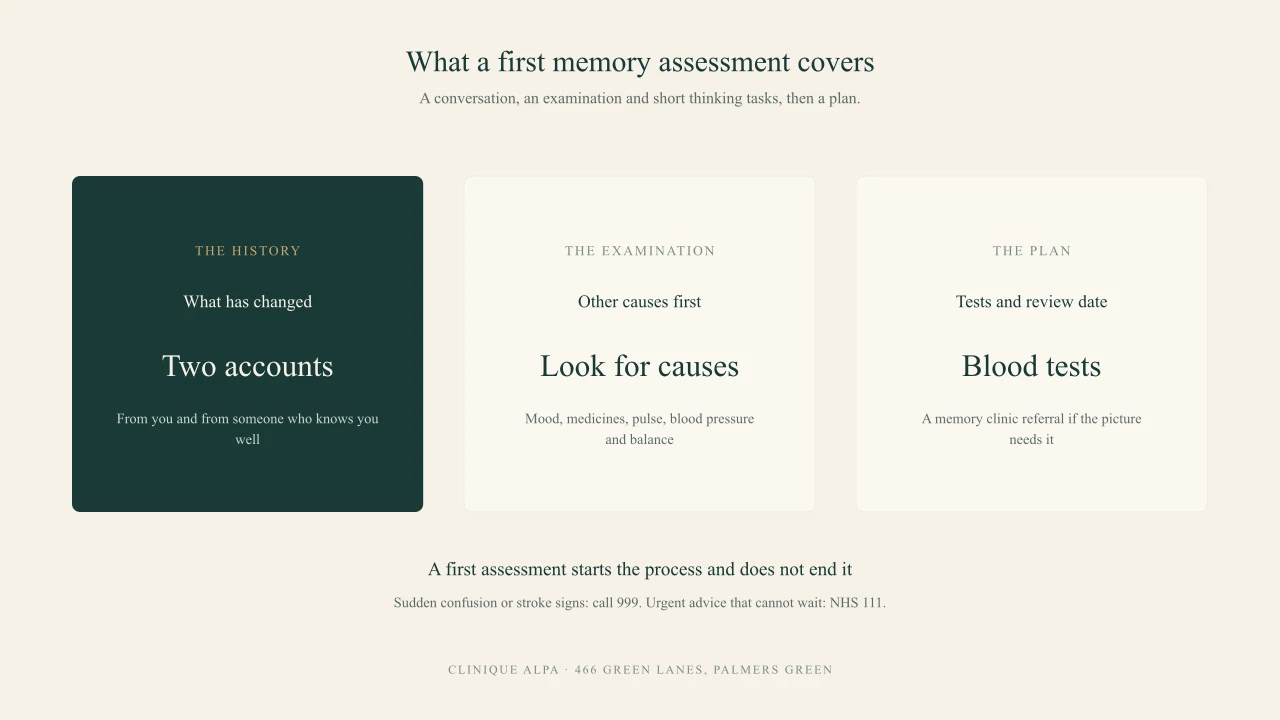
A memory loss assessment is a structured conversation, an examination and a set of short thinking tasks, followed by a plan. There is no single test for dementia. The NHS describes diagnosis as a combination of assessments, and a first appointment is the start of that process, not the end of it.
When this comes up in consultation, the most useful part is almost always the history, and the most useful person in the room is often the one who is not the patient. I ask the person to describe what they have noticed, then I ask whoever knows them well to describe what they have seen. The two accounts frequently differ, and the difference is itself information. The NHS advises that someone who knows you well should come if possible, and I would say the same without hesitation.
What do I ask about the memory problem?
What I look at in clinic begins with the shape of the change rather than the headline. I want to know how it started, whether it came on slowly or in steps, and whether anything happened around the time it began: an illness, a fall, a bereavement, a change of medicines, a bad run of sleep. Slow, steady change points one way. A sudden change, or a change that comes and goes through the day, points another.
I ask what has actually become harder. The NHS lists the early signs as memory loss, difficulty concentrating, trouble with familiar daily tasks, struggling to follow a conversation or find the right word, confusion about time and place, and mood changes. In practice I turn those into everyday questions. Who manages the money now? Who keeps track of the medicines? Can the person still use the phone, the cooker, public transport? Have they got lost somewhere familiar? The answers show how far the change has reached into daily life.
Then I ask about mood and sleep, because low mood and anxiety can look very like memory trouble, and the two can sit together. I ask about alcohol, hearing and eyesight, since a person who cannot hear or see well will appear more confused than they are. I go through every medicine, including the ones bought over the counter, because some medicines affect memory and concentration and a review sometimes changes the picture on its own.
What do I examine, and what are the thinking tasks?
The examination is practical. Pulse and blood pressure, including whether the pressure drops on standing, since dizziness on standing can pass for confusion. Balance and the way someone walks, which can reveal a problem that is not just memory. I look for signs of infection, dehydration and thyroid trouble, and I check whether a stroke could have left anything behind.
The memory and thinking tasks are short. They check memory, concentration, language and awareness of time and place. The NHS notes that a GP may use a short screening tool, and also notes plainly that such tests cannot diagnose dementia. They show whether there is a difficulty that needs further investigation. A low score on a nervous day is not a diagnosis, and a normal score does not close the question if the story from the family is clear.
The piece most people miss is how many things can make memory worse without being dementia. The NHS names depression, anxiety, delirium from an infection, an underactive thyroid and side effects of some medicines. Several of these are treatable. Finding one does not always mean the memory problem is solved, but it changes what I recommend and in which order.
From Dr Mitesh Parmar
I always ask a relative or friend to come, because they see what the person cannot. I check blood tests, mood, hearing, sleep and treatment side effects, since several can mimic memory loss. A short memory test is only one piece. Sudden confusion over a day or two needs urgent help, so call NHS 111 or 999.
What happens after the first assessment?
Usually there are three strands. First, tests to look for other causes. The NHS describes blood tests that typically check liver and kidney function, thyroid function, blood sugar over time, and vitamin B12 and folate levels. Second, if other causes are ruled out or the picture is still unclear, a referral to a specialist service such as a memory clinic, where more detailed memory tests are done and a brain scan, usually an MRI, may be arranged. Third, a plan for the weeks in between, which matters more than people expect. I cover the tests, the scan and the safety of the home in memory loss and dementia safety at home, and how decisions about care are approached in a separate piece on assessing decisions in dementia.
I give a concrete review date rather than a vague wait and see, and I tell the family what would make me bring the date forward. With your consent, a summary goes to your NHS GP, because the NHS pathway to a memory clinic runs through the GP and private care here works alongside it.
When should you not wait for an appointment?
Memory trouble that has crept up over months is a reason to book. Some changes are not, and need quick help:
- Sudden confusion, or a sudden change in how someone is thinking or talking, especially with a fever or after a fall: call NHS 111, or 999 if they cannot be woken or are very unwell.
- Weakness on one side of the body, a drooping face or slurred speech: call 999. The NHS says stroke like symptoms need urgent medical attention.
If the concern is slower but is starting to affect safety, say so when you book.
What are the most common questions about memory loss evaluation?
Is there a memory loss assessment test on the NHS?
Yes. The NHS route begins with an appointment with your GP, who asks about symptoms, examines you, may arrange blood tests and uses a short memory test. If needed, the GP refers you to a specialist or memory clinic.
Can a memory loss evaluation be done near me?
You can have a first assessment at our clinic at 466 Green Lanes, Palmers Green. If travelling is difficult, a home visit lasts 60 minutes and is from £250 on a weekday.
How do we approach this at Clinique Alpa?
A clinic consultation is 30 minutes with a named doctor and costs £100. If 30 minutes is not enough we plan a second visit rather than hurrying. We do not diagnose dementia in a single sitting, and we say so. We explain what we found, what we suggest and what you can do while waiting for any NHS referral. This is private care alongside the NHS, never a replacement for your NHS GP.
More in this series: memory concerns
Drafted with AI assistance, clinically reviewed by Dr Mitesh Parmar, MBBS MRCGP, Principal GP and Clinical Director at Clinique Alpa, 466 Green Lanes, Palmers Green, London N13 5PA. This article is general information, not personal medical advice. In an emergency call 999. For NHS advice call 111 or visit nhs.uk.