
The request usually arrives as a practical problem. A family cannot agree whether a relative can stay at home, a care provider needs to know who may sign for a change in support, or a solicitor needs a clear medical view on a single decision. Underneath it is a delicate question that nobody wants to answer by guesswork: can this person decide this for themselves?
That is what mental capacity assessments in dementia are for. The answer is rarely a blanket yes or no. It depends on the decision, the moment and the help the person is given to make it, and a good assessment looks at memory, balance and everyday function only as far as they bear on that one question.
Chest pain, signs of a stroke, severe breathlessness, heavy bleeding, a severe allergic reaction or symptoms of sepsis need 999 or A&E immediately. For urgent advice that cannot wait, call NHS 111.
What do mental capacity assessments in dementia actually test?
The Mental Capacity Act protects and empowers people who may lack capacity to make their own decisions. The NHS sets out five principles that guide every assessment:
- Assume a person has capacity unless it is shown otherwise.
- Help people make their own decisions wherever possible.
- Do not treat someone as lacking capacity just because they make an unwise decision.
- Decisions made for someone who lacks capacity must be made in their own interests.
- Care and treatment should be the least restrictive of the person's rights and freedoms.
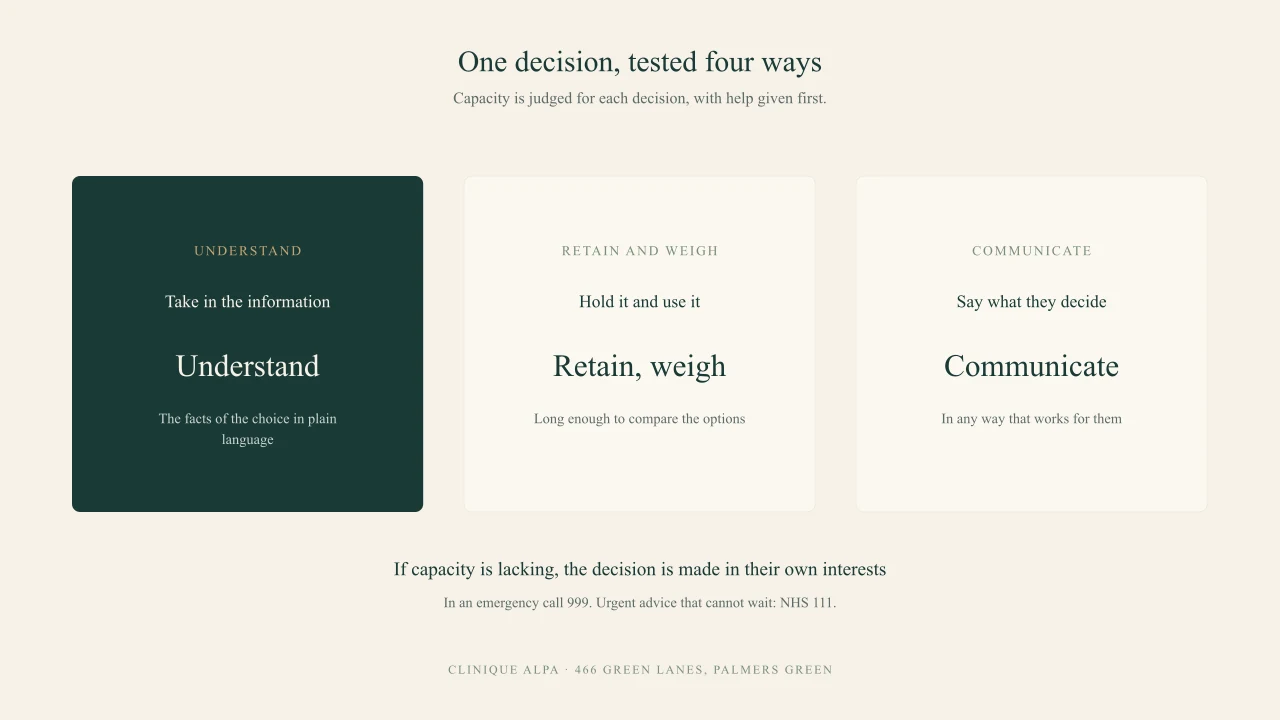
Capacity is decision specific. A person with dementia may be able to choose what to eat and who visits, and still be unable to weigh up a complex decision about where to live or about a major treatment. The NHS says a person is unable to decide if they cannot understand the relevant information, keep hold of it long enough to decide, use or weigh it, or communicate their decision in any way. There must also be an impairment of the mind or brain that explains the difficulty, which is why a medical assessment sits at the heart of it. Having a diagnosis does not by itself mean a person lacks capacity.
How are memory and falls risk looked at?
Because the question is about decisions on care, the doctor looks at the things that bear on care. When this comes up in consultation, the same three strands appear, and they are linked.
The first is memory and thinking. I use short screening tasks to see how memory, concentration, language and awareness of time and place are working. The NHS is clear that such tasks cannot diagnose dementia, and they certainly cannot decide capacity. A low score does not settle the question. What counts is whether the person can take in and use the information about this particular decision.
The second is falls risk, because falls often drive decisions about care. The NHS lists the usual contributors: weakened muscles, conditions affecting balance, low blood pressure, side effects of some medicines, problems with eyesight or hearing, and dementia itself. I check how the person stands and walks, take blood pressure sitting and standing, and review every medicine. Some of these findings are treatable, and fixing them can change what support is needed.
The third is daily function: washing, dressing, cooking, shopping, handling money and managing medicines. This tells me what help is needed already, and whether the problem described by the family matches what I see.
What do I do to give the person a fair chance of deciding?
The law requires that the person is helped to decide before anyone concludes they cannot. The NHS describes simplifying information, using visual aids, trying different ways of communicating and choosing a better time or place, and delaying the decision if that helps. I take that seriously. I speak to the person on their own and with family. I explain the choice in plain language and ask them to tell me back in their own words what the options are and what would follow from each. I note how they weigh one against the other.
Capacity can change between a good morning and a bad evening, and it can be affected by infection, dehydration, pain or medicines. If the picture is unclear, I would sooner see the person twice than record an answer from one tired hour. I write down what was asked, what help was given, and why I reached my conclusion, so that anyone reading it later can follow the reasoning.
From Dr Mitesh Parmar
Capacity is specific to one decision at one time. I begin by assuming the person can decide, then check whether they can understand, retain, weigh and communicate. I ask what support might help, such as quiet, time or a familiar face. A sudden worsening may be an infection, so I look for that.
What happens if a person cannot make the decision?
Then it is made for them, in their own interests, and the NHS says what that involves. The person is encouraged to take part as much as possible. Their past and present wishes, feelings, beliefs and values are sought. Assumptions based on age, appearance, condition or behaviour are avoided. The team checks whether the person might regain capacity, in which case the decision may be postponed. People close to them, including carers, relatives, friends and any attorney or deputy, are consulted. The option chosen should be the least restrictive of the person's freedom.
GOV.UK explains that a person must have mental capacity when they choose someone to help with decisions, and that a lasting power of attorney for health and welfare starts only when the person no longer has capacity. That is a practical reason to raise these matters early, while the person can still say who they would want to decide for them. Where there is no attorney or deputy and a decision cannot wait, an application can be made to the Court of Protection.
Is the Mental Capacity Act the same as the Mental Health Act?
No. They are different laws. The Mental Capacity Act is about whether a person can make a particular decision. In dementia, it is the one that applies to everyday questions about care, treatment and where someone lives.
Common questions
Is there a mental capacity test for dementia?
There is no single test. A doctor weighs the person's ability to understand, retain, weigh and communicate for one decision, with support, and records the reasons.
Can a person with dementia still make decisions?
Often, yes, for some decisions and at some times. The Act starts from the assumption that a person has capacity unless it is shown otherwise.
How does Clinique Alpa help?
Our medico legal reports include decision specific mental capacity assessments, including COP3 completion where a GP assessment is appropriate. Where the picture is complex or contested, the assessment is led by a consultant psychiatrist. Fees are quoted on instruction, and the medical report fees page explains how. Solicitors, families and individuals can instruct us. For day to day concerns, a clinic appointment is a better first step.
This is an independent clinical opinion. It cannot be written to a required conclusion and does not guarantee the outcome of any claim, application, exemption or hearing.
All medico-legal assessments and expert reports are independent professional opinions. No particular diagnosis, conclusion, causation opinion, prognosis, consistency assessment, recommendation or outcome can be promised or guaranteed.
More in this series: memory concerns
Drafted with AI assistance, clinically reviewed by Dr Mitesh Parmar, MBBS MRCGP, Principal GP and Clinical Director at Clinique Alpa, 466 Green Lanes, Palmers Green, London N13 5PA. This article is general information, not personal medical advice. In an emergency call 999. For NHS advice call 111 or visit nhs.uk.