
Families rarely begin with the word dementia. They begin with a kettle left on, a front door found open in the morning, a pill organiser that is either full or empty when it should not be. Each event has an explanation, and each explanation is reasonable, until there have been enough of them to make the whole household watchful.
The question behind dementia safety at home is simple to say and hard to answer: is it still safe for this person to be here, as they are, and what would make it safer? The honest answer starts with understanding why memory has changed, so the safety plan is not built on a guess.
Chest pain, signs of a stroke, severe breathlessness, heavy bleeding, a severe allergic reaction or symptoms of sepsis need 999 or A&E immediately. For urgent advice that cannot wait, call NHS 111.
What does dementia safety at home mean in practice?
It means looking at the day as the person actually lives it, room by room and hour by hour, and asking where a lapse of memory or judgement could cause harm. When this comes up in consultation, the same handful of areas appear again and again.
- The kitchen. Hobs and kettles left on, food left out, meals missed.
- Medicines. Doses taken twice, forgotten, or mixed up with older supplies.
- The front door. Going out at night, getting lost on a familiar street, or letting in someone who should not be let in.
- Falls. Poor lighting, loose rugs, stairs, wet floors and unsteady walking.
- Driving. GOV.UK states that you must tell the DVLA if you have dementia, and the duty sits with the driver. Families need to know that this is not optional.
- Money and post. Unpaid bills, and decisions that are easy to be talked into.
The NHS says plainly that many people with mild to moderate dementia can stay at home with the right support. That is worth holding on to, because the choice is rarely between nothing and a care home. In between sit reminders, a carer for part of the day, a personal alarm, changes to the home and a regular medical review.
Is dementia not safe at home, or is it a risk that can be managed?
I do not use a single sign to decide. The pattern matters more than the one incident. What worries me is a run of near misses that are getting closer together, a person who no longer notices the danger, or a family member who is quietly doing more every week and is close to breaking.
The signals that make me more concerned are these:
- More than one episode involving fire, gas or hot water.
- Missed or doubled medicines that have caused illness or a close call.
- Falls, or walking that is clearly less steady than before.
- Weight loss, because meals are being forgotten.
- Wandering, or being brought home by someone else.
- The main carer is exhausted, unwell or unable to leave the person alone for a short time.
None of these means a care home. Each means that the current arrangements need to change, and I would say that to the family early, while there is still time to choose.
When does progressive memory loss need blood tests, a scan and a memory clinic?
Whenever the change is progressive, it has not been investigated, and it is starting to affect safety. A safety plan built around an unexplained memory problem can miss a cause that is treatable. The NHS describes the usual order. A GP asks about symptoms and daily tasks, examines the person and arranges blood tests and a urine test to look for other causes. If other causes are ruled out, the GP may refer to a specialist, often working in a memory clinic.
The NHS says the blood tests typically look at liver and kidney function, thyroid function, blood sugar over time, and vitamin B12 and folate levels. Brain scans usually come after the simpler tests. An MRI scan is recommended to help confirm dementia and its type, and a CT scan can check for signs of a stroke or a tumour. The memory clinic may also carry out more detailed memory tests.
I use the first assessment to decide how urgent this is. If a person is unsafe now, I say so, and I explain what to ask for from the NHS GP and what can be set up in the meantime. If anything in the history suggests a stroke or sudden change, that is a different and faster route. The steps of a first assessment itself are in memory getting worse: the first assessment.
From Dr Mitesh Parmar
Family first, then the person alone, because they often describe things differently. I also look at the home itself: the cooker, the stairs, the lighting and how treatment is stored. Small changes often make a bigger difference to safety than any label does.
What is a sensible home safety checklist for dementia?
These are the changes I suggest most often. None needs special equipment, and all can be done by a family this week.
- Keep a clear, large print list of medicines and doses. Ask the pharmacy about packing them by day, and keep spare supplies out of sight.
- Make the kitchen simpler. Think about which appliances are safe to leave within reach, and whether meals can be prepared by someone else some days.
- Light the way to the bathroom at night, and remove loose rugs and clutter from walking routes.
- Fit a personal alarm. It is the one piece of equipment the NHS names, and it works only if the person wears it.
- Put a note by the door with a phone number, and tell neighbours who to call.
- Keep a recent photograph and a list of the person's usual places, in case they go missing.
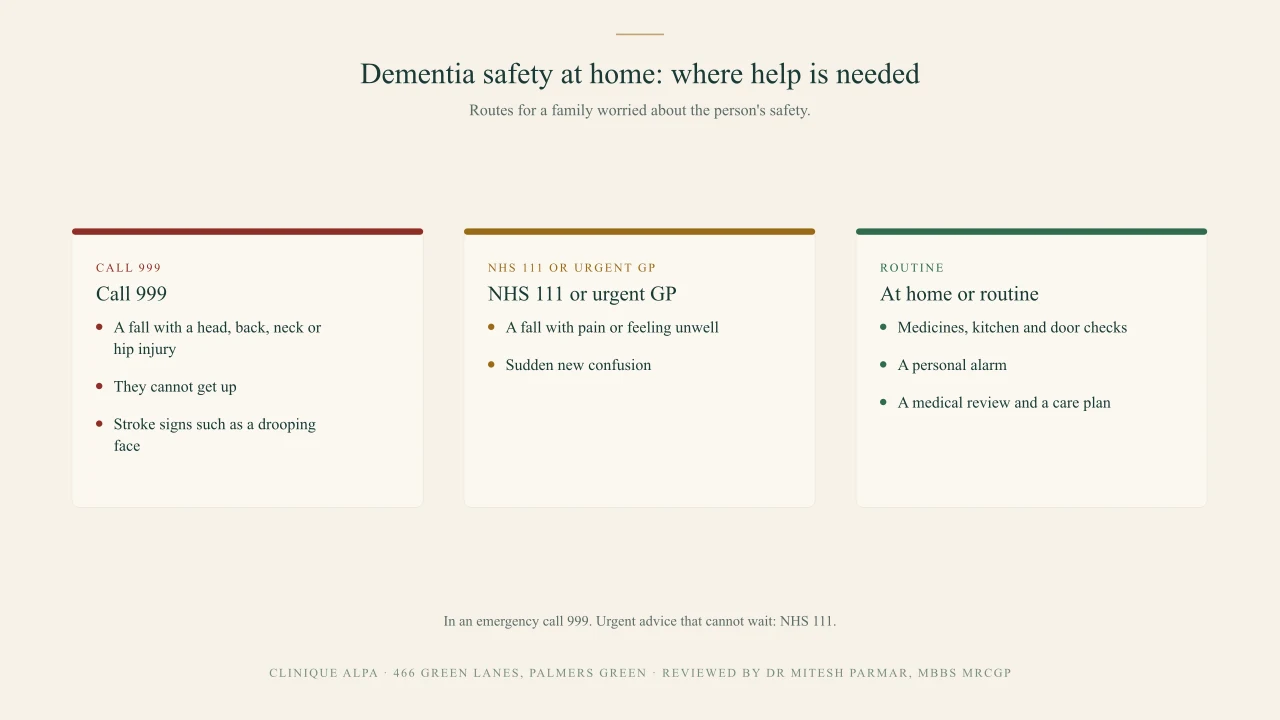
On falls, the NHS says that dementia, medicines, eyesight and hearing problems all raise the risk, and it advises asking a GP or pharmacist whether medicines could affect balance. Call 999 if someone has fallen and may have injured their head, back, neck or hip, or cannot get up. Call NHS 111 if someone has fallen and may be in pain, injured or unwell.
Who can help the family?
The NHS advises asking the council's social services for a needs assessment when help is needed with washing, dressing or cooking, ideally face to face and with a relative present. If you care for someone with dementia, you can ask for a carer's assessment before you receive any help from the council. After a diagnosis, you should have a care plan, reviewed at least once a year.
When decisions about care are needed, and the person may not be able to make them, that is a separate and careful process. I have written about it in assessing decisions about care in dementia.
Common questions
How do I make a home safe for someone with dementia?
Start with the kitchen, medicines, the front door and falls, then add a personal alarm and a regular medical review. Ask the council for a needs assessment if daily tasks have become hard.
What are the signs that dementia is not safe at home?
Repeated near misses with heat, medicines or the door, new falls, weight loss, or an exhausted main carer. Any of these is a reason to ask for a review promptly.
How do we help at Clinique Alpa?
A clinic consultation is 30 minutes with a named doctor and costs £100. If travelling is difficult, a home visit lasts 60 minutes and is from £250 on a weekday, from £325 at weekends and bank holidays and from £450 for an evening start, with travel priced by postcode. We look at the whole picture, explain what we think is happening and write down a plan the family can follow. This is private care alongside the NHS, and with your consent a summary goes to your NHS GP.
More in this series: memory concerns
- Memory loss assessment: the first appointment
- Assessments of mental capacity in dementia and care needs
Drafted with AI assistance, clinically reviewed by Dr Mitesh Parmar, MBBS MRCGP, Principal GP and Clinical Director at Clinique Alpa, 466 Green Lanes, Palmers Green, London N13 5PA. This article is general information, not personal medical advice. In an emergency call 999. For NHS advice call 111 or visit nhs.uk.