
The health check was a birthday present to yourself, and you expected a clean sheet. The report has ALT with an H beside it, and further down a line called GGT sits just above its range. You drink less than most of your friends. The internet, consulted at midnight, offered fatty liver, hepatitis and several things worse.
A liver function test is a panel, not one measurement, and a flag on a single line seldom means what the search results suggest. What matters is which markers have moved, how far, in what combination and whether they stay that way. This is how I read it.
Chest pain, signs of a stroke, severe breathlessness, heavy bleeding, a severe allergic reaction or symptoms of sepsis need 999 or A&E immediately. For urgent advice that cannot wait, call NHS 111.
What does a liver function test measure?
The name is slightly misleading. Most of the panel shows whether the liver is irritated, not how well it is working.
- ALT is an enzyme that lives inside liver cells. When those cells are inflamed or under strain, more of it leaks into the blood. AST, often printed beside it, behaves in a similar way but is also found in muscle.
- ALP comes mainly from the small ducts that carry bile out of the liver, and also from bone.
- GGT is another bile duct enzyme. It is sensitive to alcohol and to some medicines, and it helps show whether a raised ALP is coming from the liver or from bone.
- Bilirubin is the yellow pigment left when old red blood cells are broken down. The liver clears it. When it builds up, the skin and the whites of the eyes turn yellow, which is jaundice.
- Albumin is a protein the liver makes. It is the line that says most about function, and it is usually normal even when the enzymes are not.
How do I read the pattern?
What I look at in clinic is the shape of the whole panel, then the person it belongs to.
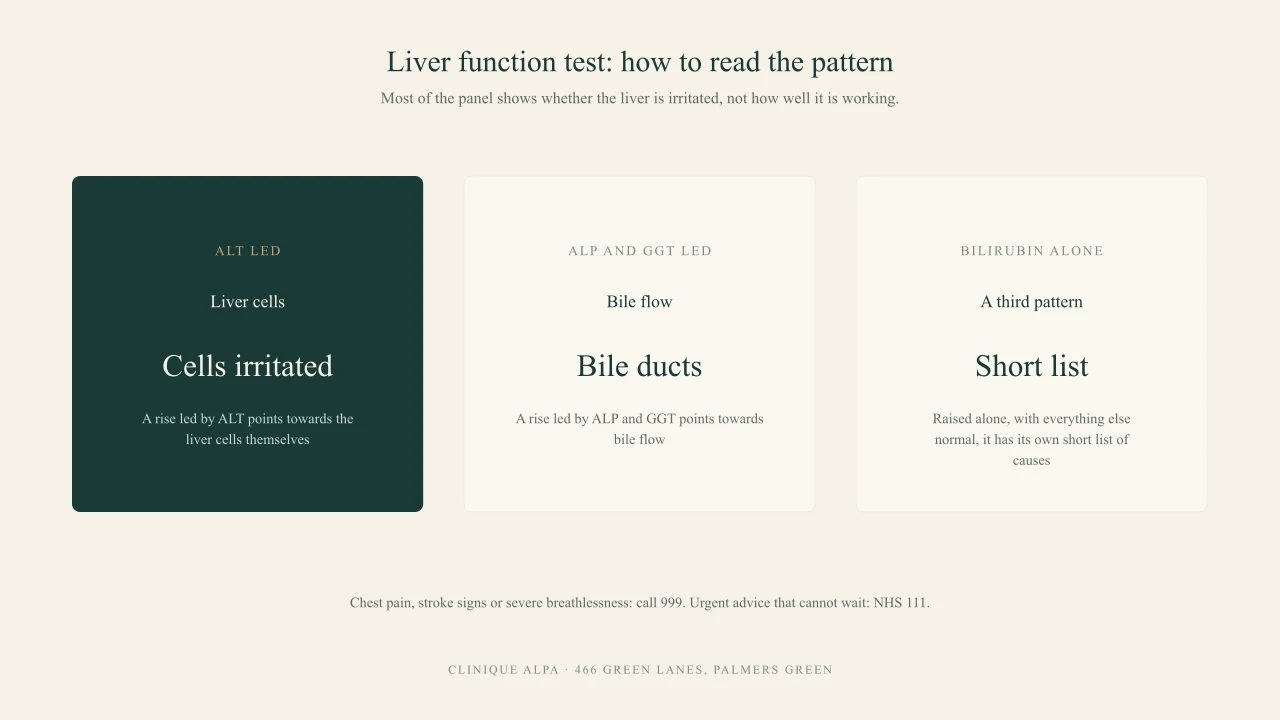
Which group has moved. A rise led by ALT points towards the liver cells themselves. A rise led by ALP and GGT points towards bile flow. Bilirubin raised alone, with everything else normal, is a third pattern with its own short list of causes.
How far. A result a little above the range is a very different finding from one several times higher. The first usually earns a repeat. The second earns a prompt look for the cause.
Alcohol, counted properly. Not "a normal amount" but drinks in a typical week, added up as units against the guideline of 14. I ask without judgement because the figure changes what I do next.
Weight and metabolism. Waist measurement, blood pressure, blood sugar and cholesterol. Fat building up in the liver is common and is linked to being overweight, type 2 diabetes, high blood pressure and high cholesterol. It usually causes no symptoms and is often first noticed on exactly this kind of test.
Everything you take. Medicines from a doctor, anything bought over the counter, and supplements: herbal products, gym powders, weight loss teas. Bring the packets. People rarely count these as medicines, and the liver does not make the distinction.
Infection risk. Hepatitis is usually caused by a virus and can be silent for years. So I ask about countries lived in, medical or dental treatment abroad, tattoos, and partners. These are routine questions, asked of everyone.
Family. Liver disease in relatives, or a condition of iron overload called haemochromatosis, which runs in families.
Then the examination: weight, waist, blood pressure, the abdomen, the skin and the eyes.
What are the common harmless causes?
Several ordinary things move these numbers.
Gilbert's syndrome is the classic one. It is a common inherited condition in which bilirubin runs a little high. It does not damage the liver, and many people only learn they have it during tests done for something else. The yellow tinge, if it appears at all, tends to follow poor sleep, not drinking enough, alcohol or hard exercise.
ALP can be raised from bone and not the liver: in a teenager who is growing, in pregnancy, or while a fracture heals. A normal GGT beside it is the clue.
Hard exercise in the day or two before the sample can lift AST and ALT from muscle. A recent viral illness can do the same from the liver, and settle within weeks.
I would add one caution. Harmless is a conclusion reached after looking. It is not an assumption made because the patient feels well, since the NHS is clear that most types of liver disease cause no symptoms in the early stages.
From Dr Mitesh Parmar
One slightly raised liver number is rarely the whole story. I ask about alcohol honestly, but also about weight, over-the-counter painkillers, herbal products and recent hard exercise, because all can nudge the result. Often the first step is simply repeating the test later. Yellow skin or eyes, or dark urine with pale stools, needs a prompt call to NHS 111.
When is it worth looking further?
A mildly raised result in someone who feels well is usually repeated after a few weeks, with alcohol and hard exercise avoided beforehand. I look further when the result is still raised on the repeat, when it is rising, when several markers have moved together, when albumin is low, or when the history carries a risk. Looking further means more blood tests, aimed at the causes the NHS lists: viral hepatitis, iron overload and conditions involving the immune system. Sometimes it means an ultrasound scan. Our guide to abnormal liver blood tests, fatty liver and gallstones describes those conditions and what you can do about them.
Some signs should not wait for a repeat:
- Yellow skin or yellow whites of the eyes. Ask for an urgent appointment or call NHS 111.
- Dark urine with pale stools, or itching all over.
- Vomiting blood, or black tarry stools. Call 999 or go to A&E.
- A swollen abdomen, or new confusion or drowsiness.
- Severe pain under the right ribs, particularly with a fever.
How do we arrange this at Clinique Alpa?
If you already have a report, bring it. A clinic consultation is 30 minutes with a doctor at 466 Green Lanes for £100. Where a repeat or further tests are needed, the blood is taken at the clinic. The liver function profile on our list covers ALT, AST, bilirubin, albumin, ALP and GGT, and a hepatitis B profile is listed separately. Both are on private blood tests, with prices on blood test prices. Listed prices include taking the sample, and the clinic confirms any preparation and the expected result time.
Results are reviewed by a doctor. If a scan or a liver specialist is the right next step, a referral letter is written where clinically appropriate after assessment and is included in the consultation fee. With your consent, a summary goes to your NHS GP. If the layout of the page is the difficulty, I have written about how to read a blood test report.
Drafted with AI assistance, clinically reviewed by Dr Mitesh Parmar, MBBS MRCGP, Principal GP and Clinical Director at Clinique Alpa, 466 Green Lanes, Palmers Green, London N13 5PA. This article is general information, not personal medical advice. In an emergency call 999. For NHS advice call 111 or visit nhs.uk.