
The hands are the one part of the body that cannot be rested. They are in water, soap and gloves several times a day, and they are looked at by everyone. A rash that began on one finger can spread to the thumb and across the other fingers, turn blistered and sore, and make simple jobs painful.
By the time someone books with me, they have usually already tried more than one cream. The question is not what is the next cream. It is why a hand rash that responded at first has stopped responding, and what needs to change. That is what this article is about, from the point of view of hand eczema and the other conditions it can be confused with.
Chest pain, signs of a stroke, severe breathlessness, heavy bleeding, a severe allergic reaction or symptoms of sepsis need 999 or A&E immediately. For urgent advice that cannot wait, call NHS 111.
Why is hand eczema so hard to clear?
The NHS notes that contact dermatitis most commonly affects the hands and face, and that it can leave skin itchy, blistered, dry and cracked. Irritants are the most common cause, and they include soaps, detergents, solvents and regular contact with water. Allergic contact dermatitis is less common, with triggers such as substances in cosmetics, metals such as nickel and, in some people, handling raw fruit and vegetables.
Hand eczema is also a condition that can be driven by the skin itself, with no outside trigger at all, particularly in people who have had eczema elsewhere. In practice, it is often a mix: skin that is prone to eczema, plus daily irritation, plus a break in the barrier that lets the rash take hold.
When this comes up in consultation, a few pictures repeat. The rash settles well on a first course of treatment, comes back as soon as it stops, and then does not respond as it did before. Or the rash has spread beyond where it began, and what looked like one problem is now two.
What I look at in clinic
I begin with a plain description of where it started, how it spread and what makes it better or worse. Which hand, which fingers, the palms or the backs, the sides of the fingers, the nails. Is it dry and cracked, or blistered and weeping. Is it worse after certain tasks. Does it ease when the gloves are on, or does it ease on a break from work or routine. That last question is very informative, because a hand rash that clears when away from its usual environment points strongly towards something it is in contact with.
I ask what the hands do in a day: how often they are washed, what with, whether gloves are worn and for how long, because the NHS advises taking gloves off periodically as sweat can make things worse, and cotton liners under rubber gloves help. I ask about products and about metals such as jewellery.
Then I look at the skin in good light. I look at both hands even when only one is complaining, because it tells me about pattern. I look at the nails, at whether there are blisters, small cracks, weeping, crusting or pus, at whether the skin is warm, and at the feet, because a rash on the hands can have a fungal cause that also shows on the feet, and fungal rashes can look like eczema. A rash that spreads or worsens after a steroid cream is a clue that something other than simple eczema may be present, or that the skin has become infected.
From Dr Mitesh Parmar
The question I ask first is what the hands do all day. Work, washing, gloves and hobbies matter more than the cream. I also look for infection, fungal change and contact allergy, which can look identical. When a rash is blistering and sore, it is worth looking again rather than carrying on.
How is hand eczema treated when the first cream has not worked?
The NHS describes avoiding the trigger, where one is found, as the thing that usually lets the skin clear, together with emollients to stop the skin drying out. Steroid creams or ointments can relieve severe symptoms. Oral corticosteroids are rarely used, only for severe episodes, and the NHS explains that when a steroid is taken for longer than 3 weeks or at a high dose, it should be reduced gradually and not stopped suddenly.
In practice, treatment is about matching strength to site and stage, giving it long enough, and protecting the hands while they heal. Cracks and blisters need different handling from dry scaly skin. Where there are signs of infection, that is treated first. Where a fungal cause is suspected, that is checked rather than assumed, because treating it as eczema makes it worse and treating eczema as a fungus does nothing.
When is a skin specialist needed?
The NHS says a GP may refer you to a dermatologist for further tests if the cause cannot be identified or if symptoms do not respond to treatment. That is the usual reason for referral. In my experience it also makes sense when the rash is disabling, when it keeps returning after each course, when the diagnosis is uncertain, or when allergy testing of the skin is being considered. A specialist can look for an allergic cause that a GP appointment cannot test for. If a referral is the right step, the letter is included in the consultation fee, written where clinically appropriate after assessment.
If you have been told one thing elsewhere and are not sure, getting a second opinion is a legitimate use of a consultation. The eczema guide covers the condition more broadly, and eczema that keeps coming back deals with the wider pattern of relapse.
When should you come in sooner?
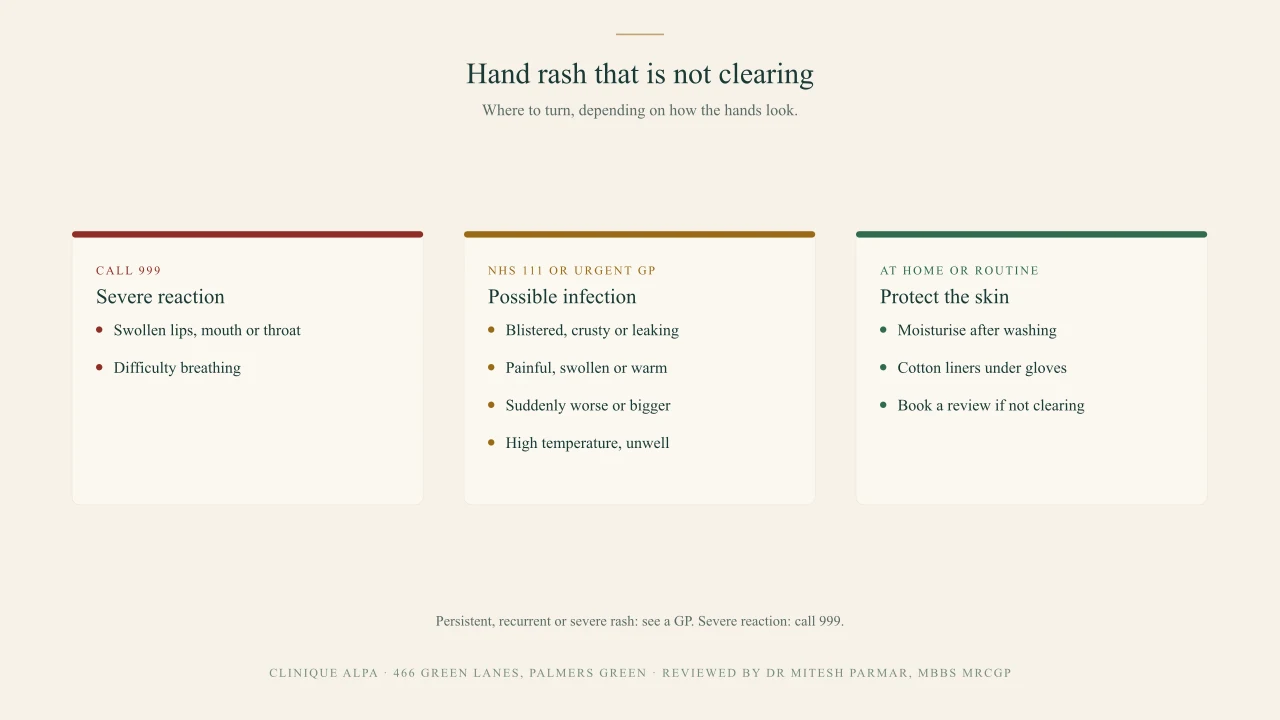
Call 999 for swelling of the lips, mouth or throat, or difficulty breathing. Ask for an urgent GP appointment or call NHS 111 if the skin is blistered, crusty, leaking fluid or has spots filled with pus, is painful, swollen or warm, suddenly gets worse or bigger, or comes with a high temperature or feeling generally unwell, because the NHS lists these as possible infection or a serious complication called eczema herpeticum. See a GP if the rash is persistent, recurrent or severe, or if treatments are not helping.
How do we approach this at Clinique Alpa?
You see a doctor for 30 minutes at 466 Green Lanes. A clinic consultation is £100. Both hands are examined in good light, I go through what has been used and what the hands do in a day, and we agree a plan in writing with a date to review. With your consent, a summary is sent to your NHS GP.
Common questions
What causes hand eczema?
Most often it is irritation from soap, water and detergents on skin that is prone to eczema. Less often it is an allergy to something the hands touch.
Why does hand eczema form blisters?
Blistering is a feature of active inflammation in the skin of the hands. If blisters are weeping, crusting or painful, get them looked at promptly, as infection can follow.
What treatment helps hand eczema that is not clearing?
It depends on the cause and the stage, so a proper examination matters. Avoiding triggers, moisturising, protecting the hands and the right strength of treatment used long enough are the foundation.
Sources: NHS: contact dermatitis and NHS: atopic eczema and NHS: steroid medicines.
Drafted with AI assistance, clinically reviewed by Dr Mitesh Parmar, MBBS MRCGP, Principal GP and Clinical Director at Clinique Alpa, 466 Green Lanes, Palmers Green, London N13 5PA. This article is general information, not personal medical advice. In an emergency call 999. For NHS advice call 111 or visit nhs.uk.