
The skin had been calm for a long time. The moisturiser was still on the bathroom shelf, but it had stopped being part of the day, and then one week the red, dry patches and the itch came back across the chest, shoulders and neck. Sleep goes first, then patience.
That question is the heart of relapsing eczema, and it deserves a more careful answer than a repeat of the cream that worked last time. This article is about what a flare after a good spell usually means, what I check, and how I decide between adjusting the plan at home, a short reducing course of oral treatment, and a skin specialist.
Chest pain, signs of a stroke, severe breathlessness, heavy bleeding, a severe allergic reaction or symptoms of sepsis need 999 or A&E immediately. For urgent advice that cannot wait, call NHS 111.
What is relapsing eczema?
Eczema is a long term skin condition that tends to come and go. Relapsing eczema is simply the pattern in which clear or near clear skin is followed by a flare, sometimes after weeks and sometimes after years. The NHS describes triggers that include soap and detergents, pets, house dust mites, some fabrics, heat, stress, hormonal changes and skin infections.
Why does an eczema rash keep coming back?
When this comes up in consultation, a few patterns repeat. The first is that moisturising was stopped once the skin looked better. The NHS advice is to keep using emollients at least 2 times a day, even when the skin improves, and to use them in place of soap for washing. It is the most ordinary advice and the most often dropped.
The second is a trigger that has quietly changed: a new detergent, a new job or routine that means more hand washing, a hot shower habit, a change in the weather, a run of poor sleep or a stressful stretch. The third is infection. Skin that is broken and itchy is easier for bacteria to settle on, and an infected patch looks like a worse flare. The fourth is a treatment that is being used in a way that does not fit the skin: a cream that is too weak, used for too short a time, or used on a patch where something else is going on.
What I look at in clinic
I start with the pattern over time rather than the rash in front of me. When was the skin last clear, what was different then, what has changed since, and what has been used, how often and for how long. I ask about anything that touches the skin: soaps, washing products, work, hobbies, new fabrics, new products on the scalp or face.
Then I look at where it is. Eczema in a person who has had it for years tends to sit in the creases of the elbows and knees, the neck, the face and the hands, and I look at whether this flare follows that pattern or sits somewhere new. A patch in an unusual place, or one that is a different shape from the others, makes me think of a second problem on top of the eczema, such as a fungal infection or a contact reaction.
I look closely for signs of infection: crusting, weeping, spots filled with pus, pain or warmth. The NHS lists these, together with a sudden worsening, a high temperature or feeling generally unwell, as reasons to get an urgent GP appointment or NHS 111, because they can be signs of infection or a serious complication called eczema herpeticum. I would rather see someone with these on the day than hear about them after another night.
I also ask what has been tried and did not work. Sometimes a treatment was never given a fair run. Sometimes it truly did not help, and that matters most in deciding what comes next.
From Dr Mitesh Parmar
Soaps, detergents, work, stress and new pets are what I ask about first, then how much moisturiser is truly being used. Most flares settle when people use enough emollient, enough of the time. I also look for infection and for patches that do not behave like eczema, which sometimes need testing.
What changes in the plan when it keeps relapsing?
The foundation does not change: regular emollients, avoiding the irritants that apply to you, and treating a flare early and properly with the right strength of steroid cream, used as directed rather than sparingly and for too short a time. The NHS lists emollients, steroid creams, lotions or gels, special dressings or medicines depending on severity, and referral to a dermatologist. If treatments are not helping, the NHS advice is to see a GP.
For eczema that relapses, I often write a short plan for the next flare, so that treatment starts on day one rather than day ten. It says what to use, where, for how many days and what to do if it is not improving.
When is a reducing course of oral treatment used?
For a severe or widespread flare that is not controlled by creams, a doctor may decide on a short course of oral steroid treatment that is brought down in steps. This is a clinical decision made after an assessment, not something to expect or ask for. The NHS explains that a steroid taken for longer than 3 weeks or at a high dose usually needs to be reduced slowly, and that it should not be stopped suddenly without talking to a doctor. That is why a reducing plan has stages, with a clear end point written down, and why the plan matters as much as the treatment itself.
If the skin relapses as soon as a reducing plan finishes, that tells us the underlying control is not right, and it is a main reason to think about a specialist.
When is a skin specialist or light therapy worth considering?
A referral to a dermatologist is worth discussing when flares keep coming back despite sound basic treatment, when you need repeated courses of stronger treatment, when the eczema is affecting sleep, work or mood, or when the diagnosis is not certain. Light therapy is a specialist treatment decided by a dermatologist after assessment, so it is not something a GP appointment can start, but it is one of the reasons people are referred.
A referral letter is included in the consultation fee, written where clinically appropriate after assessment. If you already have a diagnosis and want to check the plan, I wrote about getting a second opinion. For a general overview of the condition, the eczema guide in our health library covers causes and everyday care, and if your hands are the main problem, hand eczema that is not clearing deals with that separately.
When should you come in sooner?
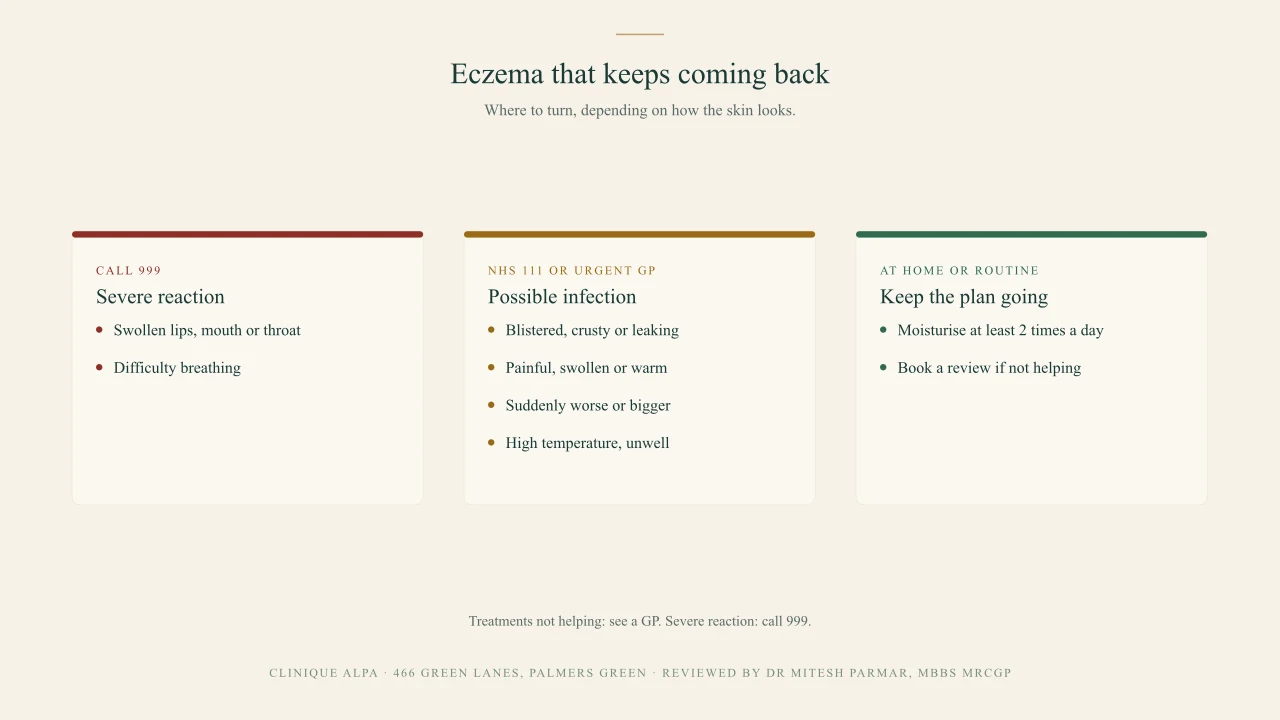
Call 999 if you have a severe allergic reaction, with swelling of the lips, mouth or throat or difficulty breathing. Ask for an urgent GP appointment or call NHS 111 if the eczema is blistered, crusty, leaking fluid, has spots filled with pus, is painful, swollen or warm, suddenly gets worse or bigger, or comes with a high temperature or feeling generally unwell. Book a routine appointment if treatments are not helping, if you are using stronger cream more often than you meant to, or if itch is stopping you sleeping.
How do we approach this at Clinique Alpa?
You see a doctor for 30 minutes at 466 Green Lanes, with the skin examined in good light. A clinic consultation is £100. We look at the whole pattern, write a clear plan for the next flare and, with your consent, send a summary to your NHS GP.
Common questions
Why does my eczema rash keep coming back?
Usually because the skin barrier is still prone to it, and a trigger, a gap in moisturising or an infection tips it over. Keeping up emollients and starting treatment early in a flare is the most useful protection.
What is chronic relapsing eczema?
It is a long term pattern of eczema that settles and then flares again. It is common and manageable, and a clear written plan for flares helps a great deal.
When should I see a doctor if eczema keeps coming back?
See a GP if treatments are not helping, and get urgent help if the skin is blistered, crusted, leaking, painful or warm, or you feel unwell.
Sources: NHS: atopic eczema and NHS: atopic eczema treatment and NHS: steroid medicines.
Drafted with AI assistance, clinically reviewed by Dr Mitesh Parmar, MBBS MRCGP, Principal GP and Clinical Director at Clinique Alpa, 466 Green Lanes, Palmers Green, London N13 5PA. This article is general information, not personal medical advice. In an emergency call 999. For NHS advice call 111 or visit nhs.uk.