
The dread rarely starts at the airport. For many people it begins the moment the booking is confirmed, and it grows through the weeks beforehand: poor sleep, a tight chest when the trip is mentioned, a stomach that turns over at the sight of a departure board. By the time the day arrives, a good part of the effort has already gone into getting that far.
People ask me the same thing in different words. Is there anything I can do for myself before I fly, and when is it time to see someone? Fear of flying self help can do a surprising amount, and it works far better when it is planned in advance rather than improvised in the departure lounge.
If you are at immediate risk of harming yourself or someone else, call 999 or go to A&E. For urgent mental health help, call NHS 111 and choose the mental health option, or call Samaritans free on 116 123, any hour.
What is a fear of flying, and why does it feel so physical?
The NHS describes a phobia as an anxiety condition, usually triggered by a particular object or situation. The body reacts as if the danger were real. The NHS lists severe anxiety, dizziness, a noticeable heartbeat, chest tightness, nausea, trembling, and a strong fear of fainting, losing control or dying. When this comes up in consultation, people often tell me the physical part frightens them more than the thought of the flight itself, because it feels like proof that something is wrong.
It helps to name which part is the problem. For some it is turbulence or take off. For others it is being enclosed, or not being able to leave, or the fear of having a panic attack in front of strangers. The same two words, fear of flying, cover very different problems, and the plan for each is different.
Which self help steps are worth trying?
The NHS suggests a handful of simple steps for phobias, and I would start there.
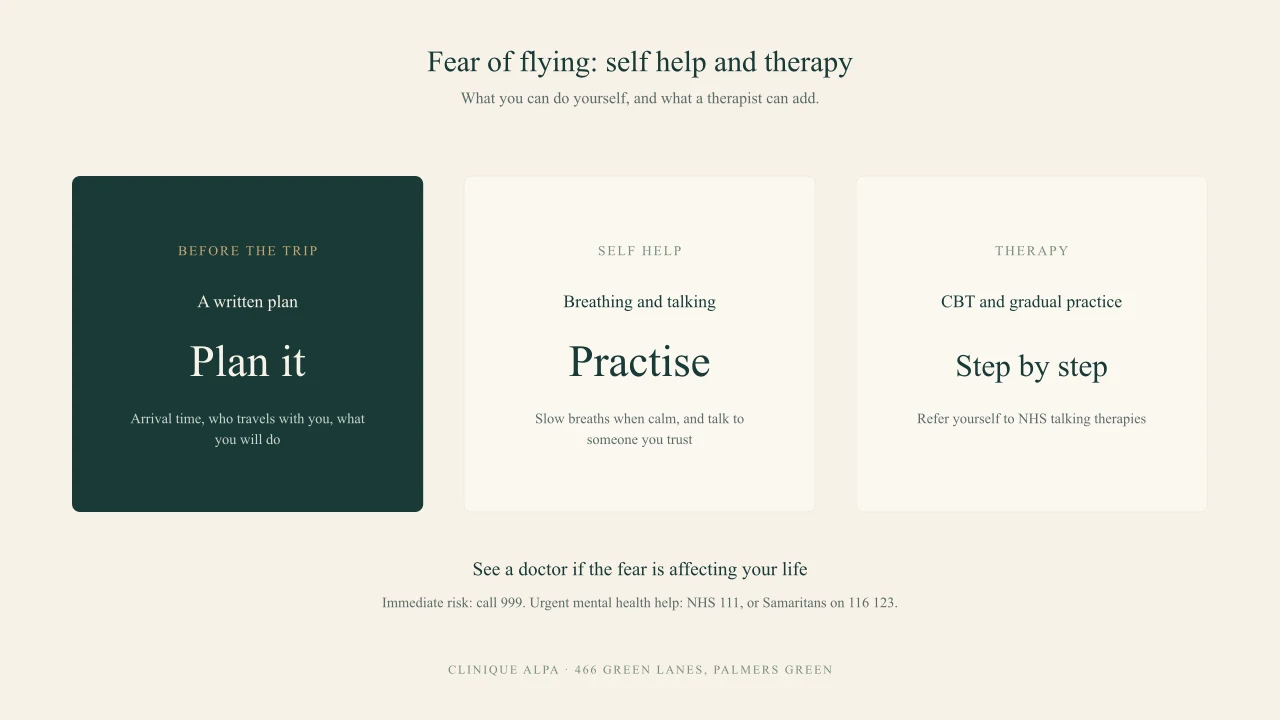
- Breathing exercises. Practise a slow, steady breath when you are calm, so that it is familiar when you are not.
- Talk to someone you trust. Fear that is said aloud is usually smaller than fear that is carried.
- Be careful what you search for online. The NHS warns about images. Searching for crash footage in the weeks before a flight feeds the fear and does not prepare you.
- Look at what the airline offers. The NHS notes that some airlines run sessions for people with phobias.
- Watch caffeine. The NHS advises avoiding caffeine and energy drinks after 3pm, because they disrupt sleep and can make anxiety worse.
On top of those, a written plan for the day makes a difference. Decide what time you will arrive, who you will travel with, what you will do while waiting, and what you will do if the fear surges mid flight: the breathing, a task for your hands, a person to tell. A plan turns a vague threat into a list of steps. I would also suggest saying something to the cabin crew at the door. It costs nothing, and crew are used to it.
What does therapy for fear of flying involve?
The NHS lists talking therapies such as cognitive behavioural therapy, and hypnotherapy, among treatments for phobias. You can refer yourself to an NHS talking therapies service without a GP referral. CBT looks at the thoughts that make the fear grow, such as the belief that a panic attack will cause something terrible, and tests them. Therapists commonly pair that with gradual practice, facing the feared situation in small steps that you can manage, from talking about flying to visiting an airport. The aim is to learn that the fear rises and falls, and that you can stay through it.
Therapy takes time, and it takes practice between sessions. That is the honest answer to those who want something quicker. If your flight is close, work on the plan and the breathing now, and treat therapy as the longer project.
What do I look at in clinic?
What I look at in clinic is the fear itself and the person around it. I ask when it started, what the triggers are, what the body does, and whether panic also happens outside flying. If it happens everywhere, that points to a wider anxiety problem, and the plan changes. If it is confined to flying, the work is more focused.
I ask what has been tried already, whether a course, a book, a therapist or a technique, and what helped or did not. That tells me where to begin and what not to repeat. I ask about sleep, caffeine and alcohol, which can all push anxiety up. I ask about mood, because low mood and anxiety travel together. I check pulse and blood pressure and ask about other health problems, since racing heart, breathlessness and chest tightness need to be understood and not just assumed to be anxiety.
I also ask about the practical side: how soon you fly, how often, and whether you travel with others. That decides how much time there is for a plan to work.
From Dr Mitesh Parmar
Ask yourself what exactly frightens you: turbulence, being trapped, heights or panic itself. The answer shapes what helps. Learning how the body reacts to fear is often more useful than distraction. I also check for a heart or breathing condition, so a racing pulse in the air is understood.
When should you see a doctor sooner?
The NHS advises seeing a GP if you think you have a phobia and it is affecting your life. Come sooner, or use urgent routes, if:
- You are avoiding travel that you need, such as for work or family, and it is damaging your life.
- The fear is spreading to other situations, or you are having panic attacks with no clear trigger.
- Your mood has fallen, or you have stopped enjoying things you normally do.
- You are thinking of harming yourself: call 999 or go to A&E, or call Samaritans free on 116 123.
- You have chest pain or a racing heart that does not settle: call 999 or NHS 111 without waiting.
Common questions about fear of flying help
Is a fear of flying self help book worth it?
It can help you understand the fear and learn techniques. It works better alongside practice and a plan, not as the only step.
Can I find fear of flying help near me?
You can see a doctor at our clinic at 466 Green Lanes, Palmers Green, or by video for the conversation, and you can refer yourself to NHS talking therapies.
What is the treatment for fear of flying?
Talking therapies such as CBT are the main approach the NHS lists, with self help alongside. Each person is assessed individually.
How do we approach this at Clinique Alpa?
A clinic consultation is 30 minutes with a named doctor and costs £100. A video consultation with Dr Alpa J. Morawala is £79.99 for 30 minutes and suits a conversation that does not need an examination. I describe what the doctor asks and agrees in fear of flying advice from a doctor. Each person is assessed individually for all options, including whether any short term medical treatment for the flight is clinically safe and suitable, and nothing is promised in advance. The consultation pays for an independent assessment and advice. With your consent, a summary goes to your NHS GP. You can read more about video consultations before you decide.
More in this series: fear of flying
Drafted with AI assistance, clinically reviewed by Dr Mitesh Parmar, MBBS MRCGP, Principal GP and Clinical Director at Clinique Alpa, 466 Green Lanes, Palmers Green, London N13 5PA. This article is general information, not personal medical advice. In an emergency call 999. For NHS advice call 111 or visit nhs.uk.