
It is 10 at night and the appointment is at 9 tomorrow morning. The kettle is on, and halfway to the fridge for the milk you stop, because somebody mentioned fasting and nobody said what that meant. Whether the tea counts. Whether the medicines you take at breakfast count. Whether the whole test is wasted if you get it wrong.
Fasting before a blood test is simpler than the worry around it. Only some tests need it, water is nearly always allowed, and the person who requested the test should tell you which kind yours is. This is how I explain it in clinic, along with the one question about medicines that is worth asking before the night before.
Chest pain, signs of a stroke, severe breathlessness, heavy bleeding, a severe allergic reaction or symptoms of sepsis need 999 or A&E immediately. For urgent advice that cannot wait, call NHS 111.
Which tests need fasting before a blood test?
Fewer than most people expect. The NHS puts it plainly: you may be asked not to eat or drink anything other than water for a short time before some tests, and the GP, nurse or specialist should tell you if you need to do anything to prepare. No instruction usually means no fast, and a quick call settles any doubt.
What I look at in clinic is what the test measures, because that decides whether breakfast can change it. A meal alters the sugar in your blood within minutes and the fats in it for some hours. It does not alter your red cells, your kidney function or your thyroid hormones in a way that changes how the result is read.
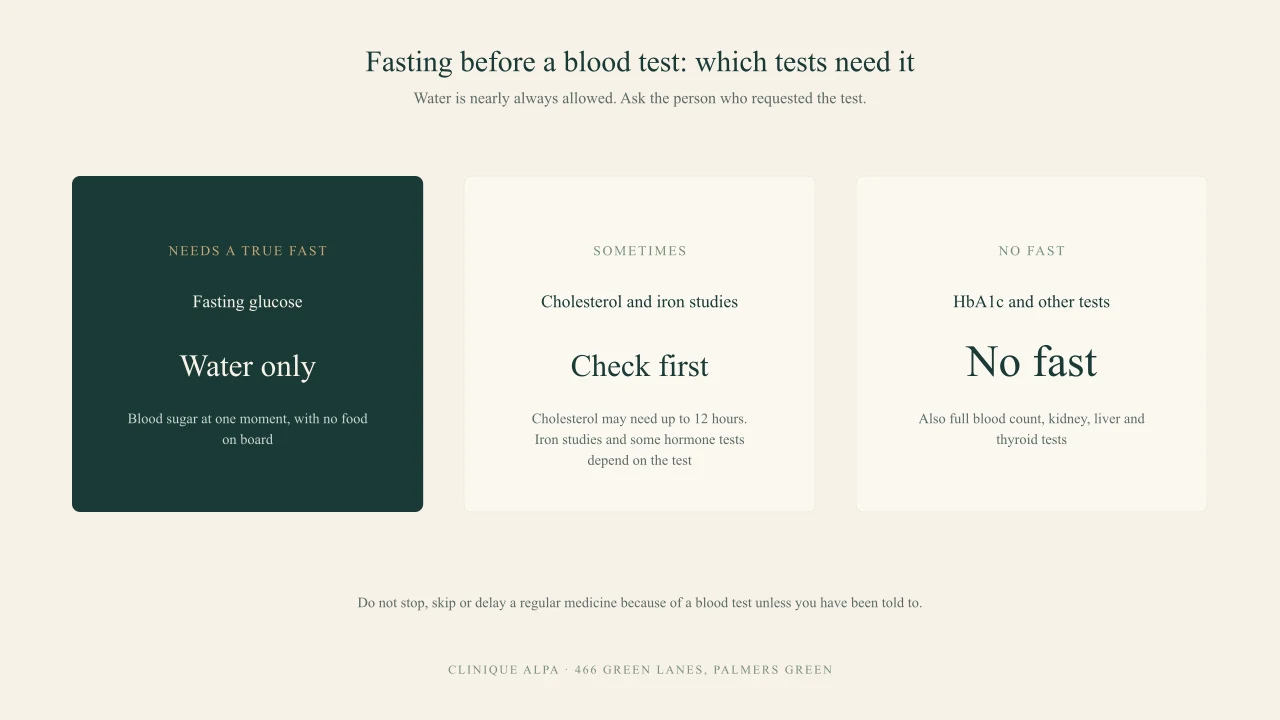
- Fasting glucose. This measures blood sugar at one moment, with no food on board. It needs a true fast, because that is the whole point of the test.
- Cholesterol. The NHS says most people do not need to fast, although you might be asked to for up to 12 hours beforehand. Triglycerides, one of the fats on a fuller lipid profile, are the line most affected by a recent meal, and that is the usual reason for the request. I have written separately about reading a cholesterol result.
- HbA1c. This reflects your average blood sugar over the last 2 to 3 months, so one meal does not move it. No fast is needed. There is more in the HbA1c test explained.
- Full blood count, kidney, liver and thyroid tests. These are generally taken without fasting.
- Iron studies and some hormone tests. These are sometimes requested as a morning sample, with or without a fast, depending on the test and the laboratory.
When several tests come from one sample, the strictest one sets the rule. A profile that bundles glucose and lipids with everything else may be requested fasting, even though most of its lines would not need it. That is why the instruction you were given for your own appointment matters more than any list, including this one.
The piece most people miss is that the timing of a sample is part of the result. When I read a report I want to know when the blood was taken, when you last ate and what you took that morning. A slightly raised sugar an hour after breakfast is a different finding from the same number after a true fast. The laboratory cannot tell the two apart. Only you can, by saying so.
There are instances where you do need to fast before a blood test. And my recommendation is not to eat anything after 10 am and we will endeavour to give you an appointment at around 9 am. I would encourage you to drink plenty of fluids at least eight glasses of water in 24 hours that way there is sufficient volume of blood in the veins and the blood test can be drawn with ease.
Can I drink water, tea or coffee while fasting?
Water, yes. The NHS wording is nothing to eat or drink other than water, and I would go further and encourage it. Someone who has had a glass or two of water is easier to take blood from.
Tea and coffee are where people come unstuck. Milk and sugar plainly break a fast. Black coffee and plain tea are not water either, so leave them until the sample has been taken. The same goes for fruit juice, squash, smoothies and chewing gum.
How long should the fast last?
Follow the number you were given. For a cholesterol test, the NHS says up to 12 hours. In practice the easy way to manage any fast is overnight: finish your evening meal, drink only water after that and have the sample taken in the morning. Most of the fast then happens while you are asleep, which is why fasting samples are booked early. Longer is not better.
If you forget and eat, say so when you arrive. Often the tests that do not depend on fasting can go ahead, with a note of when you last ate, and the fasting part is rebooked. A result read against the truth is far more useful than one read against a fast that did not quite happen.
Should I take my medicines on the morning of the test?
This is the question to ask first, and to ask when you book, not at midnight. The NHS says you may need to stop taking certain medicines before some tests, and gives medicines that help prevent blood clots as an example. That is a decision for the clinician who requested the test. It is not one to make alone at the kitchen table.
So the rule is short. Do not stop, skip or delay a regular medicine because of a blood test unless you have been told to. Ask one plain question: should I take my usual medicines before this test, and at the usual time? Mention supplements as well, because we would rather know what you take than guess.
If you have diabetes and take medicines that lower blood sugar, a fast can bring on a low. Ask for specific advice before you fast, and do not adjust anything on your own.
When should you check before fasting, or stop a fast?
- You have diabetes and take medicines that lower your blood sugar.
- You are pregnant.
- You have fainted before when missing meals or having blood taken. Tell the person taking the sample, who can take it with you lying down.
- The test is for a child or a frail older relative. Ask whether a fast is needed at all, and for how long.
- You are unwell on the day with a fever or vomiting. Ring first, because the test may be better moved.
- You feel shaky, sweaty or faint during the fast. Stop, eat something and tell the clinic. A test can always be rearranged.
How does preparation work at Clinique Alpa?
Before your visit we confirm any preparation, the samples needed and the expected laboratory timing for the profile you have chosen. Samples are taken at 466 Green Lanes in Palmers Green and results are reviewed by a doctor. The profiles are set out on our blood test prices page, and the listed prices include taking your blood.
If your test needs a fast, ask for an early appointment when you call. The clinic is open Monday to Friday 09:00 to 20:00 and Sunday 09:30 to 17:30, and is closed on Saturday.
If you are not sure which tests you need, that conversation comes first. A clinic consultation is 30 minutes and costs £100. I would much rather choose the tests after hearing the story than run a long list and explain it afterwards. I have written about that in when a private blood test does not need a referral.
If the instruction you were given and anything you have read here disagree, follow the instruction and ring to check.
Drafted with AI assistance, clinically reviewed by Dr Mitesh Parmar, MBBS MRCGP, Principal GP and Clinical Director at Clinique Alpa, 466 Green Lanes, Palmers Green, London N13 5PA. This article is general information, not personal medical advice. In an emergency call 999. For NHS advice call 111 or visit nhs.uk.