
The report has 5 lines where you expected one. Total cholesterol sits a little over the range and has a flag beside it. HDL is described somewhere as the good kind, and it is high, which sounds like good news. Then there is a line called non HDL that nobody has ever mentioned. Your brother takes a daily medicine for his cholesterol and yours is higher than his was.
Cholesterol test results are harder to read than they need to be, mostly because the headline number is the least useful one on the page. The question to answer is not whether the total is over 5. It is what these lines say together about your risk of a heart attack or stroke, and whether anything should be done about it.
Chest pain, signs of a stroke, severe breathlessness, heavy bleeding, a severe allergic reaction or symptoms of sepsis need 999 or A&E immediately. For urgent advice that cannot wait, call NHS 111.
What do the lines on my cholesterol test results mean?
Cholesterol is a fatty substance carried around the blood in small packages. The report counts the packages by type, in mmol/L. The NHS gives guide levels for healthy adults, and I have put them beside each line they cover.
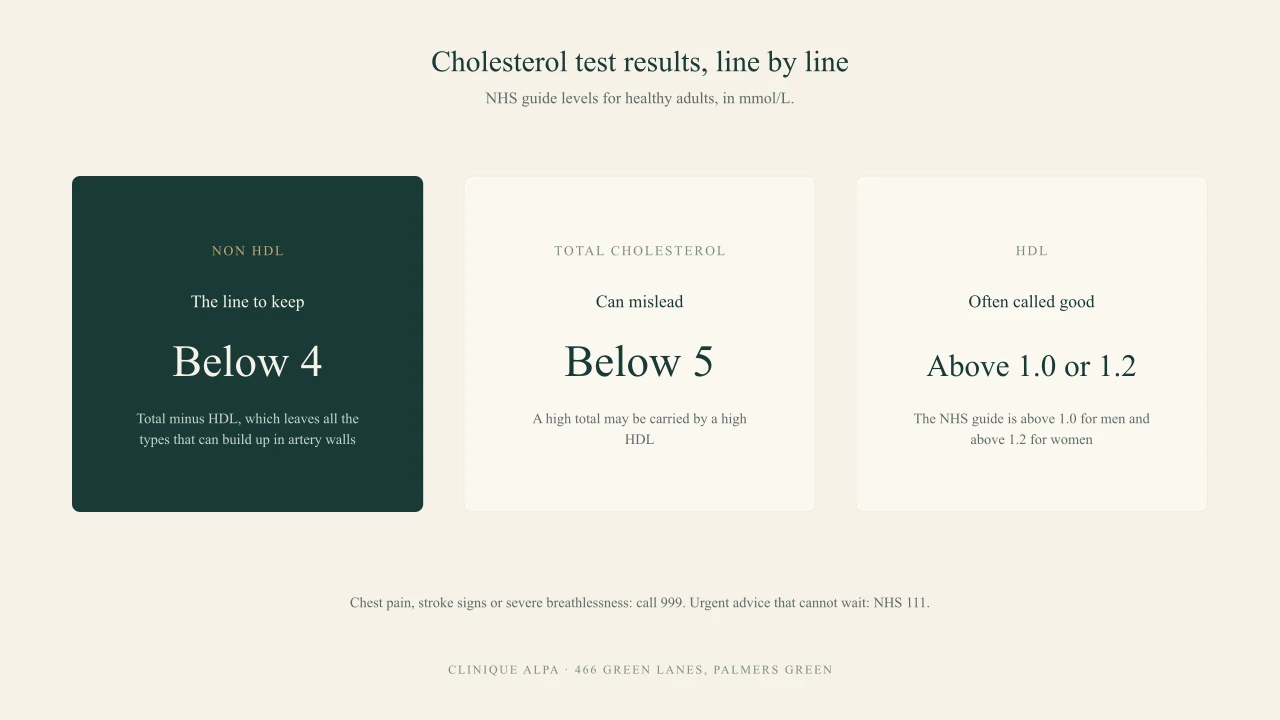
- Total cholesterol. Everything added together, helpful and harmful alike. The NHS guide is below 5. On its own it can mislead in both directions, because a high total may be carried by a high HDL.
- HDL. Often called good cholesterol. These packages carry cholesterol away from the vessel walls. The NHS guide is above 1.0 for men and above 1.2 for women.
- Non HDL. The total minus the HDL, which leaves all the types that can build up in artery walls. The NHS guide is below 4. If I could keep only one line from the report, it would be this one.
- LDL. The largest part of non HDL, and the one most people have heard called bad cholesterol. Some reports measure it and some calculate it from the other lines. Read it against the range on your own report.
- Triglycerides. A different kind of fat, which the body uses to store energy. They rise after meals and are pushed up by alcohol, sugary food, excess weight and poorly controlled diabetes. A very high level needs attention in its own right.
Some reports also print a ratio of total cholesterol to HDL. It is a way of expressing the balance between the two in one figure, and it is one of the inputs to the risk calculators doctors use.
So the person in the opening paragraph, with a total a little over 5 and a high HDL, may have a non HDL comfortably within the guide. The flag was on the wrong line.
Does it matter whether I fasted?
Less than people think. The NHS says it does not make much difference to total, HDL and non HDL whether you have eaten or not, and that most people do not need to fast, although some are asked to for up to 12 hours. Triglycerides are the line a recent meal moves most. If yours are raised on a sample taken after lunch, the usual next step is a repeat after a fast, not a diagnosis. I have set out the rules in fasting before a blood test.
Other things shift the numbers for a while. The NHS notes that levels may be lower or higher than usual if you have been ill, are taking some medicines or have recently had a baby. A result from one of those times is worth repeating before anything is decided.
Why does risk matter more than one number?
What I look at in clinic is the person the cholesterol belongs to. High cholesterol does not usually cause symptoms. It matters because of what it can lead to over 10 or 20 years, and how much it matters depends on everything else that is true of you.
Take 2 people with the same non HDL. One is 38, has never smoked, has normal blood pressure and no family history. The other is 62, smokes and has high blood pressure and diabetes. The printed result is identical. The risk is not remotely the same, and nor is the advice.
This is why the NHS says a good target depends on your age, any health conditions and your risk of cardiovascular disease. A GP puts cholesterol together with age, blood pressure and other conditions to estimate that risk, often as a QRISK score: the chance of a heart or circulation problem over the next 10 years. People aged 40 to 74 without certain existing conditions are invited to an NHS Health Check every 5 years, which does exactly this.
So in the consultation I measure blood pressure, weight and waist. I ask about smoking, alcohol, activity and what a normal week of food looks like. I ask who in the family had a heart attack or stroke, and at what age. I check for diabetes and kidney disease, and for an underactive thyroid, which can raise cholesterol. Then the conversation is about the risk as a whole.
Sometimes that conversation ends with changes to food, activity, smoking and alcohol, and a date to test again. Sometimes cholesterol lowering medicines are part of it, and the NHS is clear that some people need them as well as the lifestyle changes. That decision follows from the overall risk and is made with you. A result under 5 is not a free pass for someone at high risk, and a result over 5 is not a sentence for someone at low risk.
One pattern deserves its own mention. A very high cholesterol in a younger adult, particularly with close relatives who had heart disease early, can be inherited. That needs proper assessment, because close relatives may be affected too.
At Clinique Alpa we take a holistic way to approach one's lifestyle changes should your cholesterol result come above five. It's not always the case that you need to start medications. The doctors at Clinique Alpa can discuss in depth and formulate a bespoke diet plan which is suited to your needs and preferences. Every individual has a preference to their diet with respect to their culture or heritage. And it's fundamentally important to understand that and to guide individuals in how lowering cholesterol can be made in a holistic manner. There are instances where if the cholesterol is too elevated, then further intervention by a specialist lipid clinic or cardiologist or further investigations may well be needed. And medical interventions may also need to be put in place. But generally speaking, a good place to start is to have a conversation with a doctor in the first instance.
When should you be seen sooner?
- Chest pain, tightness or pressure, or pain spreading to the arm, jaw or back, needs 999. A normal cholesterol never explains chest pain away.
- Sudden weakness of the face or an arm, or slurred speech, needs 999.
- Chest discomfort or breathlessness that comes on with effort and settles with rest should be assessed promptly, whatever the report says.
- A very high result, or a parent, brother or sister who had a heart attack or stroke at a young age.
How does cholesterol testing work at Clinique Alpa?
Samples are taken at 466 Green Lanes in Palmers Green and results are reviewed by a doctor. The lipid profile and the wider profiles that include it are set out on our blood test prices page, where the listed prices include taking your blood. We confirm beforehand whether your profile needs a fast.
A cholesterol result is only half of the answer without the blood pressure, the history and the examination. A clinic consultation is 30 minutes and costs £100. That is time to put the result into a risk estimate and agree what, if anything, to do. Our guide to cholesterol and heart health covers the ways of lowering it. With your consent, a summary goes to your NHS GP.
If you take one thing from the report, take the non HDL, and bring it with your blood pressure to someone who will look at both.
Drafted with AI assistance, clinically reviewed by Dr Mitesh Parmar, MBBS MRCGP, Principal GP and Clinical Director at Clinique Alpa, 466 Green Lanes, Palmers Green, London N13 5PA. This article is general information, not personal medical advice. In an emergency call 999. For NHS advice call 111 or visit nhs.uk.