
Things had been going well for a long while, which is partly why nobody noticed the slide. Sleep got shorter. Meals became whatever was nearest. A couple of decisions were made that were not like the person making them. A treatment had been skipped for a few days, then a few more, and the drinks at the end of the evening had become bigger and more frequent.
By the time it is clear that depression relapse has started, the pattern has usually been building for a while. This page explains the early signs, how missed treatment and alcohol can combine with a stressful spell, and what helps recovery.
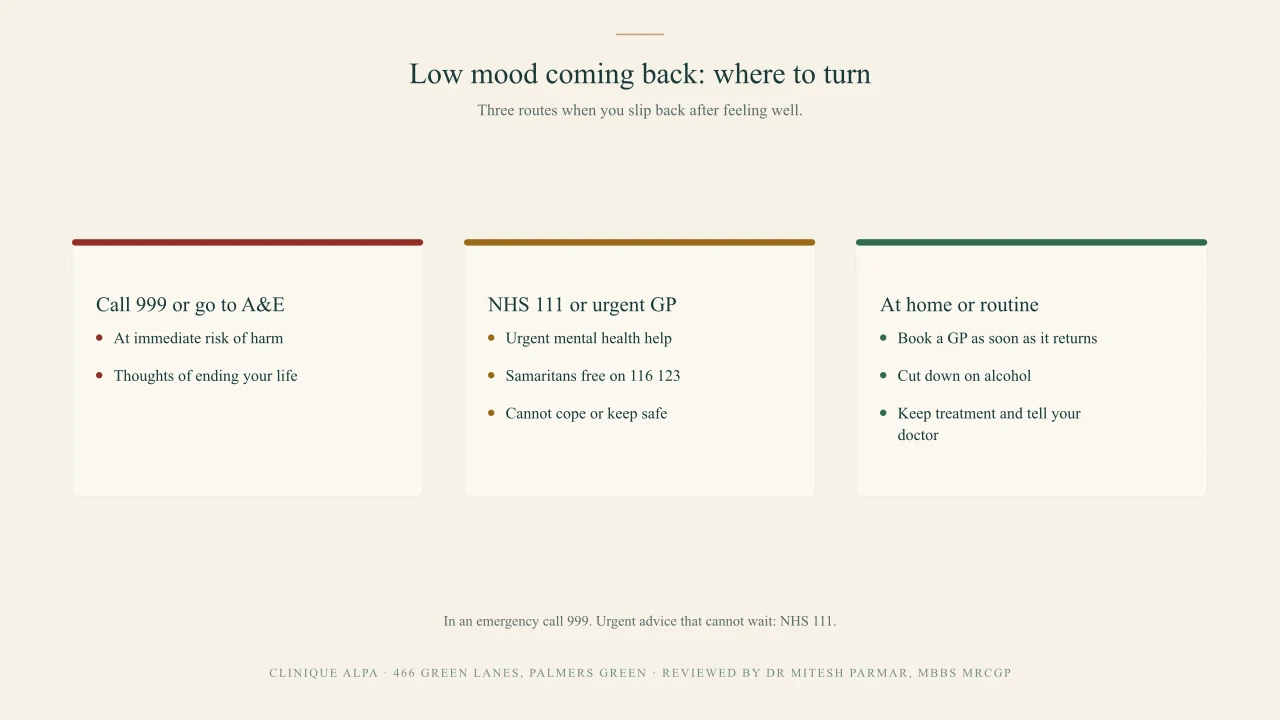
If you are at immediate risk of harming yourself or someone else, call 999 or go to A&E. For urgent mental health help, call NHS 111 and choose the mental health option, or call Samaritans free on 116 123, any hour.
What are the signs of a depression relapse?
A relapse is a return of the illness after a spell of feeling well. The NHS describes depression as persistent sadness, hopelessness, loss of interest in things you enjoy and frequent tearfulness, often together with anxiety. Physical signs include constant tiredness, poor sleep, low appetite and aches and pains. A relapse usually starts with the physical ones, because they are easier to explain away than the mood.
The early pattern I hear about most often is this:
- Sleep gets shorter, or turns upside down.
- Food becomes an afterthought.
- Concentration slips, and things that were easy begin to feel like effort.
- Interest in people and plans fades.
- Worry and a busy mind take over the quiet moments.
- Choices start to feel out of character, or hard to think through.
No single item is the signal. The change from your usual self is the signal. Keep an eye on it, and tell someone close to you what to look for, because the people around you will often notice before you do.
How do missed treatment and alcohol make it worse?
The trigger is rarely one thing. Stress comes first: a row at home, a move, a change at work, a loss. Stress then takes the structure away. Routines go, and with them the regular habits that were holding mood up. Treatment that was taken without thinking starts to be missed, because the day no longer has a rhythm. And in the evening, a drink feels like the quickest way to get through.
Alcohol is a poor helper. It may take the edge off for an hour, but it disturbs sleep, and it tends to lower mood the next day. The NHS lists cutting down on alcohol among the lifestyle changes that help people with depression. It also advises keeping to 14 units a week or fewer on a regular basis, spread over 3 or more days, with several drink free days if you want to cut down. For someone whose mood is already slipping, I would go further and ask for less, and to see how mood and sleep respond.
Missed treatment and alcohol together are a particular problem, because each makes the other easier. Treatment is skipped when drinking has taken over the evening, and drinking rises when treatment has lapsed and the mood has fallen. Seeing it as a loop, not as a failing, is the first step out of it.
What does a doctor look at with a relapse?
What I look at in clinic starts with what has changed and when. I ask about sleep, appetite, energy, interest, concentration and mood, and I ask when each began, so that I can see the order. I ask what was happening in life at the time, because the stress is part of the treatment plan, not background.
I ask directly about alcohol, and I ask without judgement. How much, how often, whether it has risen, and whether it is being used to get to sleep or to get through the evening. I ask the same about any other substance. People are usually relieved to be asked plainly.
I ask what treatment has been taken, what has been missed and why. The reason is rarely carelessness. Sometimes side effects were the problem. Sometimes the person felt well and stopped. Sometimes life simply took over. Each reason leads somewhere different. I ask people to talk to me before they stop or change a treatment, and not afterwards.
I ask whether thoughts of harming yourself have come up. I ask every time, and I ask clearly. I also ask whether mood has been unusually high or driven as well as low, or whether you have felt confused or disorientated, because that changes the assessment. And I ask about physical health, since thyroid problems, anaemia, low vitamin levels and long term illness can all drag mood down, and I will arrange blood tests where they are appropriate.
Finally, I ask who is around you. Depression shrinks the world. A partner, a friend or a family member who knows the plan can notice early and say so, which is worth more than most people expect.
From Dr Mitesh Parmar
Alcohol is something I ask about plainly and without judgement, because it often sits quietly behind a dip in mood and worsens sleep. I also ask whether treatment was stopped or missed. Relapse is common and is not a failure. If you are having thoughts of ending your life, call 999 or NHS 111 straight away.
What helps recovery?
The first step is to see a doctor as early as you can. The NHS advises not delaying. After that, the NHS describes a range of options depending on severity. For milder depression it includes watchful waiting, exercise, guided self help or talking therapies such as cognitive behavioural therapy. For moderate to severe depression it describes talking therapy with medicines, and for severe depression a referral to a specialist mental health team. The choice is made with you.
Alongside that, the practical steps matter:
- Restart a regular routine for sleep, meals and daily activity.
- Cut back on alcohol, and see how mood and sleep respond.
- Take any agreed treatment as planned, and talk to a doctor before changing it.
- Tell one or two people close to you what is going on.
- Keep a short plan for next time: the early signs, who to tell and when to call a doctor.
That last point is a depression relapse prevention plan in its simplest form. Write it down while you are well. It does not need to be formal, but it should name the first signs, the people who will notice, and the first phone call you will make.
When should you ask for help sooner?
- If you are at immediate risk of harming yourself, call 999. For urgent mental health help, call NHS 111 and choose the mental health option, or Samaritans free on 116 123.
- If you feel unable to cope or keep yourself safe, get urgent help the same day.
- If low mood has returned and has lasted more than a few days, book a GP appointment.
- If drinking is rising, or you are using alcohol to sleep.
- If you have stopped treatment and your mood is dropping.
How do we approach this at Clinique Alpa?
A clinic consultation is 30 minutes at 466 Green Lanes, with Dr Parmar, whose special interest is psychological medicine. We go through what has changed, look at alcohol and sleep without judgement, and agree a plan with a follow up date. With your consent, a summary goes to your NHS GP, because this is private care alongside the NHS. Our guides to low mood and alcohol support cover the background.
Common questions
What does depression relapse mean?
It means the illness returning after a spell of feeling well. It is common, and an early appointment is worthwhile.
Can depression relapse happen after years?
Yes. It can return after a long period of being well, often when stress, poor sleep or a gap in treatment arrives together.
Does alcohol make depression worse?
It can. It disturbs sleep and tends to lower mood, and the NHS lists cutting down on alcohol among the changes that help.
Drafted with AI assistance, clinically reviewed by Dr Mitesh Parmar, MBBS MRCGP, Principal GP and Clinical Director at Clinique Alpa, 466 Green Lanes, Palmers Green, London N13 5PA. This article is general information, not personal medical advice. In an emergency call 999. For NHS advice call 111 or visit nhs.uk.