
The night has not been restful, and the day does not recover it. Eyelids droop over the afternoon screen, the sofa becomes the safest place to sit, and the legs that were restless at midnight still feel strange at teatime. People tend to put this down to age, stress or a poor mattress for a long time before they mention it.
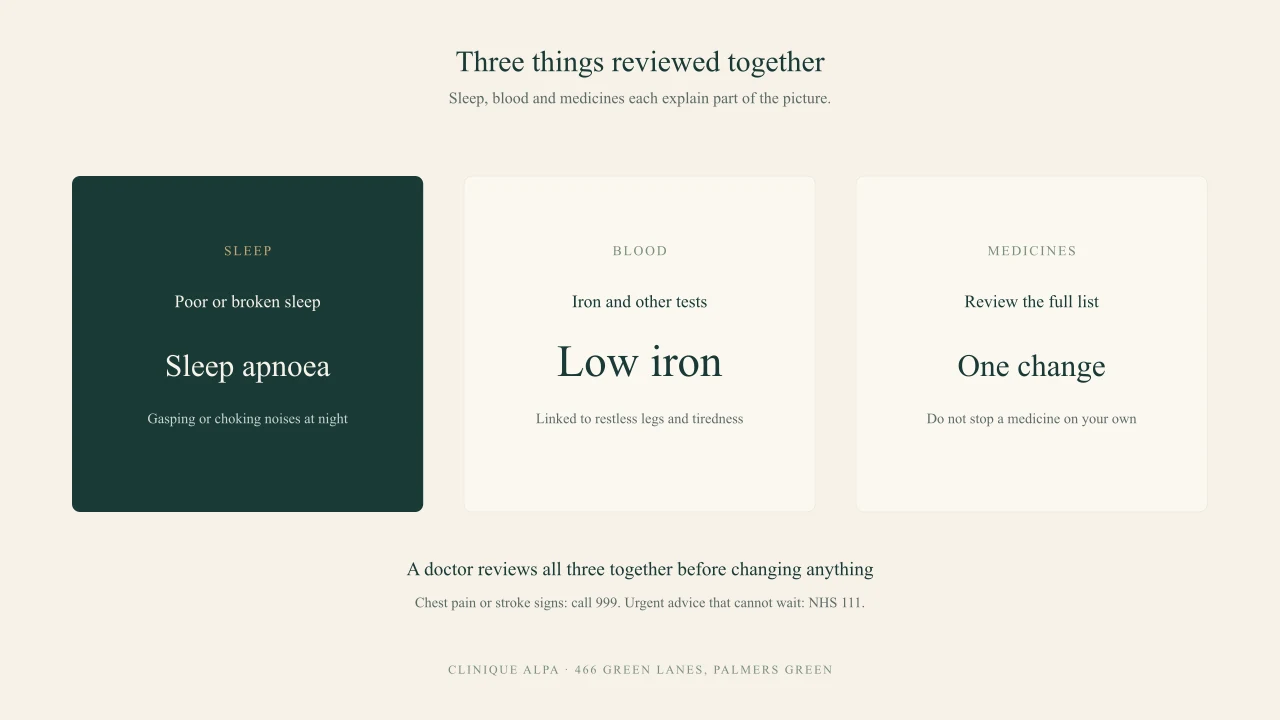
The list of daytime drowsiness causes is long, but a few of them account for most of what I find, and a review of medicines is among the most useful steps. Restless legs belong in the same conversation because the two often travel together.
Chest pain, signs of a stroke, severe breathlessness, heavy bleeding, a severe allergic reaction or symptoms of sepsis need 999 or A&E immediately. For urgent advice that cannot wait, call NHS 111.
What are the common daytime drowsiness causes?
The NHS lists poor sleep including insomnia, stress and low mood, hormonal changes, and illnesses such as glandular fever. It also lists conditions that can sit behind tiredness: sleep apnoea, iron deficiency anaemia, diabetes and an overactive thyroid. Some medicines and treatments can cause drowsiness too.
Sleep apnoea deserves a special mention. The NHS describes it as a common cause of daytime sleepiness, with pauses in breathing, gasping or choking noises, frequent waking and loud snoring at night. Many people do not notice it themselves, so a partner or family member who has heard it can be the most useful witness.
Why do restless legs go with drowsiness?
Restless legs syndrome is a creeping urge to move the legs that is worse in the evening and at rest, and it can stop sleep coming. The NHS says it is thought to be linked to low iron levels and to the brain chemical dopamine, and that it can be linked to pregnancy, iron deficiency anaemia, kidney disease and some medicines. A poor night makes the following day drowsy, and a drowsy day makes it hard to tell what is the cause and what is the consequence.
What I look at in clinic
I start with the sleep itself. When do you go to bed and when do you actually fall asleep? Do you wake, and what wakes you? Does anyone say you snore or stop breathing? Do the legs bother you at night or at rest, and does moving help? Then I ask about the day: how drowsy, at what times, and whether it has ever been dangerous, such as nodding off at the wheel. If it has, that changes how quickly we act, and I would ask you not to drive until it is sorted.
Then the medicines, and this is the part that most often changes the plan. I want the whole list, including anything bought over the counter, anything taken only at night and anything started recently. I ask when each was started and whether the drowsiness began soon afterwards. Some medicines cause drowsiness directly. Some make restless legs worse. Some are combined with others in ways that add to the effect. A symptom that began within weeks of a change is a clue, and the order of events is more reliable than memory.
It is important to say that I do not ask anyone to stop a medicine on the strength of a blog post, and nor should you. Some medicines are not safe to stop suddenly, and some are treating a condition that matters more than the drowsiness. The honest approach is to review the dose, the timing and the alternatives with the doctor who started it, and to change one thing at a time so that the effect can be seen.
I examine you: pulse, blood pressure, weight, neck size, a look at your throat, and a check of the legs and nerves. I look for pale skin and other signs of anaemia. Blood tests are often worthwhile. The NHS lists iron deficiency, diabetes and thyroid problems among the causes of tiredness, and low iron in the blood can contribute to restless legs, so I usually check blood count, iron levels, blood sugar, kidney function and thyroid function. If the pattern suggests sleep apnoea, a sleep study is arranged through a specialist.
Last, I look at the second layer. Low mood, anxiety, long shifts and caring responsibilities all affect sleep, and they are easier to deal with when they are said aloud. Where the picture is complicated, a joint plan with the specialist who looks after another condition is better than a series of separate changes.
From Dr Mitesh Parmar
A normal night is my first question, including snoring, pauses in breathing and kicking legs, since a partner often sees what you do not. Iron levels, thyroid and vitamin B12 are worth checking when legs are restless. I also review anything you take that can make you drowsy. Please do not drive if you are nodding off.
When should you come in sooner?
Call 999 or go to A&E for chest pain, signs of a stroke or severe breathlessness. See a GP soon, or call NHS 111 if you cannot reach one, if:
- You have been tired for a few weeks and do not know why.
- Tiredness is affecting your daily life.
- Restless legs are stopping you from sleeping.
- You have been told you gasp, snort or choke in your sleep.
- Weight loss or mood changes come with the tiredness.
The NHS also notes that if sleep apnoea with excessive sleepiness is confirmed, you must not drive until your symptoms are under control, and that you may need to tell the DVLA.
How do we approach this at Clinique Alpa?
A clinic consultation is 30 minutes with a doctor at 466 Green Lanes for £100. Blood tests can be taken at the clinic and are priced on the blood test prices page. We review the medicines with you and your NHS GP, with your consent, rather than changing them behind anyone's back. A referral letter is written where clinically appropriate after assessment and is included in the consultation fee. For a wider look at reviewing medicines, see the medication review guide, and for the leg symptoms alone the restless legs guide.
Common questions
What are the causes of daytime tiredness?
Poor sleep, stress, low mood, sleep apnoea, anaemia, diabetes, thyroid problems and some medicines. A doctor sorts them with your history and blood tests.
Can restless legs cause daytime fatigue?
Yes, indirectly, by interrupting sleep. Treating the cause, such as low iron, often helps.
Can a medicine cause drowsiness during the day?
Some can. Do not stop one on your own. Ask the doctor who started it to review it with you.
Sources: NHS: tiredness and fatigue and NHS: restless legs syndrome and NHS: sleep apnoea.
Drafted with AI assistance, clinically reviewed by Dr Mitesh Parmar, MBBS MRCGP, Principal GP and Clinical Director at Clinique Alpa, 466 Green Lanes, Palmers Green, London N13 5PA. This article is general information, not personal medical advice. In an emergency call 999. For NHS advice call 111 or visit nhs.uk.