
The medicine has been given, the house is quieter, and your child is finally asleep. You are sitting on the landing listening to every breath and wondering whether this is the all clear or just the calm in the middle. Nobody tells you what the next few days should sound like.
Croup recovery has a usual shape, and knowing it is what lets you sleep. This page is for the days after a child with croup has been seen and treated: what is normal, what is slower than I would like, and what means you should ring again.
Chest pain, signs of a stroke, severe breathlessness, heavy bleeding, a severe allergic reaction or symptoms of sepsis need 999 or A&E immediately. For urgent advice that cannot wait, call NHS 111. In a child, a limp or floppy body, blue, grey or blotchy skin, laboured breathing or a baby under 3 months with a temperature of 38C or higher belongs on that same list.
What does croup recovery look like?
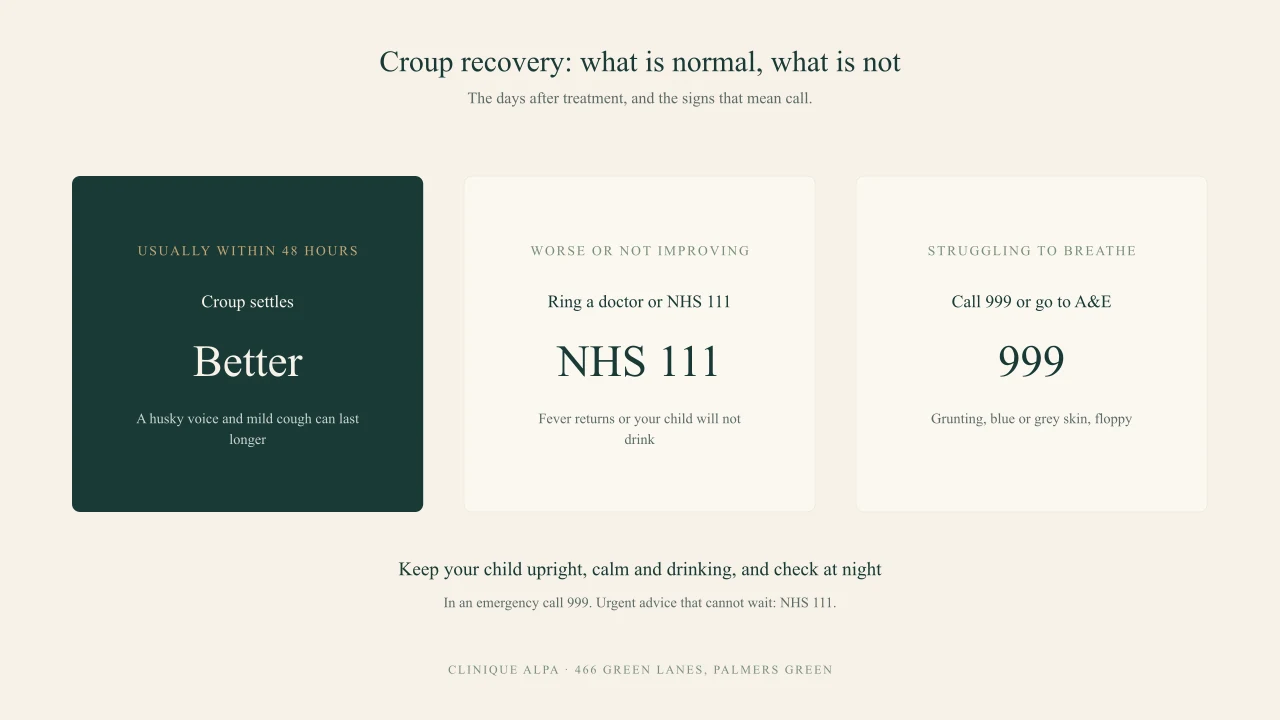
The NHS says croup usually gets better on its own within 48 hours. That is the figure I give parents, with one honest addition. Better does not mean silent. Over those first couple of days the cough usually loosens, the hoarse voice gradually clears and the rasp on breathing in fades, but each of those can lag behind the others.
Things that are usually part of a normal recovery:
- A cough that is still there but less harsh and less frequent than at the start.
- A voice that stays husky for a while after the cough has eased.
- A child who is tired, clingy and off their food for a day or two but still drinking.
- Nights that are better than the first, with the odd wake up and a few barks.
Parents often tell me the second night worries them more than the first, because they had expected to be past it. A few barks as your child settles are common. What matters is the direction of travel across a whole day, not a single hour at 3 in the morning.
What should you do at home while your child recovers?
The same things that helped on the first night still help. Keep your child upright when they are unsettled, keep them calm, offer fluids often and check on them through the night. Paracetamol or ibuprofen is fine for a temperature or discomfort, following the leaflet. The NHS advises against steam, so there is no need for the bathroom and a hot shower.
Appetite is the thing people fret about. A child who eats little for a day or two but keeps drinking and passing urine is usually fine. A child who refuses fluids, or has a very sore throat that makes swallowing painful, needs to be seen again.
What if your child is not getting better after treatment?
Croup is a viral illness, and the medicine a doctor gives is aimed at the swelling, not at the virus. Antibiotics do not treat croup. Sometimes a second illness runs alongside it, such as tonsillitis or an ear infection, and that can explain a child who seems to hit a plateau, or a temperature that comes back. Both are common enough that I always look for them at the first visit and again at review.
Call NHS 111 or contact the doctor who saw your child the same day if:
- They are getting worse or are not improving after being seen.
- The temperature returns, or the fever seems to build rather than fade.
- They will not drink, or are passing much less urine than usual.
- The rasping breath returns or becomes more noticeable, even if the cough sounds better.
Call 999 or go to A&E straight away if your child:
- Is struggling to breathe: grunting, the tummy sucking in under the ribs, or a breathing sound that has changed.
- Has blue, grey, pale or blotchy skin, lips or tongue.
- Is sleepier than usual, hard to wake, limp or floppy.
- Is drooling more than usual, finds swallowing hard, or wants to sit up rather than lie down.
What does a doctor check at a review?
What I look at in clinic at a review is different from the first visit, because the question has changed. The first time I am asking how narrow the airway is. At review I am asking whether it is opening up and whether anything else has appeared.
I start by listening to the breathing while the child is calm and distracted. A rasp at rest that is quieter than before is reassuring. One that is the same or louder is not. I check the colour, the effort of breathing, the oxygen reading on a pulse oximeter and the chest. Then the throat, the tonsils and the ears, because that is where a second infection hides. I check hydration, and I ask how the child has behaved between the barks: playing, bored, asking for the television, or flat and quiet.
I also ask what the nights have been like and who is looking after the child. Two nights of broken sleep is a long time to go on adrenaline, and a parent who is running on empty makes poorer judgements about what is normal. Part of the review is giving you a clear marker, such as which sound or behaviour means ring again, so that you do not have to decide at 3 in the morning from scratch.
If the child is clearly on the mend I say so, and agree when they can go back to nursery or school. If not, we talk about what is slowing things down, and whether hospital review makes sense.
From Dr Mitesh Parmar
Croup tends to look worse at night, and sitting your child upright and staying calm helps. What I watch for is a harsh noisy sound on breathing in while resting, drooling or a child who becomes very tired. Those are signs to call 999. Please do not wait to see whether it passes.
How long until the cough goes?
The NHS figure for the illness settling is 48 hours, but a tickly cough and a husky voice can trail on a little longer. What I want to see is a steady direction. If your child is clearly worse than yesterday, or the cough has changed from loose to harsh again, do not wait for a number of days to pass.
If the barking returns weeks later, that is a different question, and I have written about it in croup that keeps coming back. If you are reading this before your child has been assessed, start with croup in children, and for the case of a sore throat and swollen tonsils on top, read about croup with tonsillitis.
Common questions
What is the croup recovery time?
The NHS says croup usually gets better on its own within 48 hours. A husky voice and a mild cough can last a little longer.
What is a normal croup recovery for a toddler?
A toddler is often tired and clingy for a day or two, with a cough that is gradually looser. Fluids, upright rest and regular night checks are the plan, and a worsening or a returning rasp means ring again.
When should I take my child back after croup?
Go back if they are not improving, are getting worse, will not drink, or the fever returns. Call 999 if the breathing becomes a struggle.
How do we help after croup at Clinique Alpa?
Call 020 8882 8088 or book online and tell us how your child has been since treatment. A 30 minute clinic consultation at 466 Green Lanes is £100 and a parent or guardian stays throughout. If your child is too tired to travel, a home visit lasts 60 minutes and is from £250 on a weekday, with travel priced by postcode. With your consent, a summary goes to your NHS GP.
More in this series: croup
Drafted with AI assistance, clinically reviewed by Dr Mitesh Parmar, MBBS MRCGP, Principal GP and Clinical Director at Clinique Alpa, 466 Green Lanes, Palmers Green, London N13 5PA. This article is general information, not personal medical advice. In an emergency call 999. For NHS advice call 111 or visit nhs.uk.