
It was supposed to be over. The barking stopped, the voice came back, and everyone slept through. Then a few nights later your child coughs in that way again, and there is the same rasp on breathing in. You are lying in the dark thinking that croup is not meant to behave like this.
When croup keeps coming back, two questions matter. The first is tonight: is the noisy breathing an emergency? The second is longer term: why does it keep happening, and does anyone need to look more closely at the airway?
Chest pain, signs of a stroke, severe breathlessness, heavy bleeding, a severe allergic reaction or symptoms of sepsis need 999 or A&E immediately. For urgent advice that cannot wait, call NHS 111. In a child, a limp or floppy body, blue, grey or blotchy skin, laboured breathing or a baby under 3 months with a temperature of 38C or higher belongs on that same list.
What does noisy breathing at rest mean?
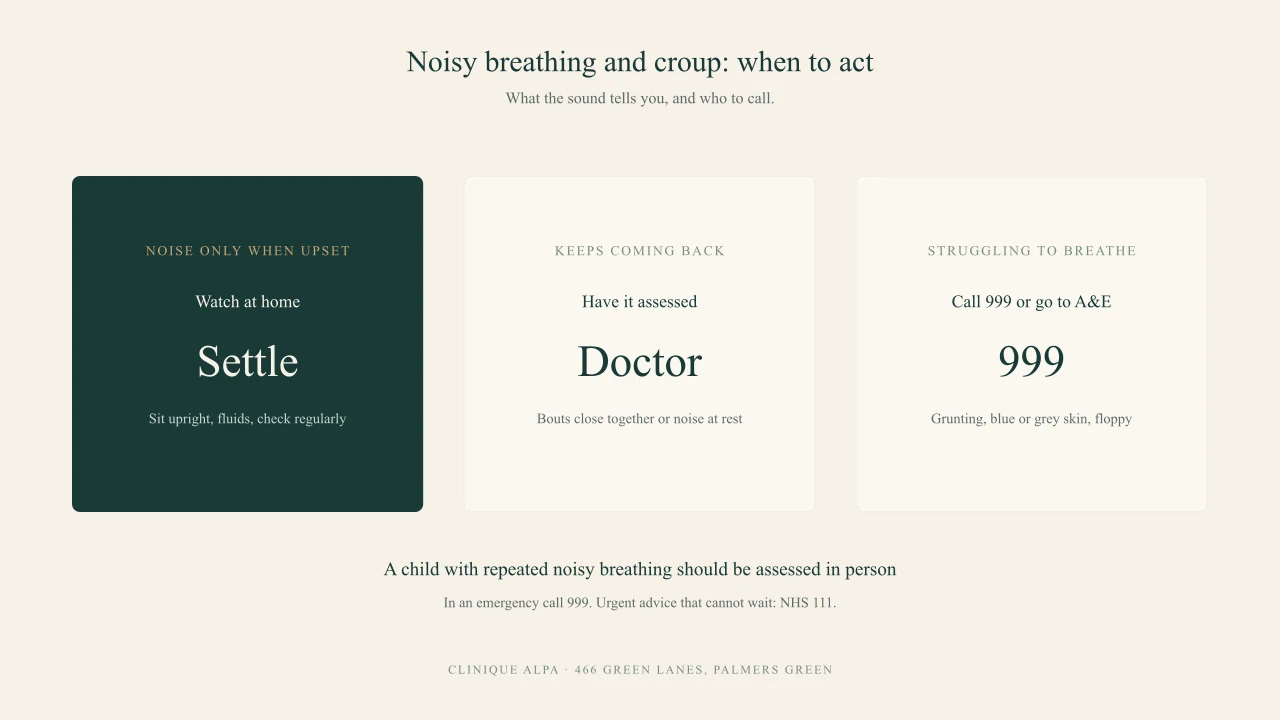
Croup narrows the airway around the voice box. The noise on breathing in is called stridor. It is often louder when a child coughs, cries or is upset, and it often quietens when they are calm. The version that worries me most is the one that stays when the child is still and quiet, because that tells me the airway is narrow even with no effort being made.
The NHS lists the signs that make it an emergency. Call 999 or go to A&E if your child:
- Is struggling to breathe: grunting, the tummy sucking in under the ribs, or a breathing sound that has changed.
- Has blue, grey, pale or blotchy skin, lips or tongue.
- Is sleepier than normal, hard to wake, limp or floppy, or unusually quiet and still.
- Is very upset or restless, cannot be calmed and is finding it hard to breathe.
- Is drooling more than usual, finds swallowing hard, or wants to sit rather than lie down.
Do not wait to see whether it passes. If the breathing is noisy at rest and your child looks tired or frightened, that is the moment to call.
What if croup keeps coming back?
Croup is common in young children, and it is not unusual for a child to have it more than once. A viral cold that settles into the airway is simply one of the things small airways do. If your child has had a bout, recovered fully and is then hit by a fresh virus, that is a new illness and often the whole picture.
What I look for is the pattern. When this comes up in consultation, there are a few shapes that make me stop and think:
- Bouts that come back close together, before a child has really recovered.
- Noisy breathing that is present between bouts, not just during a cold.
- Bouts that start without a cold at all.
- A child who has needed hospital more than once.
- Noisy breathing that has been there since early life.
Any of those suggests the cause may not be a simple viral croup each time. Other things can cause a barking cough and noisy breathing: allergy or asthma, reflux irritating the airway, a structural narrowing of the airway, or something small that has been breathed in. I would not want to guess at those from a distance, and a child with repeated stridor should be assessed in person.
What does a doctor look at when croup keeps coming back?
What I look at in clinic starts with the history, because the history carries most of the information. How many episodes, how close together, and how did each one start? Was there a cold first? What does the breathing sound like between bouts? Does feeding, lying flat or being active make it worse? I ask about eczema, hay fever, wheeze and family history of asthma, since a child who is prone to allergy often has airways that react more.
I ask about the early months of life too, including how the baby fed and whether the noisy breathing was already there. Reflux can make a child hoarse and cough at night, and I ask about it directly.
Then the child. I watch them play and breathe before I examine them. I listen to the breathing at rest, look for the chest pulling in, check the oxygen reading with a pulse oximeter and listen to the chest. I look at the throat as far as the child will allow, and I check the ears and glands. I look at growth and weight, which tell me about the wider picture.
Most of the time I can tell whether we are dealing with a run of ordinary viral illnesses or whether something deserves a specialist look. If it does, I arrange referral to a children's breathing or ear, nose and throat specialist, and write the reasons clearly so the family does not need to retell the story. If it does not, I say so, and I explain what to do when the next cold comes. With your consent, a summary goes to your NHS GP.
From Dr Mitesh Parmar
Between episodes I think about what keeps setting it off: another cold, a narrow airway, or something else. The rasp on breathing in is what matters most. If your child is struggling, drooling, pale, or noisy even when calm, call 999 and keep them upright and as calm as you can.
What can you do at home when the barking returns?
The home advice is the same each time. Sit your child upright, keep them calm, offer fluids, and check on them regularly through the night. Paracetamol or ibuprofen is fine for a temperature or discomfort, following the leaflet. The NHS advises against steam. And because your child has done this before, treat this episode as new: if you think it is croup again, ask NHS 111 or a doctor to assess, because a doctor may give medicine that shortens the illness.
Keep a short note on your phone of the date, what came before it, and what the breathing sounded like. A few lines saves a lot of recall later, and it helps a doctor see a pattern.
Common questions
Can croup come back?
Yes, a child can have croup more than once because each bout follows a fresh virus. Repeated bouts close together, or noisy breathing between bouts, should be assessed.
Can you get croup back to back?
It can seem like that when the cough lingers and then a new cold arrives. If your child is not recovering between episodes, or the rasp is present at rest, see a doctor.
Does a croup cough keep coming back when it is something else?
It can. Allergy, asthma, reflux and structural causes can all give a barking cough, which is why a child with repeated episodes is worth examining properly.
For the first night of croup, see croup in children, and for the days after treatment, croup recovery after treatment. If a sore throat and swollen tonsils come with it, read croup with tonsillitis.
How do we help at Clinique Alpa?
Call 020 8882 8088 or book online and describe the pattern. If it sounds urgent we tell you to call 999 first. A 30 minute clinic consultation at 466 Green Lanes is £100 and a parent or guardian stays throughout. A home visit lasts 60 minutes and is from £250 on a weekday, with travel priced by postcode. This is GP care for children, not a paediatrician service, and we refer on when a specialist is needed.
More in this series: croup
Drafted with AI assistance, clinically reviewed by Dr Mitesh Parmar, MBBS MRCGP, Principal GP and Clinical Director at Clinique Alpa, 466 Green Lanes, Palmers Green, London N13 5PA. This article is general information, not personal medical advice. In an emergency call 999. For NHS advice call 111 or visit nhs.uk.