
Someone on long term treatment that holds the immune system back learns to treat a cough with suspicion. A tickle that other people would ignore comes with a question: is this a cold, or is this the kind of infection that needs seeing this week? The honest answer is that it is hard to know from the outside, which is the reason to ask early.
Chest infection immunosuppressed is a combination where a low threshold for review is sensible, because the usual warning signs can be fainter than they should be.
Chest pain, signs of a stroke, severe breathlessness, heavy bleeding, a severe allergic reaction or symptoms of sepsis need 999 or A&E immediately. For urgent advice that cannot wait, call NHS 111.
Why does a weakened immune system change a chest infection?
The immune system is what normally keeps a cold local and short. When it is damped down, deliberately, by treatment for an inflammatory or autoimmune condition, by cancer treatment, or by a condition that affects the immune system itself, an infection can spread further, last longer and cause less obvious symptoms. The NHS lists people with a weakened immune system among those at higher risk from a chest infection, and advises seeing a GP if you are in that group.
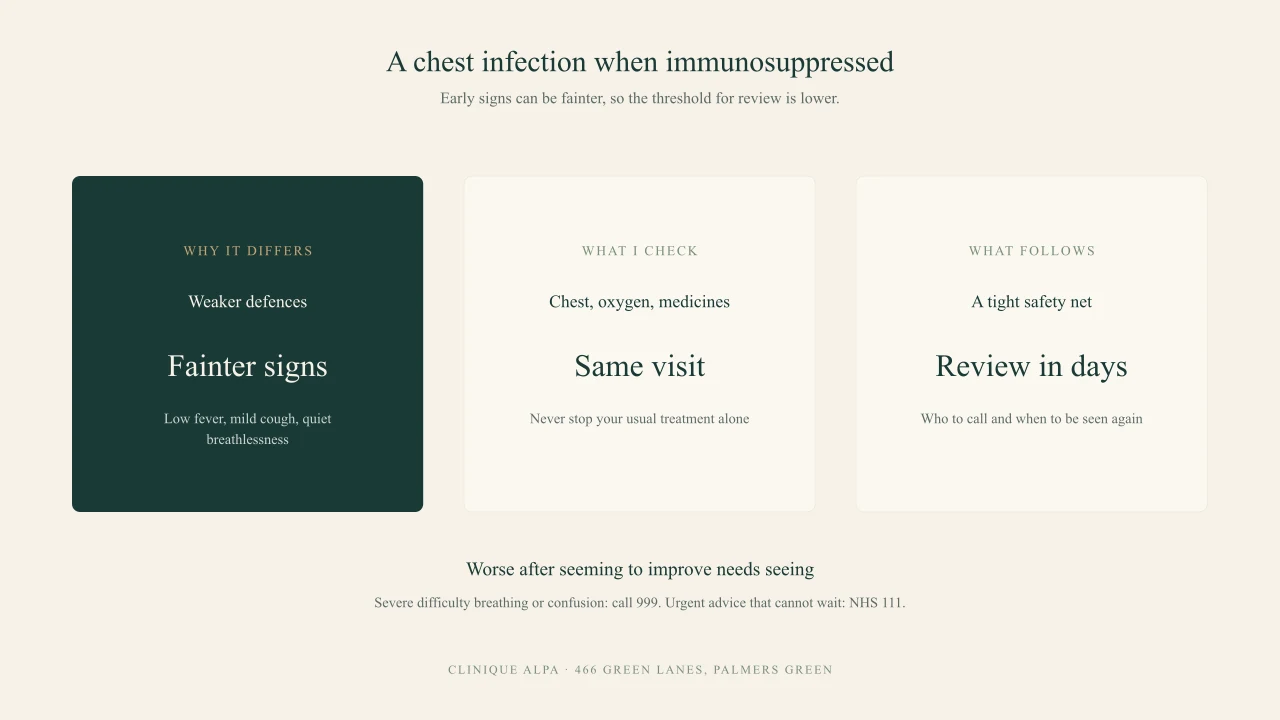
A fever may be low or absent. The cough may be mild while the breathing is quietly getting harder. Feeling more tired than the condition explains is sometimes the only early sign.
Which lung infections affect people with a weakened immune system?
The usual ones: the viruses behind colds and flu, and the bacteria behind bronchitis and pneumonia. In some people, a wider range of germs becomes possible, which is why a cough that lingers or an illness that does not behave like a usual cold gets a lower threshold for tests, including a chest X ray. It is the specialist team that knows how far a particular treatment affects infection risk, and I work alongside them, not around them.
Can a viral chest infection turn bacterial?
It can happen. A virus can damage the airway lining and make it easier for bacteria to take hold, and a person who seemed to be recovering then gets worse again, with a new fever, more breathlessness or coloured phlegm. The NHS notes that viral infections like flu or viral bronchitis usually clear up by themselves, and that antibiotics only work for bacterial infection. A chest flare that worsens after seeming to settle is exactly the kind that needs seeing, so it can be sorted into the type that needs treatment and the type that does not.
What I look at in clinic
When this comes up in consultation, people often have an established diagnosis, a specialist team, and a cupboard of medicines that includes some that matter a lot in an infection. They are often well informed, and also anxious about doing the wrong thing.
I begin with timing: when the symptoms began, whether they are improving, flat or worsening, and how they compare with an ordinary cold. Then the picture: cough, phlegm, fever or chills, breathlessness, chest pain, tiredness, appetite, and any contact with someone unwell.
The examination is the usual one, done carefully. Temperature, pulse, blood pressure, oxygen level with a pulse oximeter and breathing rate, then listening to the chest, looking at the mouth and throat, and checking for a rash or sores that might point elsewhere. I pay attention to how you look and sound at rest, because it can tell me more than a single number.
Then the medicines. Treatment that suppresses the immune system should never be stopped or changed on your own because you have an infection, and I do not advise it without involving the team that manages it. What I can do is tell you promptly whether this looks like something that needs their input today, and I can write to them with my findings. I also check inhalers, painkillers and other medicines for how they sit alongside your usual treatment.
If a chest X ray or blood tests are needed to decide between a viral illness and a bacterial one, I explain what they will show and why. If the picture is a bacterial infection, treatment is usually needed without delay, and I say so. If the person is struggling, hospital is the right place, and I say that early.
Finally, the safety net. Because early signs can be subtle, I tell people exactly what to watch, who to call and when I want to hear from them, often within a day or two. The NHS advises contacting a doctor if you are not feeling better 2 to 3 days after starting antibiotics, and for someone on immune suppressing treatment I would want to hear sooner.
From Dr Mitesh Parmar
When the immune system is held back, I lower my threshold for examining you in person, including listening to the chest and checking oxygen levels. A fever may be modest even when the infection is not. Tell me every treatment you take, including any recent changes. Breathlessness, confusion or blue lips means 999.
When to come in sooner
Call 999 or go to A&E for severe difficulty breathing, gasping or being unable to speak full sentences, a tight or heavy chest, pale, blue or grey lips or skin, coughing up blood, or sudden confusion. Do not drive yourself.
Call NHS 111 or arrange an assessment promptly if:
- you have a new fever or chills, or you are shaking
- your breathing is harder than usual, even if the cough is mild
- you were improving and then got worse
- you are coughing up coloured phlegm or blood stained mucus
- you are not improving after 2 to 3 days of antibiotics
How do we approach this at Clinique Alpa?
A face to face consultation at 466 Green Lanes is 30 minutes with a named doctor and costs £100. I listen to the chest, check the oxygen level, review your medicines and agree who needs to be told. A video consultation does not suit this problem, because the chest needs examining. If you cannot travel, a home visit is from £250 on a weekday.
A referral letter or a summary for your specialist team is written where clinically appropriate after assessment and is included in the consultation fee, and with your consent a summary goes to your NHS GP. Similar reasoning applies in chest infection with diabetes, and for the broader picture, see when treatment helps.
Common questions
Is a chest infection more serious if you are immunocompromised?
It can be, because the body is slower to contain it and the signs may be fainter. That is why the NHS advises seeing a GP if you are in a higher risk group.
Can a viral upper respiratory infection turn into pneumonia?
Sometimes, particularly in people at higher risk. A cough or breathlessness that worsens after seeming to improve should be assessed.
Should I stop my usual treatment if I have a chest infection?
Not without advice from the team that looks after it. Call them or me, and have the medicine list ready.
More in this series: chest infection with another condition
- A chest infection when you have diabetes
- A chest infection when you have asthma
- Chest infection and heart failure in older adults
Drafted with AI assistance, clinically reviewed by Dr Mitesh Parmar, MBBS MRCGP, Principal GP and Clinical Director at Clinique Alpa, 466 Green Lanes, Palmers Green, London N13 5PA. This article is general information, not personal medical advice. In an emergency call 999. For NHS advice call 111 or visit nhs.uk.