
The list on the fridge door has been growing since the spring. Milk came off first, then wheat, then tomatoes after one bad evening, and the hives still arrive some weeks and not others. By now you are eating around a dozen suspicions and none of them has been proved. At that point most people type allergy blood test London into a search bar and hope a laboratory can settle it.
A blood test can help, and the broad panel we use screens about 300 allergens from one sample. What it cannot do is replace the account of what happened to you. The useful question is what a panel like this shows, what it does not, and whether it suits your kind of reaction.
Chest pain, signs of a stroke, severe breathlessness, heavy bleeding, a severe allergic reaction or symptoms of sepsis need 999 or A&E immediately. For urgent advice that cannot wait, call NHS 111.
Allergy blood test London: what does a 300 allergen panel screen for?
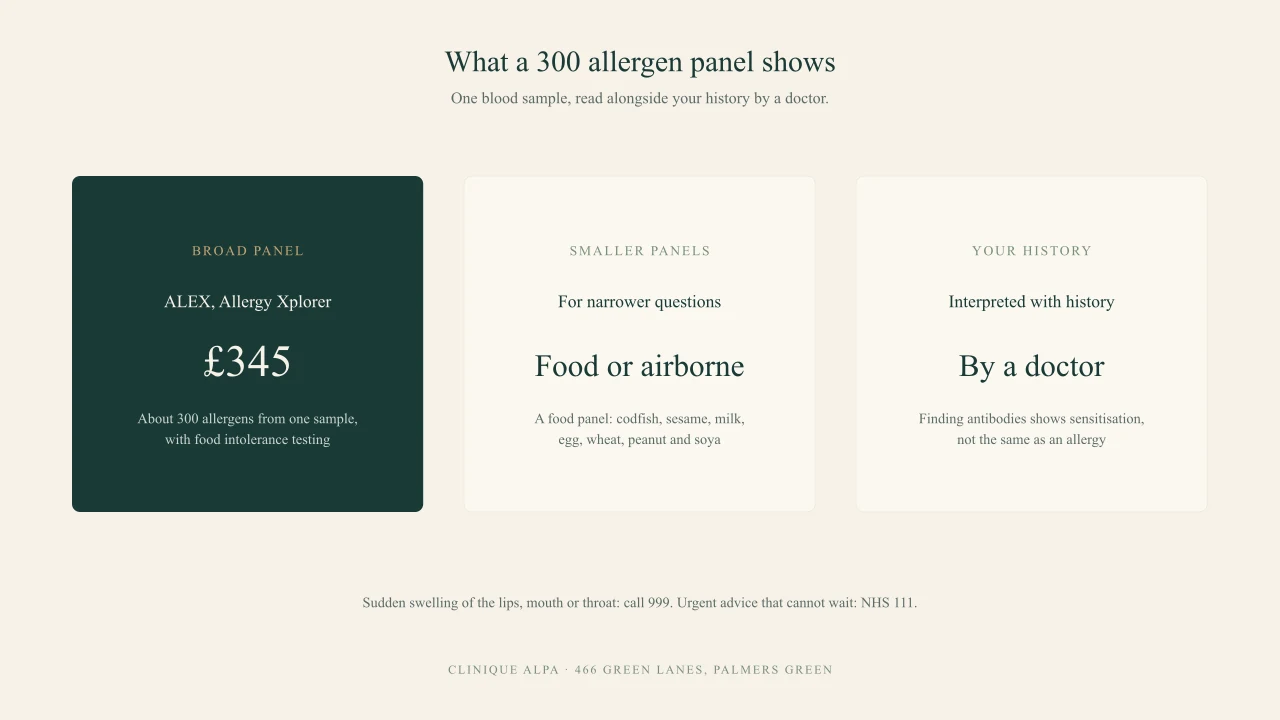
The broad test at the clinic is called ALEX, short for Allergy Xplorer. One blood sample is checked against about 300 allergens, and the report includes food intolerance testing. Smaller panels sit beside it on the price list for narrower questions: a food panel covering codfish, sesame, milk, egg, wheat, peanut and soya, for example, and an airborne panel covering birch, timothy grass, house dust mite, cat and dog.
An allergy blood test looks for antibodies your immune system has made against a particular allergen. Finding them shows that your body has noticed that allergen. Doctors call this sensitisation, and it is not the same as an allergy. Plenty of people carry antibodies to a food they eat every week without trouble. With 300 allergens on one report, a few positives that mean nothing in daily life are to be expected.
An allergy is a positive result that matches a reaction. That match is made in the consultation, not in the laboratory, which is why the result here is interpreted alongside your history by a doctor.
Why does the history decide what the result means?
What I look at in clinic is the reaction itself, in as much detail as you can give me.
What happened, and how fast. Allergic symptoms can appear within minutes or after a few hours: a raised itchy rash, swelling of the lips, face or eyes, sneezing and a streaming nose, coughing or wheezing, feeling or being sick, tummy pain and diarrhoea. I ask what you ate or touched beforehand, how much, and how long the gap was.
Which parts of the body were involved. A rash alone is a different conversation from a rash with a tight chest. Anything that touched breathing, the throat or consciousness changes the plan.
Whether it repeats. A true allergy tends to behave consistently: the same trigger, a similar reaction. Hives that come and go regardless of what you ate often turn out not to be a food allergy at all, and no panel will find a food to blame.
Where and when. Worse in May and June, worse in the bedroom, worse after an evening at a friend's house with a cat, better on holiday. Places and seasons point to things you breathe in, and they tell me which lines of the report deserve attention.
The background. Eczema, asthma and hay fever, in you or in close relatives. What you have already cut out and whether it made any difference.
Photographs of a rash or swelling help a great deal, and so does a diary: what you ate, how soon the symptoms started, what they were and how long they lasted.
With that account in hand, the choice of test usually becomes clear. If the history points at one or two suspects, a smaller panel may be all that is needed. The broad panel earns its place when the reactions are real but the trigger is unclear, or when food, season and home all seem to play a part. And sometimes the answer is that a blood test is not the next step at all. A reaction that involved the throat or breathing needs a specialist allergy clinic, where skin prick testing and supervised food challenges can be done safely, and I would write that referral before ordering a panel.
The piece most people miss is the list on the fridge. By the time someone books, the restricted diet is often causing as much trouble as the reactions: meals out avoided, a child eating 5 foods, a constant low worry at every plate. Part of the job is to hand foods back.
It may well be the fact that, you come out in hives and then itching all over the body and you have no idea what it is. This test is extremely useful in identifying what it could be.
What are the limits of food intolerance testing?
A food intolerance is difficulty digesting a food or ingredient. It is not caused by the immune system overreacting, so it does not cause a serious allergic reaction. The symptoms usually start a few hours after eating: bloating, wind, diarrhoea and tummy pain.
Because the mechanism is different, no blood result settles an intolerance by itself. The NHS advice on food intolerance is that some home tests claiming to diagnose it are not recommended: there is limited evidence that they are accurate, and they can tell people to avoid several foods, which can be harmful. I read the intolerance section of a report in that light. It gives candidates to check against your diary, usually by removing one food for a planned period and then bringing it back. It is not a verdict.
Two practical points. If wheat is the suspect, a coeliac blood test should be done while you are still eating gluten, because avoiding it can make the result inaccurate. And do not cut several foods from a child's diet without advice from a doctor or dietitian.
When should you get help sooner?
Call 999 for sudden swelling of the lips, mouth, throat or tongue, a tight throat or difficulty swallowing, struggling to breathe, skin or lips turning blue, grey or pale, sudden confusion or drowsiness, or a child who is limp and floppy. If you carry an emergency allergy pen, use it first and still call 999, even if things improve.
See a doctor soon, without waiting for a panel, if:
- A reaction involved wheezing or throat tightness, even if it settled.
- Reactions are becoming stronger or more frequent.
- A very small amount of a food was enough to set one off.
- A child's diet is narrowing or their weight is falling behind.
Never eat a suspected trigger on purpose to prove a point.
How does allergy testing work at Clinique Alpa?
The ALEX 300 allergen blood test with food intolerance testing is £345. The blood is taken at 466 Green Lanes, the listed price includes taking the sample, and the result is interpreted alongside your history by a doctor. The clinic confirms the expected result time, how the result will be shared and any follow up fee before you book. The smaller panels are on the blood test prices page, and the full range is on private blood tests.
If you would like to decide which test fits before paying for one, a clinic consultation is 30 minutes for £100. Where a specialist allergy clinic is the right next step, a referral letter is written where clinically appropriate after assessment and is included in the consultation fee. With your consent, a summary goes to your NHS GP. For the wider picture, including the difference between allergy and intolerance, see our guide to food allergy and intolerance.
Drafted with AI assistance, clinically reviewed by Dr Mitesh Parmar, MBBS MRCGP, Principal GP and Clinical Director at Clinique Alpa, 466 Green Lanes, Palmers Green, London N13 5PA. This article is general information, not personal medical advice. In an emergency call 999. For NHS advice call 111 or visit nhs.uk.