
The list of complaints sounds the same whichever way it is told. A mind that will not settle, a desk that never gets finished, sleep that comes late and breaks early, and a feeling of being behind on everything. People often arrive having decided it must be one thing, and having been told by someone else that it is the other.
The adhd anxiety symptom overlap is one of the commonest puzzles in mental health, because worry can look like poor attention and poor attention can produce worry. This page explains how a doctor tells them apart, and why the honest answer is sometimes that both are present.
If you are at immediate risk of harming yourself or someone else, call 999 or go to A&E. For urgent mental health help, call NHS 111 and choose the mental health option, or call Samaritans free on 116 123, any hour.
Why do ADHD and anxiety look so alike?
Both change how well you concentrate, how well you sleep and how settled you feel. The NHS lists trouble concentrating, restlessness, irritability, tiredness and difficulty sleeping as symptoms of generalised anxiety, and describes ADHD as affecting attention, energy levels and impulse control, with signs such as being easily distracted, forgetful, disorganised and restless. On a checklist the two lists share a good deal.
The NHS also says that ADHD often occurs alongside anxiety and depression, and that doctors consider anxiety when assessing ADHD symptoms. So the question is rarely a clean either or. It is usually which one is doing most of the work, and whether there is a second one underneath.
How can anxiety look like ADHD, and ADHD like anxiety?
Anxiety can take attention away. A mind busy rehearsing worries does not follow a conversation or finish a page. Anxiety also keeps people awake, and a tired person is forgetful and short tempered. Meanwhile, living with unreliable attention can generate real worry: about missed deadlines, forgotten appointments and what other people think. Over years that worry can harden into a pattern of its own.
That is why people ask whether ADHD can cause social anxiety. In my experience it can contribute. Someone who has interrupted, drifted off or lost track of a conversation often enough may become wary of social situations. The NHS describes social anxiety as an overwhelming fear of being judged that goes beyond shyness. Fear of judgement is the heart of it, while the ADHD pattern is about attention and impulse. The two can sit together and still be separate problems.
What does a doctor look at to tell them apart?
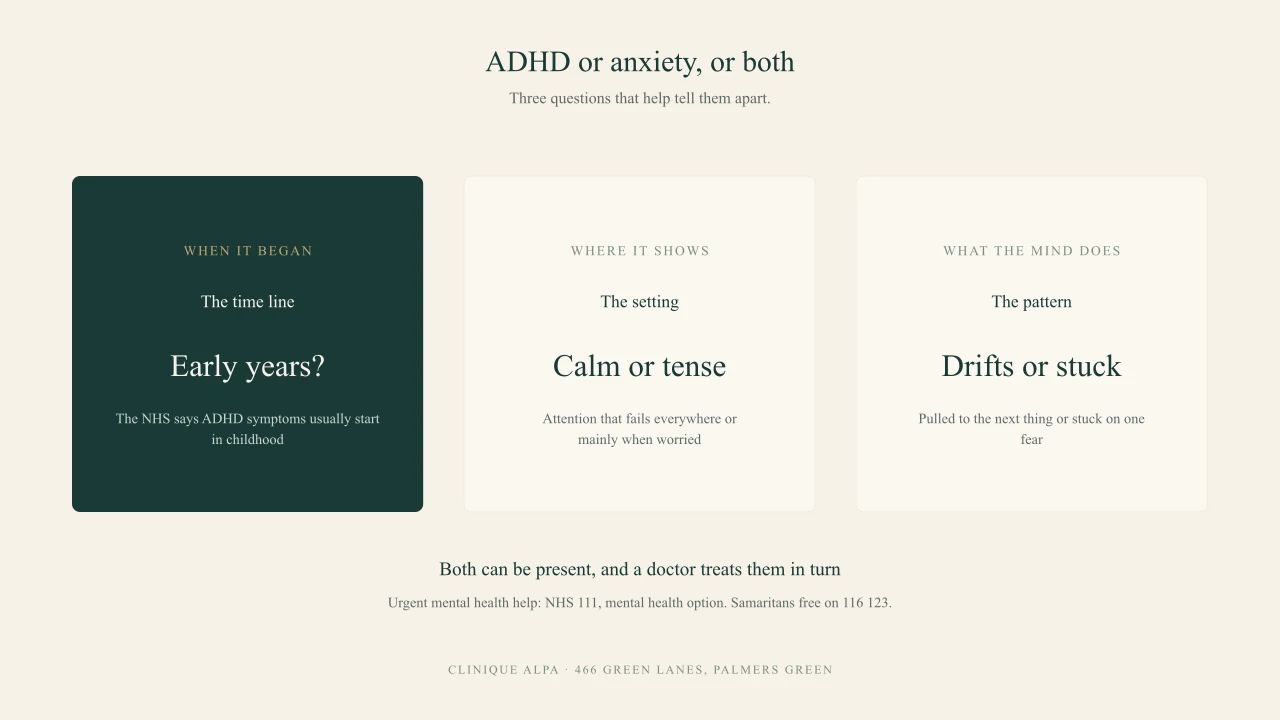
What I look at in clinic is the pattern over time, because the pattern separates them better than any single symptom.
- When it began. The NHS says ADHD symptoms usually start before the age of 12. If someone describes a lifelong pattern that goes back to early school years, that points one way. If everything changed after a particular stretch of life, it points another.
- Where it shows. Attention that fails everywhere, including in calm, safe settings, differs from attention that fails mainly when worried or under pressure.
- What the mind is doing. A mind pulled to the next interesting thing is not the same as a mind stuck on one frightening thought.
- How sleep goes wrong. Lying awake worrying is different from being unable to switch off at all, or going to bed late because the evening is the only time things feel quiet.
- What helps. Anxiety often eases when the worry is dealt with, while ADHD attention tends to follow interest and urgency.
- The company it keeps. Low mood, trauma, long term pain, poor sleep, alcohol and caffeine can all muddy attention, and so can physical causes such as thyroid problems or low iron. A doctor checks for these before putting a name on anything.
I ask for the childhood story whenever I can, and sometimes for the view of someone who knew you then. I also ask what you have already tried and what happened. Then I put the pieces together out loud, so that you can tell me where it does not fit.
Standardised questionnaires help me track change, but they do not settle the question alone. Many of them score anxiety and ADHD items in ways that overlap, which is exactly the problem being solved.
From Dr Mitesh Parmar
I ask when the difficulty began. Attention problems that were there in childhood point one way, while worry that arrived after a stressful period points another. Also ask yourself whether concentration improves when you feel calm. Sleep, low mood and caffeine muddy this picture, so I check them first.
What happens if both are present?
Then both are treated, in an order that makes sense. If anxiety is high, I often suggest dealing with it first, because assessing attention in the middle of a storm gives a muddy picture. Sometimes an assessment is paused for a few weeks for this reason. Sometimes it goes ahead and the report says clearly which findings could be due to anxiety.
For anxiety, the NHS lists talking therapies, and adults can refer themselves without a GP. For ADHD, the NHS says medicines must be started and monitored by an ADHD specialist, that not everyone with ADHD needs or wants medicine, and that other help includes adjustments at work or study and talking therapies such as cognitive behavioural therapy.
When should you ask for help sooner?
- You have thoughts of harming yourself or ending your life: use the numbers at the top of this page.
- Panic attacks are frequent, or worry is stopping you leaving the house or doing your job.
- Sleep has been poor for weeks and mood is falling.
- You are using alcohol or other substances to cope.
- Concentration problems are new, and have come on suddenly.
For any of these, see a GP, or book an appointment with the clinic.
How do we approach this at Clinique Alpa?
Start with a 30 minute GP appointment, £100. The GP takes a proper history, gives an honest view on whether a specialist assessment would help, and arranges it if so. ADHD and autism diagnostic assessments are led by consultant psychiatrists, and the fee is arranged individually and confirmed before anything is booked. The wider mental health service is on the psychiatry services page.
If you want to read around first, see adult ADHD assessment in London, and for a related question adult autism assessment in London. With your consent, a summary goes to your NHS GP.
Common questions
Can ADHD cause social anxiety?
It can contribute, because years of lost threads and interruptions can make social situations feel risky. They are still two separate things, and the NHS says anxiety often occurs alongside ADHD.
Can anxiety cause ADHD symptoms?
Anxiety can cause poor concentration and forgetfulness that look like ADHD. The difference is usually in when the symptoms began and whether they fade when the worry is treated.
Is there a test for ADHD overlapping symptoms?
No single test settles it. A careful history, information from the past and sometimes from someone who knew you then, and a check for physical causes do most of the work.
Sources: NHS: ADHD in adults, NHS: generalised anxiety disorder symptoms and NHS: social anxiety.
Drafted with AI assistance, clinically reviewed by Dr Mitesh Parmar, MBBS MRCGP, Principal GP and Clinical Director at Clinique Alpa, 466 Green Lanes, Palmers Green, London N13 5PA. This article is general information, not personal medical advice. In an emergency call 999. For NHS advice call 111 or visit nhs.uk.