
The cough has been there so long that it has become part of the morning. You wake chesty, clear a lot of mucus, and the breathlessness is back by lunchtime. Every few weeks it is called a chest infection, there is another course of antibiotics, and a week later you are where you started.
A chronic cough with sputum, the doctor's word for mucus, is rarely a slow chest infection that needs yet another course. The question is what is keeping the airways inflamed, and what would help them clear.
Chest pain, signs of a stroke, severe breathlessness, heavy bleeding, a severe allergic reaction or symptoms of sepsis need 999 or A&E immediately. For urgent advice that cannot wait, call NHS 111.
What causes a chronic cough with sputum?
The NHS says most coughs come from a cold or flu and clear within 3 to 4 weeks, and that a cough lasting more than 3 weeks deserves a GP visit. When a cough with mucus goes on for months, a different list opens up. Mucus dripping down the throat from the back of the nose, heartburn, allergies and smoking are all on the NHS list of causes of a cough. Long term lung conditions such as asthma and COPD are others.
Another is bronchiectasis. The NHS describes it as damage to the airways that leaves them wider than usual, so mucus builds up and infections keep returning. Its main symptoms are a cough that does not go away, a lot of phlegm that may be clear, white, yellow or green, and frequent chest infections. Severe past infections, other lung conditions, immune problems and some inflammatory conditions can lead to it, but often the cause is unclear.
When this comes up in consultation, people often describe a long run of coughs and courses of treatment, each one a little less effective than the last. They are tired, they have stopped going out, and they are worried they are being fobbed off. The reasonable response is to stop treating each episode as new and ask what the pattern says.
What do I look at in clinic?
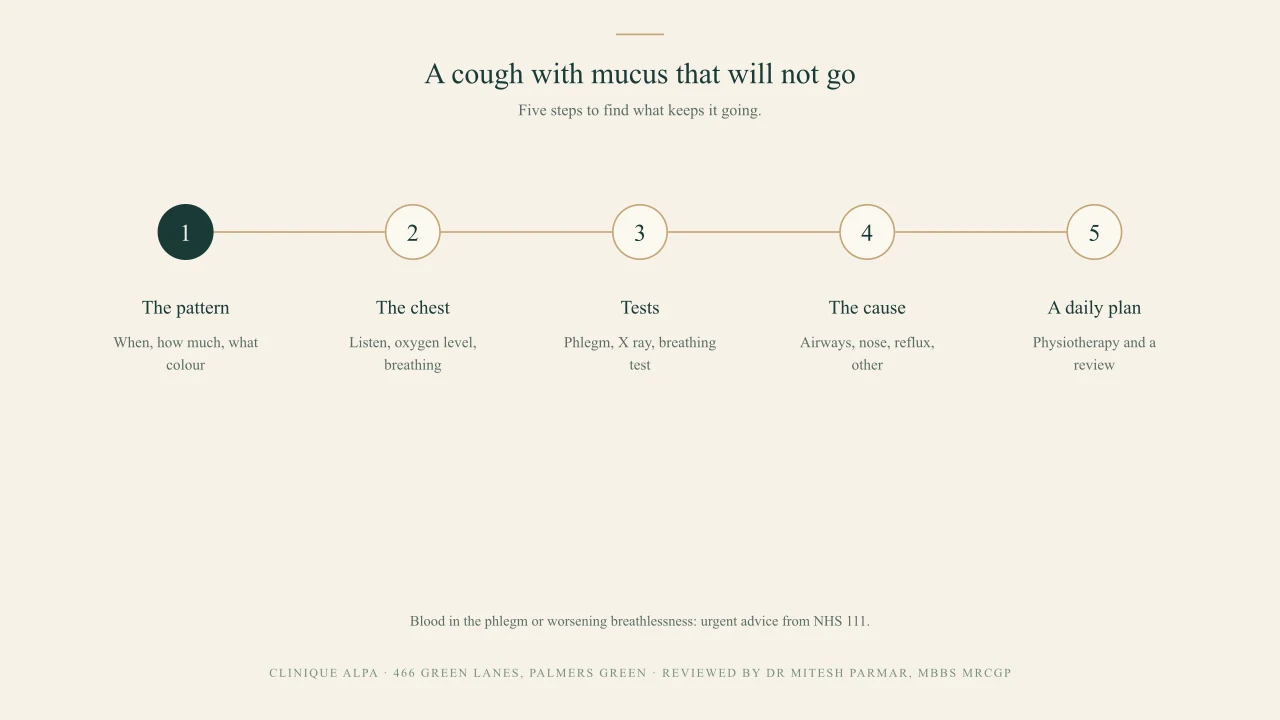
I start with the pattern. When the cough is worst, how much mucus there is, what colour, whether there has been any blood, and how often it has been called an infection. I ask about breathlessness at rest and on stairs, about waking breathless at night, about wheeze, and about weight, appetite and sweats. I ask about smoking now or in the past, and about heartburn, a blocked nose and the mucus in the back of the throat. I ask about every inhaler and medicine, and whether they are used properly, because a device used wrongly does very little.
Then the examination. I listen to the chest at the front and the back for crackles, wheeze and areas where air goes in poorly. I check the oxygen level, the breathing rate, the pulse and the temperature. I look at the fingers, the throat and the nose. I watch how long it takes to speak a full sentence.
The tests follow from that. The NHS lists phlegm tests, a chest X ray, a breathing test called spirometry and blood tests as ways a GP investigates bronchiectasis, with a specialist arranging a CT scan to confirm it. I arrange tests of this kind where clinically appropriate, some through a referral. A phlegm sample is useful because it shows which germs are present, so that treatment can be matched to them.
I am direct about what I do not know. If the picture suggests more than one cause, as it often does, we work through them in order, and I say what the first step is and when we will review. The NHS says bronchiectasis usually cannot be cured but can be managed. The same principle applies to many causes of a chronic cough: the aim is fewer flare ups, better days and a plan for what to do when things worsen.
The treatment the NHS describes for bronchiectasis is worth knowing because it is not what people expect. It centres on physiotherapy: a specialist physiotherapist teaches airway clearance techniques to do every day, and may suggest a vibration device or a nebuliser with saline. Antibiotics are used for chest infections, guided by phlegm tests, and sometimes kept at home as a rescue supply. Inhalers, oxygen therapy and surgery are considered only in severe cases. I would refer to a lung specialist and a physiotherapist for this, because the daily technique matters more than most people realise.
What helps most at the first visit is a record. Bring every inhaler and device, any scan or X ray reports, and a rough list of the courses of treatment you have had and what each one did. Previous results let me compare rather than start again, and a sequence of courses that each helped for a short time tells me something about what is going on in the airways.
From Dr Mitesh Parmar
I ask how much mucus there is, what colour, and whether it is there every morning. I check oxygen, listen for crackles, and arrange a chest X ray and breathing test. Smoking history matters, but it is not the only answer. Coughing blood or unexplained weight loss needs prompt review.
When should I come in sooner?
- Coughing up more than a few streaks of blood, or severe difficulty breathing: call 999 or go to A&E, and do not drive yourself.
- A cough that is very bad or getting worse, blood in the phlegm, or being more short of breath than usual: ask for an urgent appointment or call NHS 111.
- Chest pain or feeling very unwell: ask for an urgent appointment or call NHS 111.
- Losing weight without a reason.
- A cough that has lasted more than 3 weeks.
The NHS page on bronchiectasis and the NHS page on cough set out the same signs. I have written about a persistent cough, and about repeated chest infections.
How do we approach this at Clinique Alpa?
A clinic consultation is 30 minutes with a doctor at 466 Green Lanes for £100. We go through the pattern, examine the chest, check the oxygen level and decide on tests and referral. With your consent, a summary goes to your NHS GP.
Common questions
What is a persistent cough with sputum?
A cough that has lasted more than 3 weeks and brings up mucus. The NHS advises seeing a GP.
Can a severe cough with sputum be treated?
Yes, once the cause is clear. That may mean treating an infection, adjusting inhalers, daily airway clearance, or treating a problem in the nose or throat.
Does the colour of sputum matter?
Not on its own. The NHS notes that phlegm in bronchiectasis can be clear, white, yellow or green, so a doctor looks at the whole picture.
Drafted with AI assistance, clinically reviewed by Dr Mitesh Parmar, MBBS MRCGP, Principal GP and Clinical Director at Clinique Alpa, 466 Green Lanes, Palmers Green, London N13 5PA. This article is general information, not personal medical advice. In an emergency call 999. For NHS advice call 111 or visit nhs.uk.