
The follow up appointment is short on drama and long on detail. The scales have a new number, the person has a few things they wanted to mention, and there is often a sense of waiting to be told off or praised. Neither is what the visit is for.
A weight management follow up is a review of how the plan is working and whether it is still the right plan. Here is what is reviewed, and why each part matters.
Chest pain, signs of a stroke, severe breathlessness, heavy bleeding, a severe allergic reaction or symptoms of sepsis need 999 or A&E immediately. For urgent advice that cannot wait, call NHS 111.
What is a weight management follow up for?
The first assessment sets a starting point and a direction. The follow up checks that the direction is still sensible. Weight is one measure, and not always the most useful one. I am also asking whether you are well, whether the plan is tolerable, and whether it is protecting your health as well as shrinking a number.
The NHS says that changing habits takes time and that extra support may be needed. A follow up is where that support happens. It is also where a weight loss follow up is different from a diet club: the medical history, the medicines and the blood tests are part of the review.
What I look at in clinic
When this comes up in consultation, people often start with the scales, and I start with the person. The order is roughly this.
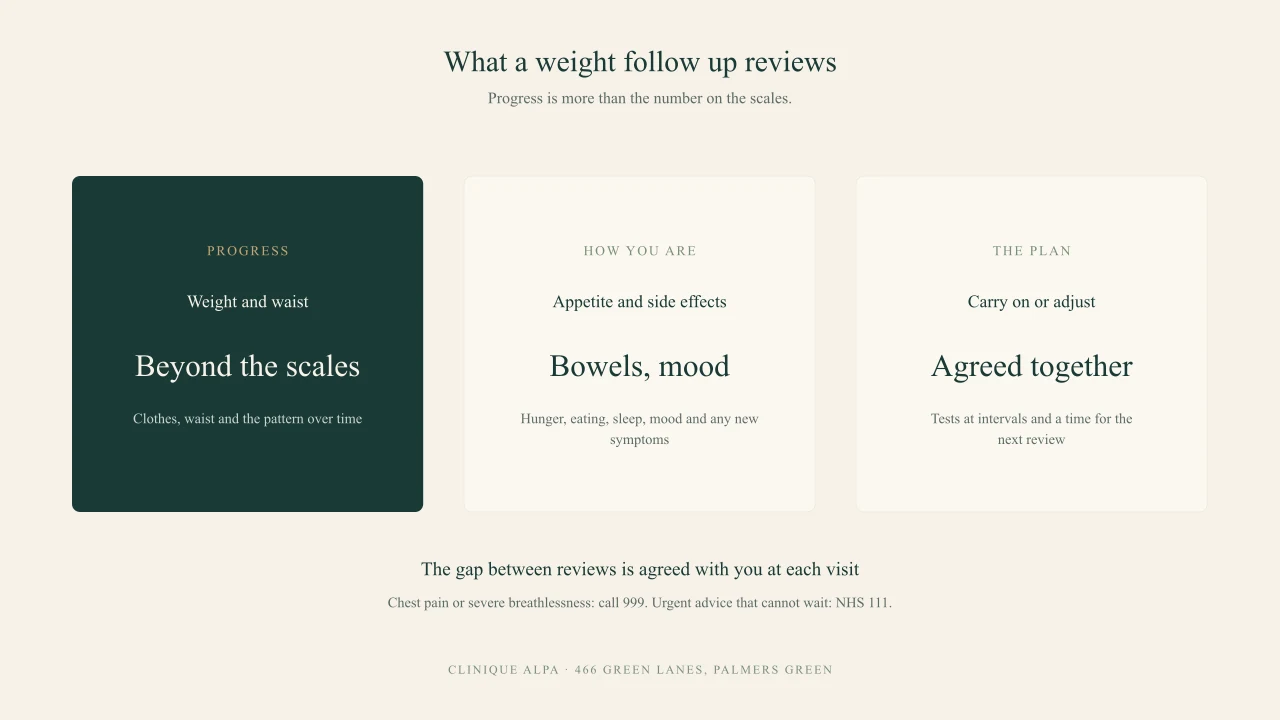
Progress, in more than one number. Weight, waist, and how clothes fit. Where weight has been stable for a while, we look at it together with the wider picture rather than treating it as failure. A plateau has its own explanations, set out in a weight loss plateau and which blood tests help.
Appetite and eating. How hunger and fullness feel now, whether the constant thinking about food has quietened, what portions look like, how many meals are eaten, and whether protein and vegetables are in each one. I ask about comfort eating and binge eating, since both can ease when the plan is working and return when stress arrives.
Side effects. Bowels are the commonest topic, and I ask directly about constipation, nausea, bloating, tummy pain, changes in taste or breath, and any new symptom. Most are minor and manageable. Some are a reason to change the plan, and some are a reason to stop. I explain which is which, and the pattern for constipation is set out in constipation when losing weight.
Activity and muscle. Steps, exercise, and whether any strength work is happening. Losing weight quickly can mean losing muscle as well as fat, so I like to ask what the plan is for protecting it.
Sleep, mood and stress. They drive appetite and they respond to the plan. A person who is sleeping poorly and feeling flat will find everything harder.
Other conditions and medicines. If you have diabetes, high blood pressure or raised cholesterol, the weight you lose changes them. Doses of other medicines sometimes need to be reviewed as numbers improve. I do not change a medicine without reasons, and you should not stop one yourself.
Blood tests. At intervals, a recheck of HbA1c, cholesterol, and liver and thyroid function shows whether the benefits are reaching the numbers that matter. Seeing a cholesterol result return to normal is one of the more satisfying parts of the job.
The plan itself. Whether to carry on as before, adjust, or step down. If you are reaching your target, we talk about what maintaining looks like, and about what happens if treatment is reduced or stopped. The NHS notes that you should be offered support to keep weight stable afterwards. Practical matters are part of it too, such as how to manage the plan when you are away from home for several days.
From Dr Mitesh Parmar
I measure more than the scales: waist, blood pressure, sugar, mood and what is working. A plateau is common and not a failure. I ask how you are coping day to day, and what side effects there have been. The plan changes with what we find, so tell me honestly how it is going.
What should you bring to a follow up?
A few things make the visit more useful:
- Your home weights, if you keep them, and the dates they were taken.
- A list of any new symptoms, however small, with a note of when they began.
- The names and doses of every medicine you take, including anything bought from a pharmacy.
- A rough account of a typical week of eating and movement. It need not be perfect.
- The question you did not like to ask last time.
Honesty matters more than a good week. A review built on an accurate picture can help you, and one built on a tidied version cannot. Nothing you say about eating, mood or setbacks is judged, and a setback is information about the plan rather than a verdict on you.
When to come in sooner
Chest pain, severe breathlessness and the other emergency signs above need 999 or A&E. Contact the clinic, or call NHS 111 for advice, before your next planned review if:
- you have tummy pain that is severe or does not settle
- you cannot keep food or fluids down
- you are losing weight faster than you meant to, or without trying
- you feel low, or food has started to take over your thinking
How do we approach this at Clinique Alpa?
A face to face follow up at 466 Green Lanes is a 30 minute consultation with a named doctor and costs £100. The interval between reviews is agreed with you at each visit, and tests are arranged through the clinic's testing service, with prices on the blood test prices page. With your consent, a summary goes to your NHS GP.
This is part 3 of a series on medical weight management. Part 1 covers what happens at the first assessment, and part 5 covers weight loss with type 2 diabetes. The weight management guide has the background.
Common questions
What happens at a weight management follow up?
Your progress is reviewed beyond the scales: appetite, eating, side effects, activity, mood and any blood test results. The plan is then continued, adjusted or stepped down.
How often is a weight loss follow up needed?
It depends on the plan and on you. The gap between reviews is agreed at each visit and can change as your needs do.
Do I need blood tests at every follow up?
No. They are repeated at intervals to check that sugar, cholesterol, liver and thyroid results are moving the right way.
More in this series: medical weight management
Drafted with AI assistance, clinically reviewed by Dr Mitesh Parmar, MBBS MRCGP, Principal GP and Clinical Director at Clinique Alpa, 466 Green Lanes, Palmers Green, London N13 5PA. This article is general information, not personal medical advice. In an emergency call 999. For NHS advice call 111 or visit nhs.uk.